
Post Details
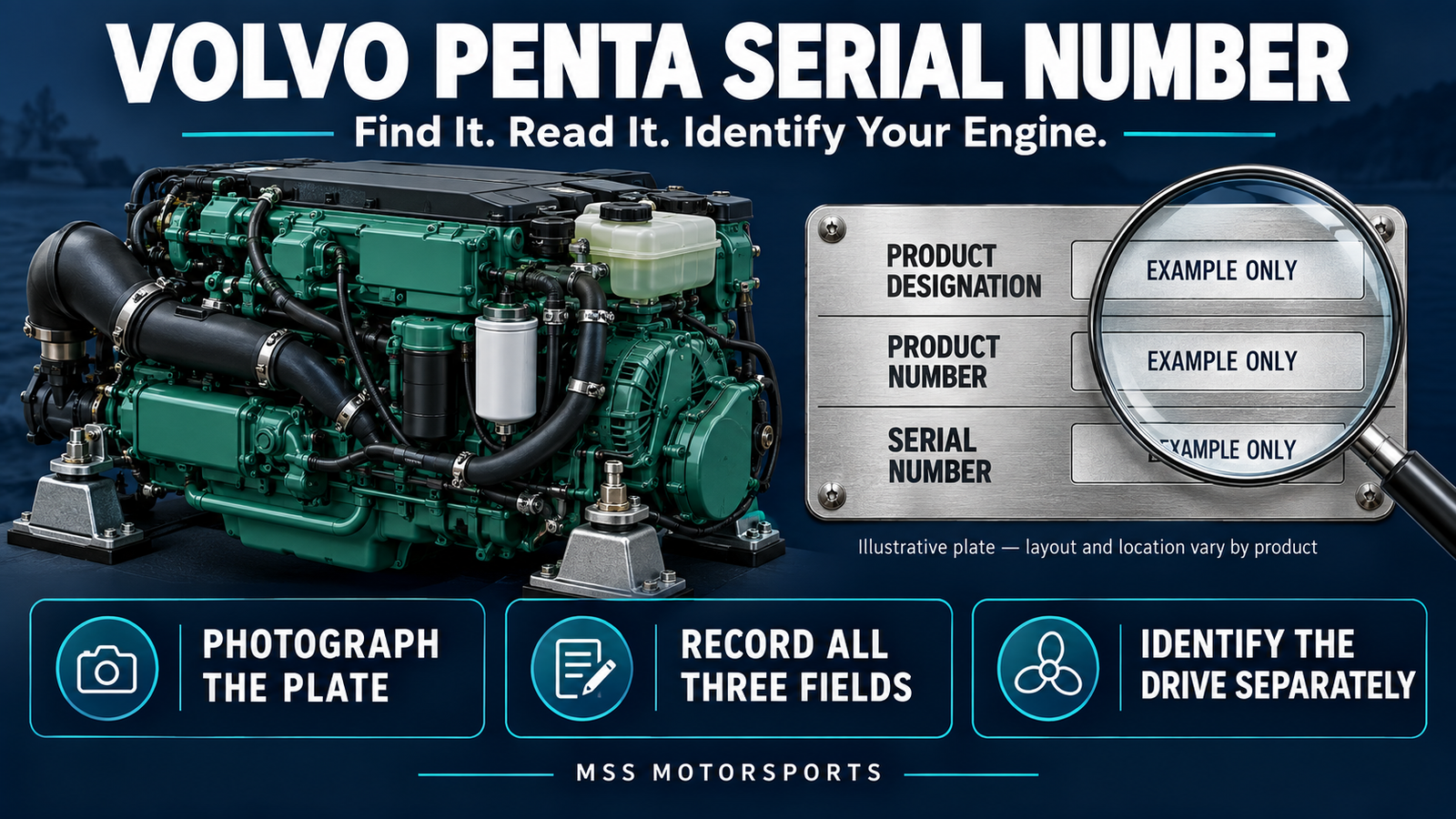
Table of Contents
ToggleLocate the Identification and Read It Correctly
While reviewing Volvo Penta’s official identification guide for this article, I noticed a detail that could easily lead to a transcription mistake: the identification fields do not appear in the same order on every plate.
One example places the product designation first. Another starts with the product number. The lesson is practical: read the field labels rather than assuming the second line always contains the serial number.
Volvo Penta also states that identification appearance and location vary by model and manufacturing year. That is why this guide avoids promising that every plate sits on the same cover or side of the engine.
Consider a hypothetical owner ordering a service component using only “Volvo Penta D6.” That identifies an engine family, but it may leave the exact variant and compatible component uncertain. A clear photograph of the identification plate gives the supplier a better starting point.
Your Volvo Penta serial number identifies the individual product. Record it alongside the complete product designation and product number, then identify the associated transmission or drive separately.
The aim is simple: obtain enough reliable information to find the correct documentation and support a compatibility check before purchasing.
Quick Answer—Where Is the Volvo Penta Serial Number?
The Volvo Penta serial number is found on an information decal and/or product plate on the relevant equipment. Its appearance and location depend on the model and manufacturing year. Consult the applicable operator’s manual for the exact location.
This is the manufacturer’s stated approach. A photograph showing the location on one model should not be treated as a universal instruction.
Look for the product plate or information decal
Start by looking for a labeled Volvo Penta identification plate or information decal.
The manufacturer’s guide illustrates formats containing product designation, product number, and serial number. Some examples also include output or certification information.
Photograph the complete label, including its heading and field names. If several labels are visible, take an overview showing which component each belongs to.
Avoid assigning an unlabeled casting number to the engine’s serial-number field. It may identify something else.
Confirm the location in the applicable operator’s manual
Use the relevant Volvo Penta engine manual to confirm the identification location for your product.
If you know the model designation, use it to narrow the documentation search through Volvo Penta’s engine information resource. Check that the manual covers the installed equipment before following its location illustration.
If the model is uncertain, begin with the official serial-number identification guide. Gather readable labels and safe overview photographs.
When the documentation or equipment identity remains unclear, request appropriate identification support. Do not dismantle unfamiliar equipment merely to search for a plate.
Record all visible identification fields
For accurate Volvo Penta engine identification, preserve the complete label rather than copying one number in isolation.
Record the product designation, product number, and serial number exactly as printed. Include output or certification information where shown.
Keep suffixes, letters, punctuation, and leading characters visible in your photograph. If a character is uncertain, identify that uncertainty rather than guessing.
A supplier can then review the image alongside your transcription.
Serial Number vs Product Number vs Product Designation
These fields are related, but they serve different purposes. Volvo Penta’s identification guide labels them separately and shows that their arrangement can vary.
| Field | What it identifies | How to use it | Common mistake |
|---|---|---|---|
| Product designation | Named product model or variant | Record the full designation when requesting documentation or parts | Shortening it to the engine family |
| Product number | Separate manufacturer product identifier | Preserve it alongside the designation and serial number | Treating it as the replacement component’s part number |
| Serial number | Individual product | Use in documentation, service, and parts enquiries | Copying a number from a different component |
| Gear ratio, where shown | Transmission or drive specification | Include when identifying the propulsion package | Assuming engine identification establishes the ratio |
Product designation identifies the named model or variant
The product designation is the model description on the label.
Record the complete value. If it includes a suffix or additional characters, retain them rather than shortening the designation to a familiar family name.
For example, “D6” describes a family. If the plate supplies a fuller designation, send that fuller designation with your enquiry.
Do not reconstruct missing characters from engine appearance, an advertised horsepower figure, or a similar boat’s specification.
Product number is a separate manufacturer identification field
The Volvo Penta product number should be recorded as its own field.
It is not automatically the part number for the filter, impeller, starter, or other item you need.
This matters when communicating with a supplier. “Product number” identifies the field you copied. “Engine number” can be ambiguous when several numbers are available.
Preserve the printed label in your transcription. Clear field names reduce the risk of a valid number being used for the wrong purpose.
Serial number identifies the individual product
The Volvo Penta serial number identifies the individual unit.
Volvo Penta describes it as a key to efficient servicing and correct parts ordering. Its official resources provide access to manuals, service protocols, and related product information.
Do not reject a number simply because it differs in format from another engine’s. Confirm the field label and applicable documentation instead of imposing one universal digit count.
For Volvo Penta parts by serial number enquiries, keep the product designation and product number available too. Identification supports the parts search; the requested component still needs a compatibility check.
Recognize numbers that identify something else
Marine installations contain many identifiers.
A number on an alternator, starter, pump, or filter housing may belong to that component. A casting mark may identify a casting rather than the complete engine. Certification labels and document references have other purposes.
The boat’s hull identification is separate from the engine’s identity. It can provide vessel context, but it does not replace the engine plate.
Before using a number, establish which component and field it belongs to. If that is unclear, send an overview and close-up without assigning an unsupported interpretation.
How to Photograph and Transcribe the Plate Safely
Secure the engine and wait for safe access
Follow the applicable instructions to shut down and secure the installation against unintended starting.
Allow hot surfaces to cool. Keep clear of belts, shafts, exposed electrical hazards, and positions where you could lose balance.
Do not remove an unfamiliar assembly solely to obtain a photograph. If access is unsafe or requires specialist work, arrange assistance.
Identification is important, but it does not justify an improvised inspection around hazardous equipment.
Take an overview and a readable close-up
Take an overview showing the engine or propulsion component and a close-up showing the entire plate.
Use adequate lighting and change the camera angle to reduce glare. Check that the characters—not just the plate outline—are sharp.
A mirror or camera may help where it can be positioned safely. Avoid reaching blindly behind equipment.
For twin-engine installations, label photographs by side immediately. Keep the engine and associated drive images grouped correctly.
| Photograph | What it helps establish |
|---|---|
| Equipment overview | Which component is being identified |
| Complete plate close-up | Field labels and recorded values |
| Associated drive or gearbox plate | Separate propulsion identity |
| Additional component label | Identity of a specifically requested accessory |
Preserve uncertain characters
Copy the field names and values exactly as shown.
If a character is unclear, mark it as uncertain and retain the original image. Do not silently substitute a likely letter or digit.
If the surface needs cleaning, use a method suitable for the label. Avoid scraping, sanding, aggressive chemicals, or repainting that could damage the marking.
Save photographs and transcriptions with your maintenance records. They provide a repeatable starting point for a Volvo Penta serial number lookup, manual search, or parts enquiry.
At this stage, the goal is a reliable record of the engine’s identity. Identifying the gearbox or drive—and checking the installed configuration—completes the picture.
Identify the Complete Propulsion Package
How Identification Differs Across Engine Families
The process stays consistent: locate the appropriate identification label, record its fields, and consult matching documentation. What changes is the equipment you are identifying and where its manufacturer places the information.
Use engine-family names to narrow the search. Use the complete identification details to establish the individual product.
D1 and D2 sailing auxiliaries
For a D1 or D2 installation, record the complete engine designation, product number, and Volvo Penta serial number.
Then establish whether the engine is connected to a shaft-drive gearbox or saildrive. Those arrangements require different propulsion records.
An engine photograph can help a supplier understand the installation, but it does not replace a readable plate. Likewise, another boat’s engine-room photograph should not be used as proof of your plate’s location.
Use the identification illustration in the applicable manual. Volvo Penta states that location and appearance vary with model and manufacturing year.
D3, D4, D6, D8, D11, and D13 diesels
Names such as D4 or D13 identify engine families. Preserve the fuller designation printed on your equipment.
Record the associated transmission or drive separately. Do not infer the installed controls, drive specification, or engine generation solely from the family name.
For an enquiry involving electronic equipment, photographs of the installed displays, controls, and relevant component labels may provide additional context. Whether those components match the original configuration requires verification.
Correct Volvo Penta engine identification begins with the recorded product details, then considers the equipment currently attached to it.
Gasoline and older AQ, MD, or TAMD installations
Older engines and gasoline installations deserve the same careful identification process.
A casting number, familiar engine shape, or paint color may provide a clue, but none should be presented as confirmed Volvo Penta product identity.
Use the complete available designation and matching historical documentation. If records are incomplete, explain what is known and what remains uncertain.
A visual assessment may narrow the possibilities. It should remain provisional until suitable evidence confirms the identification.
Find the Gearbox, Saildrive, Sterndrive, and IPS Identification
The engine serial number does not replace the identification of the gearbox or drive. Record the component relevant to the part or service you are requesting.
Volvo Penta’s official guide distinguishes engine identification from drive-unit and reverse-gear identification. It also shows separate transom-shield fields for applicable installations.
Reverse gear or gearbox plates
For a Volvo Penta gearbox serial number enquiry, photograph the gearbox plate and preserve all readable fields.
These can include the product designation, serial number, product number, and gear ratio where shown. Keep the ratio exactly as labeled; do not reconstruct it from cruising speed or propeller size.
If another manufacturer supplied the transmission, use that manufacturer’s identification and documentation.
When requesting a gearbox replacement, engine identity supplies useful context, but the gearbox’s own details are essential to assessing the proposed unit.
Saildrive identification
For saildrive identification, record the drive designation and its own identification fields.
Keep the engine and saildrive records together while clearly distinguishing them. A part intended for the drive should be checked against the drive’s identity rather than the engine family alone.
For a replacement or repower, identification starts the discussion. The hull interface, mounting arrangement, retained components, and compatibility still need assessment.
Aquamatic drive and transom shield identification
An Aquamatic installation can involve separate engine, drive, and transom-shield identities.
The Aquamatic drive serial number relates to the drive. The transom shield serial number identifies a different assembly on applicable equipment.
Volvo Penta’s identification guide presents separate fields for these components. Match the enquiry to the assembly involved rather than treating the three identities as interchangeable.
If you are unsure which assembly contains the requested part, send an overview photograph and identify the location or function of the component.
IPS identification
For IPS identification, preserve the engine and drive details separately.
A propulsion-system label such as IPS500 does not serve as the individual engine’s serial number. Record the identifiers on the installed products and consult the matching documentation.
If a service request involves steering, drive equipment, or controls, explain the affected function and provide relevant photographs alongside the identification records.
Twin-engine installations
Label records by side as soon as you collect them.
Use names such as “port engine,” “port drive,” “starboard engine,” and “starboard drive.” Keep each close-up associated with its overview photograph.
Do not assume the engines, drives, or replacement components are identical simply because they look alike.
A straightforward record helps prevent crossed information:
| Installed component | Product designation | Product number | Serial number | Additional details |
|---|---|---|---|---|
| Port engine | Copy from label | Copy from label | Copy from label | Hours, relevant records |
| Port transmission or drive | Copy from label | Where shown | Copy from label | Ratio where shown |
| Starboard engine | Copy from label | Copy from label | Copy from label | Hours, relevant records |
| Starboard transmission or drive | Copy from label | Where shown | Copy from label | Ratio where shown |
Leave unknown fields marked as unknown. An incomplete but honest record is more useful than a completed table containing guesses.
The MSS Identity Match—Verify the Product and the Installation
The MSS Identity Match is an organizing framework proposed in this article. It is not an official Volvo Penta identification procedure or a substitute for a technical compatibility assessment.
It separates three questions: which product is this, which propulsion equipment is attached, and what is currently installed?
Record three layers
| Layer | Evidence to collect | What it helps establish |
|---|---|---|
| Product identity | Complete designation, product number, serial number | The identified engine or component |
| Propulsion identity | Gearbox or drive labels, ratio where shown, applicable transom details | Associated propulsion equipment |
| Installed configuration | Overview photographs, component labels, documented modifications | What is currently fitted |
Together, these records make a marine engine parts compatibility enquiry more precise.
Compare identification with records
Review service invoices, installation documents, previous quotations, and earlier photographs.
Check whether they describe the same equipment as the current plates. If a record differs, flag the discrepancy rather than choosing whichever description appears more convenient.
For example, an invoice may refer to the boat’s previous engine or an accessory that has since been changed. Establish which record belongs to which product before relying on it.
Separate original identity from later changes
Here is the important practical insight: a serial number identifies a product, but it does not prove that every component currently attached to it is original or compatible.
A boat may have undergone a rebuild, repower, drive replacement, or accessory modification. External filtration equipment, controls, or other components may require their own identification.
Consider this hypothetical enquiry:
“The engine identification photographs are attached. A separate fuel pre-filter was replaced during earlier work, so I have included its label and an installation overview.”
That is more useful than assuming the engine serial number identifies the replacement element for every filter aboard.
How to Use a Volvo Penta Serial Number Lookup
Find official manuals and service information
Use official manufacturer resources as the starting point for a Volvo Penta serial number lookup.
Volvo Penta’s support page provides a documentation search using serial number, product number, or designation. Its engine information page directs owners to manuals, service protocols, and related information.
Check that the returned document applies to your product. A result for a similarly named engine is not automatically the correct manual.
If a search returns nothing, preserve the entered details and original photograph. A failed lookup does not, by itself, establish that the serial number is invalid.
Find parts using equipment identification
Volvo Penta’s support guidance directs owners to its parts shop and serial-number search when locating components.
Use the relevant parts catalog to identify the component and applicable reference. Where the listing distinguishes variants or serial ranges, check those details carefully.
If an older part reference has been replaced by a newer one, confirm the current reference and fitment. Finding a number in a catalog is a step toward compatibility—not a substitute for checking the application.
For modified equipment, identify the component actually fitted.
Registration, service records, and campaigns
Volvo Penta’s engine information resource recommends confirming product registration with a local dealer and provides access to recall information. Its Connect platform offers resources for registered products, including manuals and registered service history.
Treat each record according to what it establishes.
Registration does not, by itself, prove maintenance completion, current mechanical condition, or warranty coverage. A service-history entry records documented work; it should not be expanded into assumptions about work that is absent from the record.
Keep the identification photographs, applicable documentation, and available history together. This creates a clear foundation for service planning and future parts enquiries.
Resolve Missing Details and Request the Right Help
What If the Plate Is Missing, Damaged, or Unreadable?
A missing label creates an identification problem, but guessing at the serial number can create a purchasing problem too. Preserve what you can read and work systematically toward confirmation.
Check documented alternative identification locations
Consult the applicable manual for any additional identification locations.
Some products may have more than one identification marking, but do not assume every engine has a readable stamped number elsewhere. Volvo Penta states that identification appearance and location vary by product and manufacturing year.
For a missing engine identification plate, use product-specific guidance rather than searching an unfamiliar engine by dismantling components.
If locating an alternative marking requires unsafe access or specialist work, arrange assistance.
Gather supporting evidence
Collect existing photographs, installation paperwork, service invoices, and earlier parts quotations. Record where each identifier came from.
An invoice may contain useful information, but check whether it refers to the equipment currently installed. A boat that has been repowered can retain paperwork for its previous engine.
Photograph the engine overview, gearbox or drive, controls, and readable component labels. Mark uncertain characters clearly.
Supporting evidence can narrow an identification. It should not be presented as confirmation until the relevant details have been checked.
Ask for manufacturer or qualified identification support
Send your evidence to a Volvo Penta dealer or a suitably qualified service provider. Explain which fields are missing and what you need to identify.
Volvo Penta’s official serial-number guide directs owners to a nearby dealer for additional support.
For older Volvo Penta engine identification, a visual assessment may help establish a likely family. Treat that result as provisional if the individual product remains unconfirmed.
Avoid purchasing an expensive component solely because the engine resembles an online photograph.
Can the Serial Number Reveal Age, Horsepower, or Compatibility?
Manufacturing year is different from boat model year
The boat’s model year does not necessarily establish the engine’s manufacturing year.
An engine may have been built before installation or fitted later during a repower. Manufacturing, installation, and commissioning dates describe different events.
When age matters, request confirmation through appropriate manufacturer or installation records. Specify which date you need rather than asking only, “What year is it?”
Do not rely on an unsupported universal decoder
Treat online digit-to-year formulas cautiously unless their applicability is established by reliable documentation.
The manufacturer’s identification resources explain the plate fields and how to find product information. They should not be stretched into a universal decoding rule for every generation.
For output, use the applicable product information and any output field shown on the plate. Confirm the exact variant and rating rather than deriving horsepower from a partial model name.
A Volvo Penta serial number lookup is a route to relevant records—not permission to invent specifications from the digits.
Identity does not establish condition or interchangeability
A serial number does not prove that the engine is healthy, recently serviced, or suitable for your boat.
It also does not establish that every accessory or drive currently attached is original. Use the MSS Identity Match framework from Part 2 to connect product identity with the installed configuration.
For replacement engine identification, compatibility assessment may need to cover duty rating, dimensions, weight, mounts, controls, cooling, exhaust, transmission, and propeller requirements.
A similar model designation or matching horsepower is not a complete repower assessment.
Prepare an Accurate MSS Motorsports Enquiry
Send an identification pack
A useful enquiry gives the supplier enough information to understand both the equipment and the request.
Include clear plate photographs, the full product designation, product number, and serial number. Add gearbox or drive details and an installation overview where relevant.
Describe the required part, service, or replacement package. If a component has already been changed, identify what is fitted now.
For a service enquiry, include operating hours, symptoms, and relevant maintenance history. For a parts enquiry, include the existing component reference when readable.
Include quotation requirements
State how soon you intend to purchase or need the service. This helps the provider confirm availability and plan the request.
Provide billing and delivery addresses for an official parts or equipment quotation. Include the gearbox ratio when the transmission or propulsion package is relevant.
Specify whether you need a component only, a service kit, a bobtail engine, or a package with transmission or drive equipment. The quotation should make the scope clear.
Confirm compatibility before purchase
MSS Motorsports describes identifying replacement parts using the manufacturer, model, serial number, and OEM part number, with compatibility checked before quotation. Its process also addresses superseded references.
Use the Parts & Accessories page for component enquiries or contact MSS Motorsports for assistance with your request.
Before purchase, confirm the quoted reference, included components, exclusions, condition where applicable, availability, warranty terms, and delivery costs.
Volvo Penta Serial Number FAQs
Where can I find my Volvo Penta serial number?
Look for the product’s information decal and/or identification plate. Its location and appearance vary by model and manufacturing year.
Use the applicable operator’s manual and Volvo Penta’s identification guide to establish where to look.
Is the serial number the same as the product number?
No. Volvo Penta identifies them as separate fields.
Record the Volvo Penta product number, serial number, and complete product designation together. Keep their printed labels in your transcription so a supplier knows what each value represents.
How many digits should a Volvo Penta serial number have?
Do not apply one assumed length to every product and generation.
Read the serial-number field on the relevant label and preserve the complete value. If the format is unexpected, confirm it through applicable documentation or manufacturer support rather than altering it.
Can I identify the engine from its model name alone?
The model name can narrow the search, but a family designation may leave the exact product uncertain.
For manuals, service, or Volvo Penta parts by serial number enquiries, provide the complete designation, product number, and serial number wherever available.
Can I find the manufacturing year from the serial number?
Manufacturer records may help establish a date, but do not assume a universal digit-decoding formula applies.
Confirm the date through appropriate support and distinguish manufacturing year from installation, commissioning, or boat model year.
Does the gearbox or drive have a separate serial number?
volvo penta fault codes identification guide shows separate identification fields for drive units and reverse gears. Record the details of the component relevant to your enquiry.
For equipment supplied by another manufacturer, use that manufacturer’s identification system.
Why might I need the transom shield identification?
On applicable installations, the transom shield is a separately identified assembly.
Its details can be relevant when requesting parts or work involving that assembly. Do not substitute the engine or drive serial number for the transom identification without confirming what the enquiry requires.
What should I do if the serial number is unreadable?
Photograph the complete label under suitable lighting, flag uncertain characters, and gather supporting records.
Use documented alternative locations where applicable and request identification support. Avoid scraping or aggressive cleaning that could damage the remaining marking.
Why does my serial number not return an online result?
A failed search does not automatically mean the number is invalid.
Check the transcription, confirm which component the number identifies, and review the search instructions. Try another supported identifier where available, then request assistance if the result remains unclear.
Volvo Penta’s support resource offers documentation searches by serial number, product number, or designation.
Is a serial number enough to confirm replacement-engine fitment?
No. It establishes product identity, but fitment requires assessment of the proposed engine and the existing installation.
Confirm the propulsion package, duty, physical fit, controls, cooling, exhaust, transmission, and other applicable requirements before assuming interchangeability.
Conclusion: Identify the Product Before Choosing the Part
Finding your Volvo Penta serial number is the starting point. A reliable record also preserves the complete designation, product number, associated propulsion identity, and relevant installation history.
Read the labels, photograph the evidence, and mark uncertainty honestly. Use manufacturer documentation to support identification and verify compatibility before purchasing.
For parts, service, or replacement enquiries, contact MSS Motorsports with your identification photographs, engine and drive details, required component or package, and purchase timeline. Include billing and delivery addresses for an official quotation.
