

how long do Volvo Penta engines last?” covers a wide range of equipment.
A small sailing-yacht auxiliary engine and a high-output engine in a planing motorboat perform different jobs. Their designs, ratings, operating conditions, and maintenance requirements differ.
Even two identical engines can develop different conditions because of storage, servicing, previous faults, and how they were operated.
The official resources reviewed for this guide did not establish one brand-wide replacement-hour limit. A claim about Volvo Penta life expectancy should therefore identify the model, application, evidence, and meaning of “lifespan.”
An owner’s report that an engine reached a particular reading shows what happened in that case. It does not establish an average or predict the outcome for another engine.
Lifespan before overhaul versus total service life
Before accepting a lifespan figure, ask what it measures.
It could describe time before major internal work, total service including repairs, or the point when an owner chose replacement.
Those are different outcomes.
Replacing a starter or cooling component is not the same as a major internal overhaul. An engine can require an accessory repair while remaining mechanically serviceable.
Likewise, a rebuilt engine may continue operating, but the work completed and components retained must be understood.
A repair does not automatically mean the engine has reached the end of its useful life.
Mechanical life versus economic life
Mechanical life concerns whether the engine remains suitable for operation or can be restored through appropriate work.
Economic life considers whether that work makes sense.
Parts, labour, removal access, downtime, retained equipment, and your plans for the vessel all affect the decision.
An owner using a boat occasionally may evaluate downtime differently from a commercial operator. However, neither should substitute a budget preference for a technical assessment.
The useful question is: “What condition is this engine in, and which option best suits the vessel’s intended use?”
Why warranty hours do not establish engine lifespan
Warranty limits describe coverage under specified terms. They do not predict when an engine will fail.
Volvo Penta publishes warranty arrangements that vary by product, rating, and eligibility conditions. A stated coverage limit should not be presented as expected service life.
Keep these figures separate:
- Warranty limits: the applicable coverage conditions.
- Service intervals: when prescribed work is due.
- Duty-rating limits: the relevant application and operating requirements.
- Overhaul guidance: applicable inspection or restoration recommendations.
None should automatically be substituted for the others.
How Many Hours Are Too Many on a Volvo Penta Engine?
What an hour meter tells you—and what it leaves out
Volvo Penta engine hours provide operating-time information according to the fitted recording system.
The reading alone does not explain load, overheating incidents, storage quality, missed servicing, or previous repairs.
Nor does it identify the condition of the gearbox, saildrive, sterndrive, or IPS equipment.
Use the hour reading to guide questions. Use records and inspection findings to assess condition.
Are 1,000, 2,000, or 5,000 hours automatically excessive?
There is no universal verdict attached to these readings.
At any of them, establish the engine identity, maintenance history, and current condition. The assessment should also account for the intended use.
| Recorded hours | Question to investigate | Useful evidence |
|---|---|---|
| 1,000 | Was prescribed maintenance completed? | Dated service records |
| 2,000 | What does the current condition show? | Records and appropriate inspection |
| 5,000 | Is continued operation suitable for the proposed use? | Model-specific assessment and repair history |
| Unknown or disputed | Does the reading represent this engine’s history? | Replacement records and available corroboration |
These figures are enquiry scenarios, not replacement thresholds.
Check whether the recorded hours are credible
Compare the current reading with invoices, maintenance logs, and earlier inspection reports.
Ask whether the engine, display, or hour meter has been replaced. Establish how any replacement affects the recorded history.
Where supported, a technician may be able to compare available electronic records. Do not assume every model provides independently verifiable lifetime hours.
Uncertainty should be recorded openly.
Why converting marine hours into road mileage is misleading
A fixed hours-to-miles conversion cannot account for marine load, vessel resistance, operating patterns, or storage history.
It may create a familiar comparison, but it does not measure remaining engine life.
For used boat engine hours, relevant marine evidence is more useful than an automotive equivalent.
Do Volvo Penta Diesel and Petrol Engines Have the Same Lifespan?
Compare engine types without promising a fixed lifespan
Diesel and petrol engines have different designs and operating characteristics. That does not establish the condition of an individual example.
Broad marine diesel engine life expectancy claims can overlook differences in output, rating, installation, maintenance, and use.
For both Volvo Penta diesel engine lifespan and Volvo Penta petrol engine lifespan, compare the exact equipment and its history.
Avoid treating fuel type as a substitute for inspection.
Separate engine health from drive and transmission condition
A propulsion installation contains several systems.
A drive or gearbox can need repair while the engine remains serviceable. Equally, satisfactory engine operation does not prove that connected equipment is healthy.
Assess both when buying a boat or considering replacement.
An engine-only quotation may leave important propulsion or installation work unresolved.
Match comparisons to the actual model and application
Record the full designation, generation, serial number, rating, and propulsion arrangement.
A comparison between an auxiliary sailing engine and a high-output motorboat engine needs that context.
“Volvo Penta diesel” is too broad a description for a meaningful remaining-life assessment.
Engine Hours Versus Calendar Age: Which Matters More?
Why a low-hour engine still needs inspection
Low hours do not establish good preservation or completed calendar-based maintenance.
Review storage records and inspect relevant components for corrosion, leaks, deterioration, and unresolved faults.
Volvo Penta’s hours-or-time approach to servicing explains why an engine can need maintenance despite limited use.
Why a higher-hour engine may remain a viable option
A high-hour marine engine may remain suitable when maintenance records and assessment findings support continued use.
That does not make higher hours inherently desirable. It means the reading cannot settle the question alone.
For example, a documented engine with satisfactory findings may be a stronger candidate than a lower-hour engine with unresolved problems. This is a comparison principle, not a guarantee.
Evaluate usage history rather than assuming “less use is better”
Ask about frequent operation, seasonal use, extended inactivity, and repeated short runs.
Assess those patterns against the applicable operating and preservation guidance.
The key question is whether the equipment was used and maintained appropriately—not simply how little it ran.
Assessing Condition and Recognising Rebuild Evidence
The hour meter gives you a starting point. Now you need evidence about how the engine was maintained, what it experienced, and how it performs today.
A meaningful assessment of Volvo Penta engine lifespan combines equipment identity, operating history, current condition, and repair economics. No single symptom or test can establish an exact number of hours remaining.
This section explains how to organise that evidence and recognise when a rebuild assessment becomes justified.
What Factors Affect Volvo Penta Engine Service Life?
Maintenance quality and the applicable schedule
Start with the Volvo Penta maintenance schedule for the exact engine and propulsion equipment.
Volvo Penta’s support guidance explains that service requirements depend on operating hours or elapsed time. Check both when reviewing maintenance records.
Look beyond an invoice headed “annual service.” Check which tasks were completed, which components were inspected, and whether recommended follow-up work was addressed.
An oil change provides evidence of an oil change. It does not establish completion of every prescribed service task.
Duty rating, operating load, and installation suitability
Confirm that the engine’s rating suits the vessel’s application.
The applicable marine engine duty rating and operating requirements should come from the documentation for that equipment. Restrictions from another model or rating should not be copied across.
Propeller matching and installation condition also deserve attention. A technician can assess whether the engine operates within its documented requirements under suitable test conditions.
Avoid judging load from RPM alone. The operating context matters.
Cooling-system condition and overheating history
Ask about cooling system maintenance, previous temperature warnings, and repairs.
A cooling fault and internal damage resulting from overheating are different findings. Establish what happened, how the cause was identified, what work followed, and how operation was checked afterward.
For example, a replaced seawater-pump component documents a repair. It does not establish whether a previous overheating incident caused—or avoided—internal damage.
An overheating history requires investigation, not an automatic rebuild verdict.
Fuel quality and lubrication history
Review fuel-system servicing, contamination incidents, lubricant specifications, and oil-consumption records.
If consumption has increased, establish whether the comparison uses similar operating conditions and consistent measurement methods.
External leaks and other causes must be considered before attributing consumption to internal wear.
The aim is to explain the change, rather than attach a lifespan estimate to it.
Corrosion, storage, and environmental exposure
Inspect marine engine corrosion and review storage and preservation practices.
External appearance is only part of the assessment. A freshly cleaned engine can still have unresolved faults, while visible surface corrosion does not establish the condition of every internal component.
Likewise, freshwater use does not prove good maintenance, and saltwater use does not automatically make an engine unsuitable.
Assess the relevant components and records.
Installation access and early fault detection
Check whether prescribed maintenance points can be reached.
Poor access can complicate servicing and inspection. Ask how difficult tasks were completed and whether the installation provides suitable access for future work.
Review changes in starting, temperatures, pressure readings, consumption, noise, and performance. Investigating a developing fault is more useful than accepting it as normal aging.
The MSS Four-Evidence Engine Life Check
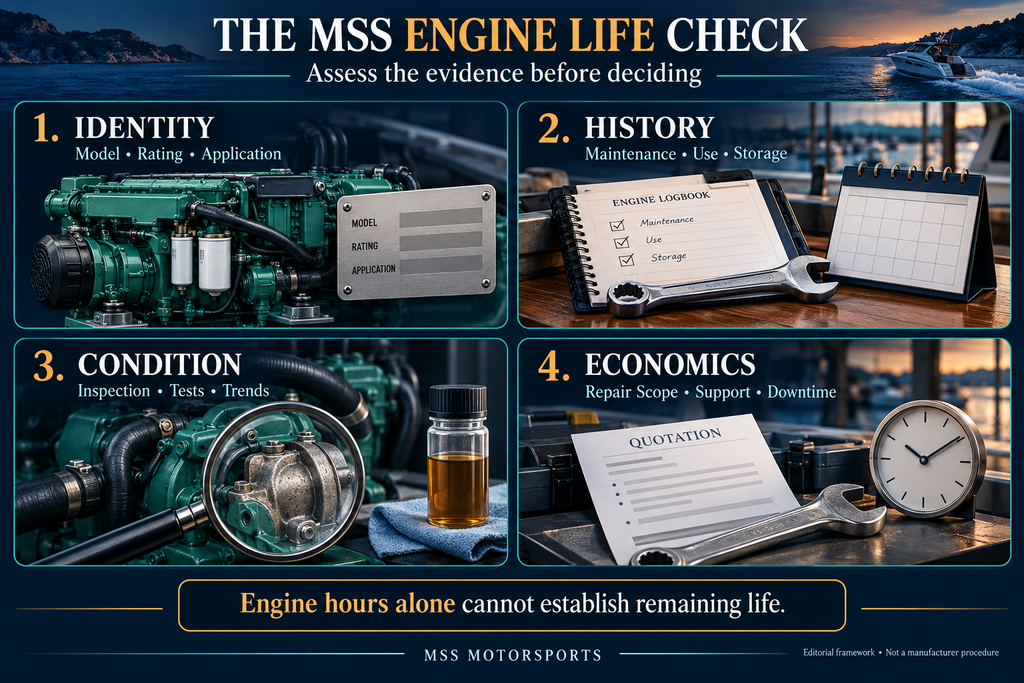
The following is an original MSS Motorsports editorial framework. It is not an official Volvo Penta procedure or a numerical remaining-life calculator.
Its purpose is to identify what is known, what remains uncertain, and which next step is supported.
Evidence 1: Identity and application
Record the complete engine designation, serial number, generation, rating, and propulsion arrangement.
Then define the proposed use: occasional leisure operation, extended cruising, or another application.
This prevents comparisons between equipment that performs different jobs.
Evidence 2: Maintenance and operating history
Collect dated service records, major repairs, storage details, and information about significant incidents.
Check whether invoices identify the engine and describe the completed work.
Record missing information openly. “Unknown” is more trustworthy than assuming that an undocumented task was completed.
Evidence 3: Current condition and trends
Assess starting behaviour, operating readings, consumption, performance, and appropriate inspection findings.
Compare results with applicable specifications and previous records where available.
A trend can be informative, but only when the measurements and operating conditions are sufficiently comparable.
Evidence 4: Economics and support
Consider parts availability, labour, removal access, downtime, retained equipment, and quotation scope.
Confirm support for the exact variant. Do not assume that every engine within a family has identical replacement options.
The technical question is whether repair is appropriate. The economic question is whether that repair fits the vessel and ownership plan.
Choose an action without inventing remaining-life percentages
Use the evidence to select a next step.
| Evidence finding | Supported next step |
|---|---|
| Records and assessment support satisfactory condition | Continue prescribed maintenance and monitoring |
| Important history or condition remains unclear | Obtain further inspection |
| A specific system fault is identified | Assess targeted repair |
| Internal wear or damage is established | Compare overhaul and replacement options |
| Repair is feasible but economically unattractive | Assess remanufacture or repower |
The framework does not justify statements such as “70% of engine life remains.” It supports a decision about what to do next.
Warning Signs That Justify an Engine Rebuild Assessment
Persistent starting difficulty after other causes are investigated
Starting problems can involve batteries, electrical connections, cranking, fuel supply, controls, or internal mechanical condition.
A slow-cranking engine should not immediately be labelled as having low compression. An engine that cranks normally but fails to start needs a different investigation.
Consider a Volvo Penta engine rebuild assessment when suitable testing supports an internal mechanical cause—not simply because starting is difficult.
Increasing oil consumption or abnormal crankcase pressure
Establish a measured trend in excessive oil consumption.
Account for external leaks, operating conditions, and how the oil level was checked. Abnormal crankcase pressure also requires suitable investigation.
Use applicable procedures and specifications. There is no single acceptable-consumption or crankcase-pressure threshold for every Volvo Penta marine engine.
Abnormal smoke or fluid contamination
Smoke colour and fluid appearance can provide clues. They do not identify every cause reliably.
Record whether smoke occurs during starting, warm operation, acceleration, or sustained load. Note accompanying symptoms.
Suspected fuel, coolant, or water contamination requires appropriate assessment. Avoid making a diagnosis from a photograph alone.
Confirmed low oil pressure, unusual noise, or repeated overheating
Follow the applicable alarm and operating instructions when these symptoms occur.
Do not continue running the engine merely to gather more evidence if the instructions require stopping.
The immediate operating decision and the later repair decision are separate. A critical warning can require prompt action without establishing that a full overhaul is necessary.
Internal wear or damage established through appropriate inspection
A marine engine overhaul becomes a more meaningful option when inspection or measurements establish relevant internal wear or damage.
Ask the technician to explain:
- What was found.
- Which applicable specifications were used.
- What repair scope is proposed.
- Which components would be retained.
- How the completed work would be verified.
| Warning sign | Other causes to investigate | Evidence relevant to overhaul assessment |
|---|---|---|
| Starting difficulty | Cranking, fuel, electrical and control faults | Suitable mechanical test findings |
| Increasing oil consumption | Leaks and operating conditions | Confirmed source and internal assessment |
| Abnormal smoke | Fuel, air, temperature and operating conditions | Corroborating tests |
| Low oil pressure | Reading accuracy and lubrication-system faults | Confirmed pressure and diagnosed cause |
| Repeated overheating | Cooling-system faults | Assessment of any resulting damage |
This table guides investigation. It does not diagnose an engine.
Which Tests Help Assess a Volvo Penta Engine?
Cold-start observation and a professionally planned sea trial
For a marine engine inspection, confirm the actual starting conditions rather than assuming the engine is cold.
Observe starting behaviour, then assess operation during a suitably planned sea trial if appropriate.
Use model-specific requirements. Avoid universal targets for RPM, temperature, pressure, smoke, or acceleration.
A satisfactory sea trial is useful evidence, but it cannot reveal every potential fault.
Diagnostic readings where supported
Available diagnostics may help identify alarms, operating data, or system faults.
Access and recorded information depend on the equipment.
Electronic diagnostics should support the assessment, rather than replace physical inspection. They do not measure every form of mechanical wear.
Oil analysis and trend interpretation
Engine oil analysis can support maintenance planning and troubleshooting. Volvo Penta has published information describing its use for those purposes.
Interpret the sample alongside oil-change history, hours on the oil, sampling method, and previous results.
A single clean sample does not guarantee future reliability. It also cannot establish a precise number of operating hours remaining.
Compression, leak-down, pressure, and internal inspection where appropriate
A qualified technician should select tests suitable for the engine and symptoms.
Compression testing, leak-down testing, pressure measurements, and internal inspection may be useful in particular circumstances. Each needs the correct procedure and interpretation.
Ask what the test establishes and what uncertainty remains.
Decide Whether to Keep, Repair, Rebuild, or Repower
Once the history and inspection findings are assembled, the question becomes more practical: what should you do with this engine?
The appropriate decision depends on confirmed condition, repair feasibility, parts support, total installed cost, and the vessel’s intended use. An hour reading alone cannot justify rebuilding or replacement.
This final section explains how to apply that principle to different installations, used-boat purchases, and repair quotations.
Lifespan Questions by Volvo Penta Engine Family
D1 and D2 auxiliary sailing engines
For D1 and D2 marine engines, identify the exact variant and review starting behaviour, cooling maintenance, preservation, and transmission records.
Establish whether the installation uses a gearbox or saildrive, then assess that equipment separately.
A low annual hour count does not remove calendar-based servicing requirements. Use the applicable maintenance documentation.
D3, D4, and D6 installations
Questions about D4 engine life or D6 engine life need the generation, rating, application, and propulsion configuration.
Confirm the installed controls and drive equipment. A sterndrive or electronic-system fault should not be presented as proof of internal engine wear.
Likewise, a satisfactory engine assessment does not establish the condition of every connected component.
D8, D11, and D13 engines
Establish the specific rating and application before comparing operating histories.
Review maintenance records and any applicable inspection or overhaul guidance for that equipment.
Do not transfer expectations from one commercial duty to another installation simply because the engines share a family name.
Older MD, TAMD, and KAD engines
Age makes repair history, corrosion, and current support important questions.
Confirm the exact identity and investigate availability of the components required for the proposed work.
An older engine should not automatically be rejected. However, technical repairability and economic practicality need separate consideration.
Petrol inboards and sterndrive installations
For Volvo Penta petrol engine lifespan, identify the engine and drive separately.
Assess relevant cooling, exhaust, ignition, fuel, and corrosion conditions using suitable procedures.
Avoid applying diesel assumptions to a petrol installation.
| Engine group | Assessment priorities | Information to obtain |
|---|---|---|
| D1/D2 | Preservation, starting, cooling, transmission | Exact identity and service history |
| D3/D4/D6 | Generation, application, controls, propulsion | Engine and drive records |
| D8/D11/D13 | Rating, operating history, condition | Applicable specifications and maintenance evidence |
| Older diesel families | Repairs, corrosion, parts support | Identity and current availability |
| Petrol installations | Engine, exhaust, cooling, drive | Exact specification and inspection findings |
This is an assessment guide, not a model-by-model lifespan chart.
Buying a Used Boat: How to Judge a Volvo Penta Engine
Request records before judging the hour reading
Ask for identification details, dated service invoices, major repairs, and storage history.
Establish whether the engine, display, or hour meter was replaced. Request documentation explaining any discrepancy.
Used boat engine hours should guide your questions. They should not replace a condition assessment.
Arrange an independent engine and propulsion assessment
Agree the scope with an appropriately qualified assessor.
Discuss the engine, transmission or drive, controls, cooling, exhaust, and installation. A suitable sea trial and further tests may be recommended according to the findings.
Inspection reduces uncertainty. It cannot guarantee that every future fault has been predicted.
Treat missing history as uncertainty, not automatic failure
Missing records do not prove that the engine is damaged. They reduce the evidence available to support confidence.
Budget for investigation and any unresolved servicing requirements.
Avoid assuming that a fixed purchase discount compensates for an unknown technical problem.
Compare complete installations, not just engine hours
Consider two hypothetical boats.
Boat A records 700 hours but has no useful maintenance history and unresolved cooling concerns. Boat B records 2,400 hours, with documented servicing and satisfactory assessment findings.
Boat B may be the stronger candidate. That does not make higher hours desirable; it shows why supporting evidence matters.
The complete installation and your intended use still need assessment.
Repair, Rebuild, Remanufacture, or Repower?
Targeted repair when the fault is localised
A diagnosed component or system fault may justify targeted repair when the wider condition supports it.
Clarify the cause, repair scope, verification method, and remaining concerns.
A failed accessory does not automatically establish that the core engine needs replacement.
Rebuild when internal damage is established and restoration is viable
A Volvo Penta engine rebuild should follow appropriate findings and have a written scope.
Ask what inspection, machine work, components, accessories, and testing are included.
“Rebuilt” does not necessarily mean every component is new. Retained equipment may still require separate assessment.
Confirm how the completed work will be checked and what warranty applies.
Remanufactured equipment as a separate option
A remanufactured marine engine should be distinguished from an unspecified used or repaired unit.
Volvo Penta’s remanufacturing documentation describes options including components, longblocks, and drive units. Current availability must be confirmed for the exact enquiry.
Check the included equipment, compatibility, exchange requirements, testing, and warranty terms.
Repower when condition, support, and vessel plans justify replacement
A Volvo Penta repower requires installation planning.
Confirm dimensions, mounts, controls, cooling, exhaust, transmission or drive compatibility, and propeller requirements.
Replacement should suit the vessel’s intended operation. More horsepower is not automatically an improvement.
Compare total installed cost and downtime
For repair versus replacement, compare complete quotation scopes.
Include diagnosis, removal, installation, ancillary work, commissioning, freight, and applicable taxes. Account for downtime and unresolved retained equipment.
| Option | Evidence supporting consideration | Questions to resolve |
|---|---|---|
| Targeted repair | Localised diagnosed fault | Cause, scope, verification |
| Rebuild | Established internal wear or damage | Restoration scope and overall viability |
| Remanufacture | Suitable supported replacement option | Availability, compatibility, included equipment |
| Repower | Technical or economic case for replacement | Installation requirements and total cost |
How to Support a Longer Service Life
Follow the correct maintenance schedule
Use documentation for the exact engine and propulsion equipment.
Track operating hours and elapsed time. Volvo Penta’s support guidance bases servicing on both measures, rather than annual use alone.
Keep evidence of completed work and follow-up recommendations.
Address alarms and changing symptoms promptly
Follow the applicable alarm instructions.
Investigate changes in starting, noise, temperature, pressure, consumption, or performance. Avoid accepting a new symptom as inevitable aging.
Record when it occurs and under what conditions.
Operate within the documented application and limits
Confirm appropriate duty, operating load, and installation condition.
Use applicable guidance rather than a universal cruising-RPM recommendation.
Ask for assessment when the engine cannot achieve its documented operating requirements under suitable conditions.
Preserve the engine correctly during inactivity
Follow appropriate storage and engine winterisation instructions for the equipment, climate, and storage period.
Limited use does not establish good preservation.
Include relevant propulsion equipment in the storage plan.
Maintain records that support future decisions
Record service dates, hours, completed work, symptoms, measurements, and findings.
A useful engine service history supports diagnosis and ownership decisions. It also gives a future buyer evidence rather than recollections.
Frequently Asked Questions
How long do Volvo Penta engines last in hours?
There is no single verified hour limit for every Volvo Penta marine engine. Assess the exact equipment, application, history, and current condition.
How many years can a Volvo Penta marine engine remain serviceable?
Age alone cannot establish suitability. Calendar-based maintenance, preservation, corrosion, parts support, and inspection findings matter.
Is 1,000 hours a lot for a Volvo Penta engine?
It is not a universal high-hour threshold. Review maintenance and condition before drawing a conclusion.
Does a 2,000-hour engine need rebuilding?
The reading alone does not justify rebuilding. That decision needs evidence of relevant internal wear or damage and a viable restoration plan.
Can a Volvo Penta diesel remain serviceable beyond 5,000 hours?
It is possible, but suitability must be established for the particular engine. The reading is neither a guarantee nor an automatic rejection point.
Is a low-hour engine always the safer purchase?
No. Poor preservation, missed maintenance, corrosion, or unresolved faults can affect a low-hour engine.
Do diesel Volvo Penta engines last longer than petrol engines?
A broad comparison cannot establish the condition of an individual example. Compare exact designs, applications, histories, and findings.
Does saltwater use automatically mean a shorter lifespan?
It does not establish a specific lifespan. Assess exposure, corrosion, maintenance, and preservation.
Does smoke mean the engine needs a rebuild?
No. Smoke has multiple possible causes. Diagnosis and corroborating evidence are needed.
Can oil analysis tell me how many hours remain?
No. It can support condition assessment, especially through trends, but cannot provide a precise remaining-life forecast.
Does rebuilding reset the engine’s total hours?
It does not erase the previous operating history. Record total known hours and hours since the documented overhaul separately.
How do I decide between rebuilding and repowering?
Compare confirmed condition, repair scope, support, complete installed cost, downtime, and intended vessel use.
Conclusion: Judge Remaining Value Through Evidence
The useful answer to “how long do Volvo Penta engines last?” depends on the equipment and evidence available.
Hours provide context. Identity, maintenance history, current condition, and economics support the decision.
Use the MSS Four-Evidence Engine Life Check to establish what is known, what remains uncertain, and which next action is justified.
Discuss Your Requirements with MSS Motorsports
For a parts or replacement-engine enquiry, contact MSS Motorsports with identification photographs, current hours, vessel details, service records, and relevant assessment findings.
Include the required gearbox ratio or drive configuration, intended purchase timing, and billing and delivery addresses for the quotation.
Arrange condition diagnosis with an appropriately qualified technician before committing to rebuilding or replacement.
