
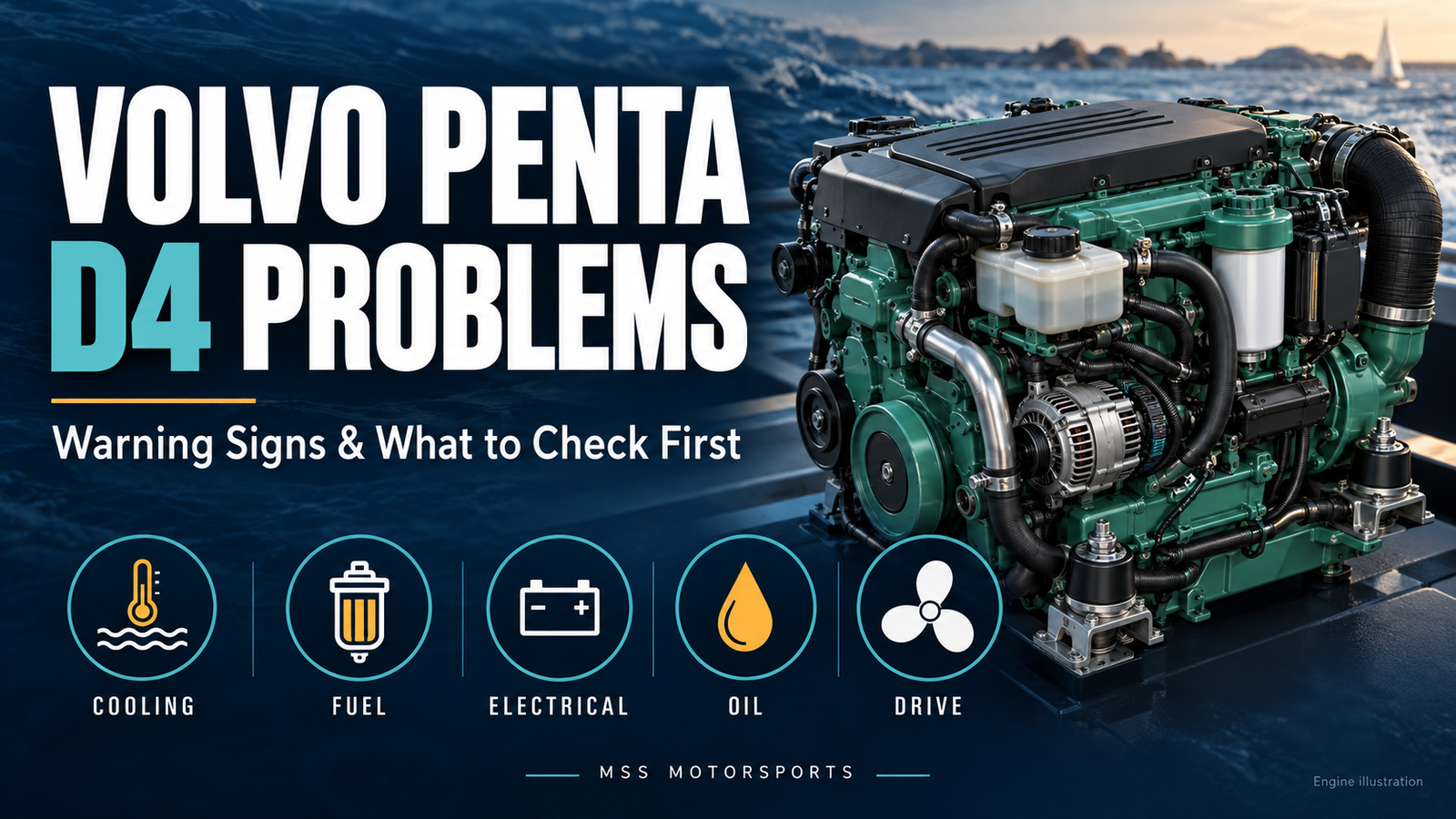
A temperature warning appears. Your boat struggles to reach its usual speed. Or the starter turns, but the engine refuses to fire.
It is easy to jump straight to the expensive explanation: a failed turbocharger, damaged injectors, or an engine that needs replacing. Before making that decision, you need to establish what happened, which D4 you have, and what evidence supports the suspected fault.
While researching this guide, one detail stood out: Volvo Penta’s 2019 D4/D6 update included substantial changes to engine management, fuel injection, and other components. That reinforced an important point—advice for one D4 generation should not automatically be applied to another. The name on the engine cover is only the beginning of identification.
This MSS Motorsports guide explains Volvo Penta D4 problems through warning signs, safe observations, and the information a technician needs to investigate them.
Here, “common problems” means recurring troubleshooting categories owners may encounter. It does not mean every D4 develops these faults, or that published evidence establishes how frequently each failure occurs. A symptom list cannot provide a reliable verdict on Volvo Penta D4 reliability.
Quick Answer: What Should You Check First?
When a Volvo Penta D4 develops a problem, first follow the displayed alarm instructions and the operator’s manual for your exact engine. Once the vessel is safe, record the warning, operating conditions, and engine identity before attempting further checks.
That sequence gives you a useful starting point: respond to the risk, preserve the evidence, and then investigate.
Follow Serious-Alarm Instructions Before Investigating
Volvo Penta identifies red alarms as warning or danger and recommends stopping operation as soon as possible. Its guidance also recognizes that you may need to reach a safe stopping place when the vessel is in a dangerous position. Follow the specific alarm instructions and prioritize vessel safety.
Do not assume that an engine is safe to keep running because it still starts or because acknowledging the alarm silences the buzzer.
For Volvo Penta D4 troubleshooting, your first reference should be the correct operator’s manual. Volvo Penta’s support resources provide access to manuals and guidance for alarms and abnormal symptoms.
Once stopped safely, avoid exploratory work around hot surfaces or moving machinery. Any inspection should stay within the owner procedures described in the manual.
Record the Operating Pattern
A useful fault report describes more than “the engine is acting up.”
When safe, record:
- The exact alarm wording, code, and color.
- Whether the marine engine was cold or fully warmed up.
- Whether the problem appeared at startup, idle, acceleration, or steady cruising.
- Engine RPM and relevant displayed readings.
- Smoke, unusual sounds, vibration, or visible leaks.
- Recent servicing, refueling, repairs, or changes to the boat.
Photograph the display if doing so does not distract you from controlling the vessel. Keep the wording intact rather than translating it into a suspected diagnosis.
“Fuel-pressure warning during acceleration” is an observation. “Failed fuel pump” is a conclusion that needs supporting tests.
Use Symptoms to Organize the Next Step
The following table is a reporting aid, not a diagnostic verdict.
| Warning sign | Useful information to record | What it does not establish |
|---|---|---|
| Temperature warning | Alarm wording, displayed temperature, load, and when it appeared | Which cooling component is responsible |
| No crank or slow crank | Whether the starter clicks, turns slowly, or does nothing | That the starter motor needs replacing |
| Engine cranks but will not start | Cranking behavior, warnings, and recent fuel-system work | That the injectors have failed |
| Lower RPM or boat speed | Previous performance, current load, and accompanying warnings | That the engine has lost compression |
| Oil-pressure warning | Exact message and circumstances | Whether the cause is pressure loss or a measurement fault |
| Vibration or shifting difficulty | Gear selection, RPM, and when the vibration occurs | That the fault is inside the engine |
The value of this information is practical: it helps a technician decide what to investigate rather than starting with a replacement-parts guess.
Identify Your Exact D4 Before Applying Advice
“Volvo Penta D4” identifies an engine family. Accurate troubleshooting requires the complete engine designation, serial number, and installed propulsion configuration.
This matters when selecting manuals, interpreting advice, and ordering replacement parts.
Find the Complete Designation and Serial Number
Record the information from the identification plate or decal, including:
- Complete engine designation.
- Volvo Penta serial number.
- Product number, if shown.
- Gearbox or drive identification.
- Engine hours and available service records.
Volvo Penta explains that the serial number uniquely identifies the product and supports correct servicing and parts ordering. Identification-label locations differ by model and manufacturing year, so use the operator’s manual to locate yours.
Take a clear photograph of the whole plate. A missing suffix or incorrectly copied digit can make identification harder.
Confirm the Generation and Fitted Equipment
Do not choose technical advice solely because a photograph looks like your engine.
Volvo Penta documented substantial changes in the 2019 D4/D6 update. This is a reason to verify the exact specification before applying older troubleshooting advice or assuming component compatibility.
Avoid treating these as universal across the D4 family:
- Service intervals.
- Expected operating RPM.
- Fault-code interpretations.
- Sensor locations.
- Fuel-system specifications.
- Replacement-part numbers.
Use documentation matched to the engine identity. If records are incomplete, ask the service provider to confirm the specification before approving parts.
Identify the Propulsion and Control Systems
A boat’s performance depends on the complete installation.
Record whether your D4 uses a shaft-drive gearbox, Aquamatic sterndrive, or another specified arrangement. Identify the fitted Electronic Vessel Control system and displays where possible.
Volvo Penta lists distinct D4 inboard and Aquamatic configurations, which is another reason to avoid treating all installations as interchangeable.
An EVC communication warning, shifting complaint, or change in boat speed needs to be considered in the context of that installation. It does not automatically identify an internal engine defect.
Keep Automotive D4 Advice Out of the Diagnosis
When searching online, include “Volvo Penta marine” and your complete engine designation.
A page discussing a Volvo passenger-car D4 is not a suitable technical reference for your marine engine. Before using instructions, check that the source covers your actual product and generation.
The MSS Three-Pattern Check: Timing, Load, and Corroboration
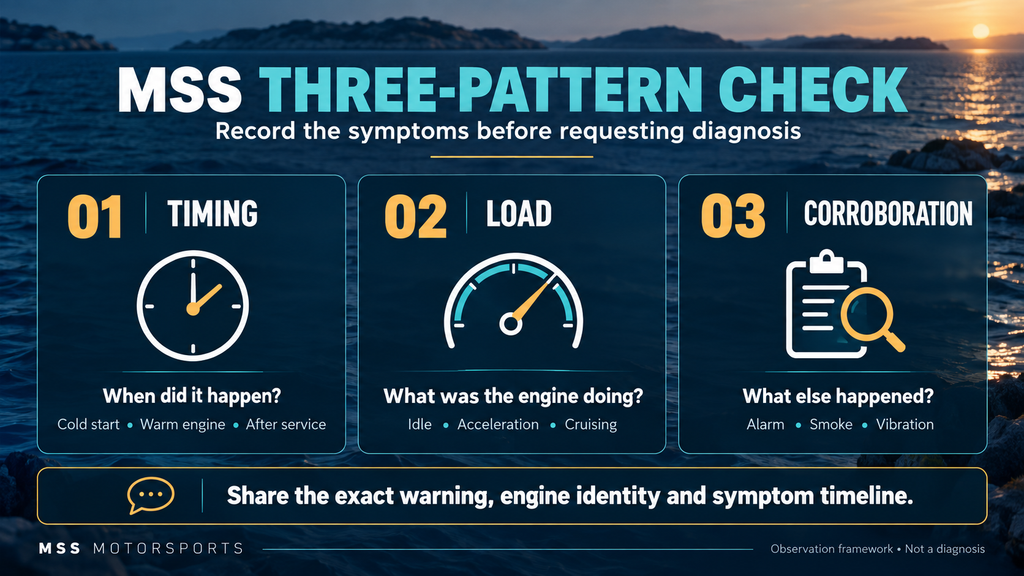
The MSS Three-Pattern Check is an article-specific way to organize observations before contacting a technician. It is not an official Volvo Penta diagnostic procedure.
Its purpose is simple: turn a vague complaint into a useful service report.
Pattern 1: Timing—When Does the Problem Appear?
Describe when you first notice the symptom:
- At the first start of the day.
- Immediately after starting.
- Once the engine warms up.
- After sustained operation.
- Following refueling or maintenance.
Timing helps establish the circumstances. It does not prove the cause.
For example, a starting problem after fuel-system work makes that recent work relevant to the investigation. It does not establish that the work caused the problem.
Pattern 2: Load—What Was the Engine Doing?
Distinguish between behavior at idle and behavior while propelling the boat.
For D4 low RPM under load, note the normal performance baseline and what changed: passengers, equipment, fuel load, recent propeller work, or the boat’s time since hull cleaning.
A slower boat does not, by itself, prove an engine-power failure. Engine behavior and vessel performance need to be assessed together.
Record what happened during normal operation. Do not conduct an additional high-load run simply to reproduce a serious warning.
Pattern 3: Corroboration—What Else Happened?
Useful corroborating observations include:
- A displayed warning accompanying a performance change.
- Smoke appearing at the same time as acceleration difficulty.
- A new vibration after drive or propeller work.
- Similar symptoms on both engines of a twin-engine boat.
Record the sequence where possible. The first visible symptom is useful evidence, but it is not automatically the root cause.
Likewise, reduced-power mode describes how the system is behaving. It does not explain why that behavior was triggered.
Example: A Clear Service Handoff
Consider this hypothetical report:
“The engine starts normally and idles smoothly. After warming up, the boat reaches less RPM than it previously did under a similar load. Black smoke appeared during acceleration. I recorded the display message and stopped further testing. The hull-cleaning and fuel-filter service dates are available.”
That report gives a technician a starting point without claiming a failed turbocharger or injector.
When contacting MSS Motorsports, provide the identification-plate photograph, exact warning, operating timeline, and D4 service history. Those details support the next stage: deciding which checks and tests are appropriate for your engine and installation.
Twelve Volvo Penta D4 Problem Categories: Warning Signs and What to Check
The following categories organize Volvo Penta D4 problems by what an owner can observe. They are not a ranking of failure rates, and the possible causes listed are investigation paths rather than confirmed diagnoses.
Use your engine-specific manual for permitted owner checks. Volvo Penta recommends professional troubleshooting to establish the root cause and emphasizes sharing the sequence of events leading to an alarm.
1. Overheating at Idle or Under Load
Volvo Penta D4 overheating requires investigation of both cooling performance and the circumstances in which temperature rises. A temperature warning alone does not identify a failed impeller or heat exchanger.
Warning signs include a rising temperature reading, a coolant-temperature alarm, or temperature that increases during sustained operation.
Possible investigation areas include seawater supply, the seawater pump impeller, coolant level and circulation, thermostat operation, and heat exchanger restriction.
Once the engine is stopped and cool, follow the manual’s procedures for checking coolant level and accessible cooling components. Note visible leaks, recent cooling-system work, and whether the symptom occurred at idle or while propelling the boat. Never remove a hot, pressurized coolant cap.
A technician may need to verify temperature measurements, inspect seawater flow, pressure-test the coolant circuit, and assess the heat exchanger.
Replacing an impeller without investigating the remaining cooling circuit may leave the underlying problem unresolved.
2. Reduced Exhaust Water or an Exhaust-Temperature Warning
This category applies where the installation has a water-injected exhaust and an observable discharge or relevant temperature monitoring.
Warning signs may include a noticeable change in normal exhaust-water discharge or an exhaust-temperature alarm.
Possible areas include restricted seawater supply, pump performance, hoses, and the exhaust-water injection arrangement. The route must be checked against the actual installation.
Record the warning and any change you noticed during normal operation. Do not restart the engine solely to watch the outlet, and do not lean overboard or approach hot exhaust components.
A technician can investigate water delivery, restrictions, and temperature-sensor operation where fitted.
Visible water at the exhaust does not establish that the entire cooling system is functioning correctly. Equally, exhaust appearance alone cannot identify which component needs replacing.
3. No Crank or Slow Cranking
If the starter does nothing, clicks, or turns the engine unusually slowly, begin by describing that behavior accurately.
Possible areas include low battery voltage, battery connections, the starting circuit, starter condition, and starting permissions within the fitted controls.
Owner observations should include whether the display powers up, whether lights dim during an attempted start, and whether the controls are positioned as required by the manual. Inspect accessible connections only with the system safely isolated and within your competence.
Technician checks may include battery load testing, voltage-drop measurements, starter-current assessment, and verification of the starting-control circuit.
D4 slow cranking does not automatically mean the starter motor has failed. A battery or connection problem can produce a similar complaint. Avoid repeated attempts beyond the manual’s starting limits.
4. Normal Cranking but No Start
When a Volvo Penta D4 won’t start despite apparently normal cranking, the investigation differs from a no-crank complaint.
Possible areas include fuel availability, contamination, air introduced during servicing, fuel filter restriction, injection-system operation, and electrical or control faults.
Record fuel level, recent refueling, filter changes, displayed warnings, and whether the engine briefly fires before stopping. Check only the fuel-system items identified as owner procedures in your manual.
A technician may compare commanded and measured fuel pressure, examine fault information, and test the fuel supply and relevant control signals.
Do not loosen common-rail pipes or injector connections to check whether fuel is reaching the engine. High-pressure fuel-system work requires the appropriate procedures and equipment.
Normal-sounding cranking does not prove that starting speed, fuel pressure, or injection control meets the engine’s requirements.
5. Rough Idle, Hesitation, or Stalling
Warning signs include uneven running, hesitation during acceleration, or an engine that starts and then stops.
Possible investigation areas include fuel quality and supply, air entry, filtration, injection performance, and engine-management inputs.
Useful owner observations are straightforward: does the symptom occur cold or warm, at idle or in gear, and did it begin after refueling or maintenance? Keep the exact alarm wording.
A technician may investigate fuel condition, supply restrictions, diagnostic readings, and cylinder contribution where the engine’s diagnostic system supports it.
Rough running is a symptom, not proof of injector failure. Approving a complete injector replacement before establishing the cause can turn a diagnostic problem into an expensive guessing exercise.
6. Loss of Power or Failure to Reach Expected RPM
Volvo Penta D4 loss of power should be assessed against the correct engine specification and the boat’s previous performance under comparable conditions. There is no single RPM target for every D4 installation.
Possible areas include fuel supply, air supply, boost performance, exhaust restriction, electronic power limitation, and excessive propulsion load.
Record engine RPM and boat speed separately. Note changes in passengers, equipment, propellers, hull condition, and recent drive work.
A technician can assess engine data alongside the propulsion installation and determine whether a controlled performance test is appropriate.
A fouled hull or unsuitable propeller can affect performance without proving an internal engine defect. Conversely, reaching an expected RPM does not establish that every engine system is healthy.
Do not conduct a wide-open-throttle trial while a serious fault remains unresolved.
7. Boost-Related Warnings or Acceleration Problems
A boost-pressure fault may accompany poor acceleration, smoke, or reduced performance. It does not automatically condemn the turbocharger.
Potential investigation areas include intake restrictions, charge-air leaks, pressure measurement, charge-air cooling, and the boost equipment fitted to the exact engine.
With the engine stopped and cool, an owner may document visibly displaced hoses or obvious external damage where accessible. Avoid dismantling boost components or reaching into the intake.
A technician may compare requested and measured boost, test for leaks, verify sensor readings, and inspect the relevant hardware.
Confirm the engine’s equipment before following advice about superchargers or their controls. Volvo Penta documented changes to boost equipment in its D4/D6 update; that announcement does not establish that every D4 variant uses the same arrangement.
8. Persistent Black, White, or Blue Exhaust Smoke
Exhaust-smoke color helps organize a diagnosis, but it cannot confirm a failed component by itself.
Persistent black exhaust smoke can direct attention toward combustion conditions, air supply, fueling, and engine load. Blue smoke can suggest oil entering combustion. White exhaust appearance needs careful interpretation because visible vapor and unburned fuel can look similar.
Record when it happens: cold start, warm idle, acceleration, or sustained operation. Note duration and accompanying changes in oil level, coolant level, RPM, or alarms.
A technician may assess fuel delivery, air and boost performance, oil consumption, and mechanical condition according to the combined evidence.
Do not diagnose damaged injectors, worn piston rings, or a head-gasket failure from a photograph alone. Persistent smoke accompanied by overheating or fluid loss warrants prompt assessment.
9. Oil-Pressure Warnings or Unexpected Oil Consumption
Treat a D4 low oil pressure warning according to the specific alarm instructions. Do not dismiss it because the engine sounds normal.
Possible investigation areas include oil level and specification, lubrication-system condition, leaks, and the pressure-measurement circuit.
Once safe, follow the manual’s procedure for checking oil level, including the required engine condition and waiting period. Record consumption using consistent measurements rather than occasional impressions.
A technician may verify actual pressure with suitable equipment, assess the sensor circuit, and investigate lubrication or internal mechanical problems if supported by the findings.
Oil level and oil pressure are different measurements. A correct dipstick reading does not rule out a pressure problem, and topping up does not prove the warning has been resolved.
10. Fuel-Pressure or Common-Rail Warnings
A common-rail fuel-pressure fault describes a detected condition. It does not, by itself, identify a failed high-pressure pump.
Possible areas include fuel-supply restriction, contamination, pressure control, sensor readings, and leakage within the injection system.
Record the exact message, operating load, recent refueling, and filter-service history. If a water-in-fuel warning appears, follow the applicable manual’s response and maintenance procedure.
Professional investigation may include low-pressure supply checks, comparison of commanded and actual rail pressure, and further component tests selected from the workshop procedure.
Keep owner checks outside the high-pressure circuit. Do not loosen pipes or use your hands to search for fuel leaks.
Replacing an expensive pump before confirming supply conditions and diagnostic evidence risks addressing the wrong cause.
11. EVC, Voltage, or Communication Warnings
A Volvo Penta D4 EVC fault can involve engine controls, displays, power supply, or communication between installed components.
Warning signs may include missing readings, unavailable functions, multiple messages, or an EVC communication warning.
Record which station and display showed the warning, whether other equipment was affected, and any recent battery or electrical work.
A technician may investigate supply voltage, grounds, connectors, network wiring, and component communication using tools appropriate to the EVC generation.
An EVC warning does not automatically mean the engine control unit needs replacing. Avoid unplugging modules or clearing fault history before diagnosis; doing so can remove useful evidence or introduce additional faults.
12. Vibration, Shifting, Steering, or Drive Problems
These symptoms require attention to the complete propulsion system.
A new marine gearbox vibration, difficult shifting, or Aquamatic steering problem may involve components beyond the engine itself.
Record whether vibration occurs in neutral, only in gear, at a particular RPM, or during turning. Include recent propeller, alignment, gearbox, or drive work.
Possible investigation areas include mounts, alignment, propeller condition, transmission or drive components, and fitted control systems. A technician should select checks for the actual installation.
Do not approach rotating shafts or inspect a propeller with the propulsion system enabled. If steering or shifting is unreliable, prioritize safe vessel control and assistance.
A drive fault is not proof that the engine needs rebuilding. Replacing the engine may leave the original propulsion problem untouched.
Why Several D4 Symptoms Can Appear Together
Multiple symptoms can make a fault look more complicated—or more catastrophic—than the evidence supports.
One Condition Can Affect Several Systems
A supply-voltage problem may affect several electronic functions. A fuel-supply restriction may accompany starting difficulty and poor performance. A cooling problem may occur alongside a protective power response.
These are possible relationships to investigate, not shortcuts to a diagnosis.
The MSS Three-Pattern Check remains useful: establish timing, operating load, and corroborating observations before deciding whether symptoms share a cause.
Record the Warning Sequence
Write down what appeared first and what followed.
“The communication warning appeared before the display lost engine readings” provides more useful information than “several alarms came on.”
Volvo Penta specifically identifies the sequence of events and observed symptoms as useful information for professional troubleshooting.
The earliest warning may help narrow the investigation, but it is not automatically the root cause.
Reduced Power Is a Response, Not a Diagnosis
Reduced-power mode indicates a change in available engine performance; it does not identify the underlying fault or establish that continued operation is safe.
An older Volvo Penta D4 operator’s manual describes different diagnostic responses, including power reduction, drive disengagement, and engine stopping. Those responses depend on the detected condition and the system covered by that manual. Follow the instructions for your own engine rather than generalizing from another generation.
The practical goal is to preserve the evidence and obtain an accurate diagnosis. That gives you a stronger basis for deciding what needs repair—and what does not.
- system operation.
The appropriate tests depend on the engine and installation. Volvo Penta explains that professional troubleshooting and repair verification can require special tools, diagnostic equipment, and workshop procedures.
Avoid Actions That Remove Evidence or Introduce Risk
Do not clear fault history before it has been recorded, bypass protective functions, or disconnect control modules as an experiment.
Likewise, avoid high-load trials to reproduce serious warnings. A symptom disappearing after a restart does not establish that its cause has been repaired.
The goal is to make the investigation more accurate, not simply make the alarm disappear.
Are These Proven D4 Failures or Reported Owner Problems?
Separate Symptoms, Diagnoses, and Failure Rates
A troubleshooting guide describes possible causes. A workshop diagnosis identifies the cause on a particular engine. A failure-rate claim needs evidence about how frequently a fault occurs across a defined population.
Those are different types of information.
This article does not establish that injectors, turbochargers, or heat exchangers fail at a particular rate across the D4 range. It explains warning signs and sensible investigation paths.
Use Forum Reports as Questions to Investigate
Owner reports can highlight symptoms worth asking about, but an individual account may omit the engine generation, maintenance history, installation details, or final repair verification.
A forum post describing an overheating repair does not prove that your overheating engine has the same fault.
Use such reports to prepare questions for a technician. Use manufacturer documentation and measured findings to make repair decisions.
Check Campaigns Against the Exact Engine Identity
Ask whether any recall or service campaign applies to your specific engine.
Volvo Penta provides recall-information resources and explains that product registration helps owners receive relevant campaign information. Check applicability through the manufacturer or an authorized dealer rather than assuming a campaign covers every D4.
Should You Repair, Rebuild, or Repower Your D4?
Choose between repair, rebuild, and replacement after confirming the fault and assessing the complete installed cost. Engine hours or one alarming symptom cannot make that decision alone.
When an Isolated Repair Makes Sense
A targeted repair may be appropriate when testing identifies a specific fault and the wider engine and propulsion system remain serviceable.
Ask the provider to explain the evidence, proposed work, and verification procedure. A component replacement should address the diagnosed cause.
When Internal Engine Assessment Is Needed
If findings suggest internal damage, request a written assessment before committing to a rebuild.
Ask which measurements support the conclusion, what further inspection is necessary, and how dismantling could change the estimate. Separate confirmed damage from suspected damage.
An uncertain diagnosis should remain clearly identified as uncertain.
Compare the Full Installed Cost
A D4 repower assessment should include more than the replacement engine price.
| Cost area | What to establish |
|---|---|
| Engine package | Exact model, condition, and included equipment |
| Propulsion | Gearbox or drive compatibility and required ratio |
| Controls | EVC, displays, wiring, and retained-equipment compatibility |
| Installation | Mounts, cooling, exhaust, access, and modification work |
| Completion | Commissioning, testing, warranty requirements, and downtime |
The least expensive engine quotation may become a more expensive installation if essential equipment or modifications are excluded.
Request a Written Scope and Verification Plan
For either repair or replacement, confirm included parts, labor, exclusions, warranty terms, and expected completion.
Ask how satisfactory operation will be demonstrated after the work. Repair verification matters as much as identifying the original fault.
Maintenance Records That Improve Future Troubleshooting
Follow the Schedule for Your Exact Engine
Use the applicable Volvo Penta maintenance schedule, not a generic interval copied from another D4 generation.
Volvo Penta states that service recommendations are provided in the engine’s maintenance schedule and use operating hours or elapsed time.
Keep Cooling, Fuel, Electrical, and Drive Records
A useful D4 service history records dates, hours, part numbers, work performed, and findings.
Include cooling-system servicing, fuel-filter changes, battery work, and gearbox or drive maintenance. Record the reason for replacing a component, particularly when it followed a warning.
“Impeller replaced” is less informative than a record explaining its condition and whether the rest of the cooling circuit was inspected.
Establish a Normal Operating Baseline
Keep occasional records of normal RPM, boat speed, temperature readings, and vessel load during ordinary operation.
Comparable records make changes easier to recognize. Avoid treating readings taken under very different conditions as direct comparisons.
Maintenance Does Not Explain Every Fault
Overdue maintenance can be relevant, but it should not become the default explanation for every problem.
A well-maintained engine can still develop a component, wiring, or installation fault. Diagnosis should follow the evidence.
Prepare a Useful MSS Motorsports Enquiry
Send the Engine and Propulsion Identity
Provide your complete D4 designation, serial-number photograph, engine hours, and gearbox or drive details.
For parts enquiries, include existing part numbers where available. Confirm the suitability of genuine replacement parts against the identified engine and any relevant supersessions.
Explain the Symptom Timeline
Use the MSS Three-Pattern Check: timing, load, and corroboration.
Include the exact warning, what happened immediately beforehand, recent work, and tests already completed. This helps separate an information request from a parts order based on an unconfirmed assumption.
Provide Quotation Details
For a replacement-package enquiry, state your vessel details, required configuration, purchase timeframe, and billing and delivery addresses. Include the gearbox ratio where relevant.
Request written confirmation of package contents, compatibility requirements, warranty terms, delivery costs, and lead time through the MSS Motorsports contact page.
Frequently Asked Questions About Volvo Penta D4 Problems
What warning signs should D4 owners watch for?
Watch for temperature or oil-pressure warnings, abnormal starting behavior, persistent smoke, reduced performance, leaks, new vibration, and unreliable shifting or steering. Record the circumstances and follow the applicable alarm instructions.
Are Volvo Penta D4 engines reliable?
A broad reliability verdict requires evidence across defined models and operating conditions. Assess an individual engine using its service history, inspection findings, installation, and diagnostic results.
Why does my D4 overheat under load?
Possible areas include seawater supply, coolant circulation, heat-transfer restrictions, and operating load. Testing must establish the cause; replacing the impeller alone is not a complete diagnosis.
Why does my D4 crank but not start?
Possible areas include fuel supply, contamination, injection pressure, electrical inputs, and control faults. Record warnings and recent work, then follow the engine-specific troubleshooting procedure.
What causes Volvo Penta D4 loss of power?
Fuel, air, boost, exhaust, protective control responses, and propulsion load can all be investigation areas. Compare engine RPM and boat speed against suitable baseline records.
Does black smoke mean the injectors have failed?
No. Black exhaust smoke can accompany several combustion or load conditions. Injector failure needs supporting tests.
Does an EVC alarm mean the engine control unit needs replacing?
No. Power supply, wiring, communication, and other components may require investigation. Preserve the warning information before considering module replacement.
Can a propeller or drive problem resemble an engine problem?
Yes. Propulsion faults or excessive load can affect performance and vibration. Assess the complete installation before approving engine work.
Can I restart after a serious warning?
Do not use a restart as proof of safety. Follow the exact alarm instructions and operator’s manual, and obtain professional guidance when the cause remains unresolved.
When should I replace rather than repair my D4?
Compare confirmed damage, wider mechanical condition, repair scope, installation requirements, downtime, and total cost. Replacement should follow an assessment rather than a symptom-based guess.
Conclusion: Get the Evidence Before Buying the Repair
Handling Volvo Penta D4 problems starts with a clear sequence: make the vessel safe, identify the exact engine, preserve the warning information, and establish the cause through appropriate checks.
The MSS Three-Pattern Check—timing, load, and corroboration—helps you give a technician useful evidence. It also helps you evaluate whether a proposed repair addresses the problem you actually experienced.
For parts or replacement-engine enquiries, contact MSS Motorsports with your engine identification, propulsion details, symptom record, and purchase timeframe. Request a clearly specified quotation so you can assess the package and installation requirements before ordering.

Comments (2)
[…] for Volvo Penta D4 fuel consumption and Volvo Penta D6 fuel consumption can return different ratings, generations, and […]
[…] “D4” or “D6” is a family name. The complete engine model designation gives you a more specific […]