
A new engine warning creates two immediate questions: “Can I keep running?” and “How expensive is this going to be?”
Those concerns are understandable. Your boat may have performed normally yesterday. Now one engine runs warmer, acceleration feels weaker, or the display shows an unfamiliar message.
While researching this guide, I compared Volvo Penta’s D6 specifications with its documented 2019 D4/D6 update. What caught my attention was the extent of the changes: engine management, fuel injection, and mechanical components were among the areas updated. It reinforced why advice that simply says “check this on a D6” needs a model-specific qualification.
This MSS Motorsports guide explains Volvo Penta D6 problems through warning signs, safe observations, and the evidence needed to support repair decisions. It draws on manufacturer information rather than claiming firsthand workshop experience or presenting individual owner reports as established failure rates.
Here, “common faults” means troubleshooting categories owners may encounter. It does not mean every D6 develops these problems, or that reliable data establishes how frequently each component fails.
The practical starting point is straightforward: establish what happened before deciding what needs replacing.
Quick Answer—What Should You Check First on a Volvo Penta D6?
Follow the specific alarm instructions, make the vessel safe, and identify the exact engine and propulsion package. Then record the warning and operating conditions, and perform only the owner checks permitted by the applicable operator’s manual.
This sequence supports accurate Volvo Penta D6 troubleshooting while keeping the immediate operating decision separate from the eventual repair decision.
Respond to the Alarm Before Troubleshooting
The displayed instructions and your engine-specific operator’s manual take priority.
Volvo Penta’s general guidance identifies red alarms as warning or danger and recommends stopping operation as soon as possible. It also recognizes that a vessel in a dangerous position may need to reach a safe stopping place. Follow the specific instructions for the warning you receive.
Do not use engine sound as your only measure of severity. A serious warning can require action even when the engine appears to run smoothly.
Acknowledging an alarm or silencing its buzzer does not establish that the fault has been repaired. A warning disappearing after a restart is also insufficient evidence that continued operation is safe.
If the vessel faces an offshore emergency, contact the appropriate rescue authorities. Volvo Penta’s support guidance distinguishes emergency assistance from ordinary troubleshooting support.
Record the Exact Symptom and Operating Conditions
Once it is safe to do so, photograph the display and record:
- Exact alarm wording, code, and color.
- Whether the engine was cold or fully warmed up.
- Whether the problem appeared during starting, idle, acceleration, cruising, or maneuvering.
- RPM and relevant displayed readings.
- Smoke, unusual sounds, vibration, or visible leakage.
- Recent refueling, servicing, or repairs.
For twin-engine boats, identify the affected side. Note whether the other engine changed at the same time.
Avoid translating the warning into a diagnosis. “Port engine temperature rose during cruising” is useful evidence. “The heat exchanger has failed” is a conclusion that needs investigation.
A Symptom Table for the First Service Conversation
Use this table to organize D6 engine warning signs. It does not replace the applicable fault-tracing procedure.
| Symptom | Useful information to record | Investigation area | What the symptom does not prove |
|---|---|---|---|
| Temperature warning | Temperature trend, load, and exact message | Cooling performance and temperature measurement | A failed impeller or heat exchanger |
| No crank or slow crank | Clicking, slow turning, or no response | Power supply, starting circuit, and controls | A failed starter |
| Cranks but will not start | Starting behavior and recent fuel-system work | Fuel supply, injection, and control inputs | Failed injectors |
| Reduced RPM or speed | Previous performance, vessel load, and warnings | Engine performance and propulsion load | Internal engine damage |
| Persistent smoke | Color, duration, and operating circumstances | Combustion, air, fuel, and oil investigation | A specific failed component |
| Oil-pressure warning | Exact message and circumstances | Lubrication and pressure measurement | A harmless sensor fault |
| Vibration or shifting difficulty | RPM, gear selection, and recent drive work | Mounting, transmission, drive, and controls | An engine requiring replacement |
These observations help establish where investigation should begin. Measurements and inspection findings support the diagnosis.
Identify Your Exact D6 and Propulsion Package
The D6 name identifies an engine family. Correct documentation, troubleshooting, and parts selection require the complete designation, serial number, and propulsion configuration.
Volvo Penta describes the D6 as a 5.5-litre inline-six marine diesel with common-rail fuel injection, double overhead camshafts, and turbocharging. That description provides context; it does not identify every detail of your installation.
Complete Designation, Serial Number, and Engine Hours
Photograph the entire identification plate or decal. Record the complete designation, Volvo Penta serial number, and product number where shown.
Gather the gearbox or drive identification separately, together with available engine-hour and service records.
Volvo Penta explains that the serial number uniquely identifies the product and supports correct servicing and parts ordering. Identification-label locations differ by model and manufacturing year, so use the operator’s manual to locate yours.
Engine hours are useful context, but they do not establish condition alone. An assessment should also consider operating history, maintenance records, inspection findings, and diagnostic evidence.
Earlier and Updated D6 Generations
The documented 2019 changes demonstrate why generation matters.
Before following instructions or ordering parts, confirm that the information applies to your engine. Avoid assuming that all D6 models share:
- Maintenance intervals.
- Fluid specifications.
- Expected operating RPM.
- Fault-code interpretations.
- Sensor locations.
- Boost-system equipment.
- Replacement-part numbers.
Similar horsepower ratings or engine-cover designs do not establish compatibility.
This also affects discussions of Volvo Penta D6 reliability. A broad claim about the entire family may overlook generation, installation, duty, and maintenance differences.
Shaft Drive, Aquamatic, IPS, and Other Installations
Identify the complete propulsion arrangement: engine, gearbox or drive, EVC equipment, displays, and controls.
Volvo Penta publishes separate information for D6 inboard, IPS, and DPI packages. Troubleshooting must account for the installed system.
A shifting complaint, steering warning, or change in boat performance may involve propulsion equipment beyond the engine.
When investigating Volvo Penta IPS problems or Aquamatic sterndrive problems, record both the engine identity and the drive identity. An IPS system designation is not a substitute for the engine model.
Find the Applicable Manual and Campaign Information
Use the manufacturer’s documentation resources to locate the correct operator’s manual and service information.
Ask whether a recall or service campaign applies to the specific product. Volvo Penta provides campaign-information resources and explains that registration helps owners receive relevant notifications.
Do not assume applicability because another owner has a similar engine. Confirm it against the product identity.
The MSS D6 Evidence Ladder—Symptom, Measurement, Repair Decision
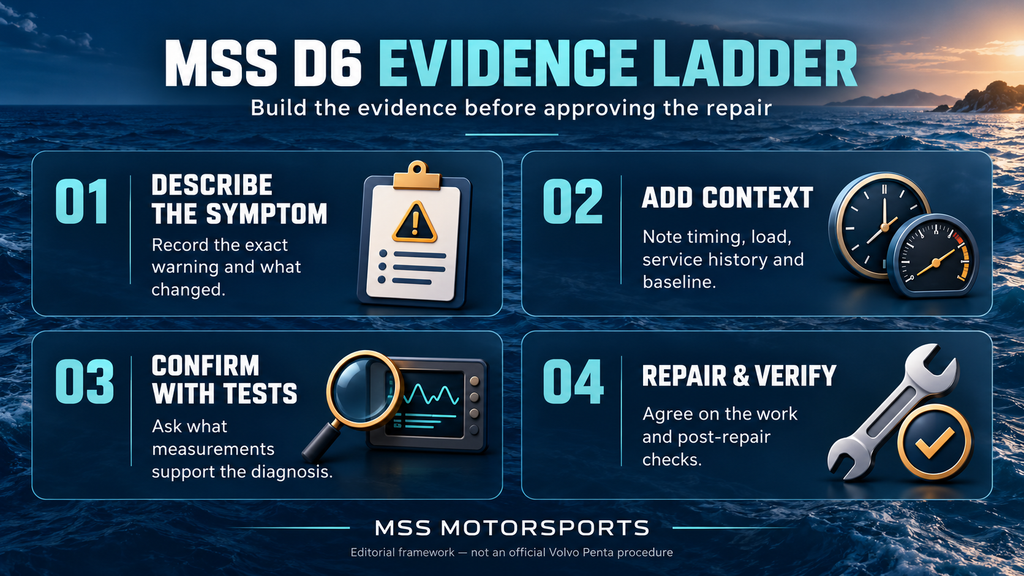
The MSS D6 Evidence Ladder is an editorial framework for evaluating repair recommendations. It is not an official Volvo Penta diagnostic procedure.
It helps owners understand the evidence connecting a symptom to proposed work.
Step 1—Describe the Symptom Without Naming a Failed Part
Start with what you observed.
“Poor acceleration accompanied by black smoke” describes a symptom. “The turbocharger is damaged” requires supporting findings.
Share your suspicions if helpful, but label them as possibilities. This leaves room to investigate other causes.
Step 2—Record the Context and Baseline
Explain when the symptom appeared, the operating load, associated warnings, and recent changes.
For D6 low RPM under load, record engine RPM and boat speed separately. Include relevant changes in passengers, equipment, hull condition, or propeller work.
Compare readings taken under reasonably similar conditions. A heavily loaded boat and a lightly loaded boat do not provide equivalent performance comparisons.
Step 3—Obtain Measurements That Test the Suspected Cause
Ask what findings support the proposed diagnosis.
A boost-pressure fault, for example, reports a detected condition. Further investigation must establish why that condition occurred before a component is condemned.
Volvo Penta explains that professional troubleshooting can require specialist tools, diagnostic equipment, and workshop procedures.
You do not need to perform those tests yourself. You should understand what they establish and what remains uncertain.
Step 4—Approve a Defined Repair and Verification Plan
Request a written explanation of the confirmed fault, proposed work, included parts and labor, and exclusions.
Ask how operation will be verified after the repair. Starting successfully may not demonstrate that a problem previously occurring during sustained cruising has been resolved.
A useful recommendation connects the findings, corrective work, and verification procedure.
Hypothetical Example of the Evidence Ladder
Suppose a D6 develops a temperature warning during sustained operation.
The owner records the message, engine identity, operating conditions, and D6 service history. A technician then investigates cooling performance and temperature readings using the applicable procedures.
If testing identifies a restriction, the recommendation explains the evidence and the proposed corrective work. If the cause remains uncertain, that uncertainty is stated before further investigation or parts replacement.
This example illustrates the decision process; it is not a documented customer case.
The benefit is practical: you can assess whether the proposed repair addresses the observed problem and whether the evidence justifies the cost.
Twelve Volvo Penta D6 Problem Categories
The following categories describe symptoms and possible investigation areas. They do not establish how frequently components fail across the D6 range.
For each category, start with the applicable alarm instructions and operator’s manual. The checks a technician selects should reflect your engine generation, propulsion package, and recorded symptoms.
1. Overheating at Idle or Under Load
Volvo Penta D6 overheating requires investigation of cooling performance and temperature measurement. A warning alone does not identify the failed component.
Possible areas include seawater supply, the seawater pump impeller, coolant circulation, thermostat operation, and heat exchanger restriction.
After stopping safely and allowing the engine to cool, follow the manual’s fluid-check procedures. Record visible leakage, recent cooling-system work, and whether temperature increased at idle or during sustained operation. Never remove a hot, pressurized coolant cap.
A technician may need to verify temperature readings, assess seawater delivery, and test the coolant circuit.
A newly fitted impeller does not establish that the remaining cooling system is healthy.
2. Coolant Loss, Seawater Leaks, or New Corrosion Evidence
Recurring coolant loss, fresh wetness, or new deposits deserve investigation even before a temperature warning appears.
Photograph the location with the engine stopped and safe to approach. Record fluid-level changes using the manual’s prescribed method. Avoid identifying a fluid solely by its color.
Possible areas include hoses, connections, seals, and cooling components. Professional inspection and appropriate pressure testing can help locate the source.
Coolant loss does not automatically prove internal engine damage. Equally, repeatedly topping up without finding the cause leaves an important question unanswered.
If fuel leakage is suspected, do not restart the engine. Volvo Penta’s operator guidance treats suspected fuel leaks as a reason not to start or run it.
3. Exhaust-Temperature Warnings or Changed Water Discharge
This category applies to installations with relevant exhaust-temperature monitoring or an observable water-injected exhaust discharge.
Record the exact warning and any change noticed during ordinary operation. Do not restart solely to inspect the outlet or place yourself near hot exhaust components.
Possible areas include seawater delivery, restrictions, and the exhaust-water injection arrangement. A technician should assess the actual installation and determine whether the incident warrants further exhaust inspection.
Visible discharge is an observation; it is not a measurement proving adequate cooling throughout the system.
4. No Crank, Slow Crank, or Intermittent Starting
Describe whether the starter clicks, turns slowly, or produces no response.
Possible areas include low battery voltage, connections, the starting circuit, starter condition, and control-system starting permissions.
Record whether displays power up and whether the controls are positioned as required by the manual. Leave energized electrical testing to someone equipped to perform it safely.
Professional checks may include battery load testing, voltage-drop measurements, and starting-circuit verification.
Slow cranking does not establish starter failure. Repeated attempts should stay within the starting limits specified for your engine.
5. Normal Cranking but No Start, or Difficult Starting
When a Volvo Penta D6 won’t start despite apparently normal cranking, record whether it briefly fires, produces smoke, or stops immediately.
Possible investigation areas include fuel availability, fuel filter restriction, contamination, air introduced during service, injection pressure, and control inputs.
For D6 hard starting, note whether the problem occurs cold, warm, or after the boat has stood unused.
A technician may examine fuel supply, relevant diagnostic readings, and starting conditions.
Do not loosen common-rail pipes or injector connections to check for fuel delivery. Follow only the fuel-system owner procedures specified in the applicable manual.
6. Rough Running, Hesitation, or Stalling
Uneven idle, hesitation, and unexpected stopping need a clear operating timeline.
Does the symptom occur before warming up, after sustained cruising, or only when gear is engaged? Did it begin after refueling or filter replacement?
Possible areas include fuel quality, supply restriction, air entry, injection performance, and engine-management inputs. Technician tests should follow the combined evidence.
Rough running is not proof of failed injectors. Recent work is relevant information, but timing alone does not establish that the work caused the problem.
7. Loss of Power or Low RPM Under Load
Volvo Penta D6 loss of power must be assessed against the exact engine specification and comparable vessel conditions. There is no universal operating-RPM target for every D6 package.
Possible areas include fuel supply, intake and boost performance, exhaust restrictions, protective control responses, and propulsion load.
Record RPM and boat speed separately. Include changes in passengers, equipment, hull condition, and propellers.
A technician can assess engine readings alongside the installation and decide whether a controlled performance test is appropriate.
A slower boat does not automatically have an internally damaged engine. Avoid high-load testing while a serious warning remains unresolved.
8. Boost-Related Warnings and Acceleration Problems
A boost-pressure fault may accompany weak acceleration, smoke, or reduced performance.
Potential areas include intake restrictions, charge-air leakage, pressure measurement, the charge-air cooler, and the boost equipment actually fitted.
With the engine stopped and cool, document obvious external hose displacement or damage where safely accessible. Do not dismantle the intake or boost components as an exploratory check.
A technician may compare requested and measured pressure, verify sensors, and test for leakage.
Volvo Penta documented boost-equipment changes during the D4/D6 update. Confirm the variant before applying turbocharger or supercharger advice.
9. Persistent Smoke or Increased Fuel Consumption
Record smoke color, duration, and the circumstances in which it appears.
Persistent black exhaust smoke can direct investigation toward combustion conditions, air supply, fueling, and load. Blue smoke may suggest oil entering combustion. White exhaust appearance needs careful interpretation because vapor and unburned fuel can look similar.
For increased fuel consumption, compare reasonably similar operating conditions and reliable records.
A technician may investigate air and fuel performance, fluid consumption, and mechanical condition as the evidence warrants.
Neither smoke color nor a single fuel-use observation proves a specific component failure.
10. Oil-Pressure Warnings, Oil Leaks, or Rising Consumption
Follow the specific instructions for a D6 low oil pressure warning. Do not dismiss it because the engine sounds normal.
Once safe, check oil level using the manual’s prescribed conditions. Record visible leakage and consumption consistently.
Professional investigation may include verifying actual pressure, examining the measurement circuit, and assessing lubrication-system condition.
Oil level and oil pressure are different measurements. A correct dipstick reading does not rule out a pressure problem. Adding oil does not establish that a warning has been resolved.
11. Fuel-Pressure, EVC, or Communication Warnings
Separate the message categories before interpreting them.
A common-rail fuel-pressure fault concerns a detected fuel-pressure condition. A Volvo Penta D6 EVC fault or EVC communication warning may involve controls, power supply, wiring, or communication between components.
Record exact messages and their sequence. Include recent electrical work, refueling, and fuel-filter servicing. Follow the applicable response to any warning about water in diesel fuel.
Technicians may investigate supply conditions, pressure control, sensors, voltage, and communication as appropriate.
Neither a pressure warning nor an EVC message automatically justifies replacing an expensive pump or control module.
12. Vibration, Shifting, Steering, or Propulsion Warnings
A marine gearbox vibration, steering complaint, or shifting warning requires assessment of the complete propulsion system. documented D4/D6 generation changes
Record whether vibration occurs in neutral, only in gear, at particular RPM, or during turning. Include recent propeller, alignment, gearbox, or drive work.
Possible areas include mounts, alignment, propellers, transmission or drive components, and fitted controls.
Keep clear of rotating shafts and do not inspect propulsion equipment while it can be activated. Unreliable steering or shifting requires priority attention to vessel control and assistance.
An engine replacement may leave a propulsion fault unresolved.
What Twin D6 Engines Can—and Cannot—Tell You
A twin-engine installation offers useful comparisons, but interpreting them requires care.
Compare Like Conditions
Where safe, record both engines at the same time during ordinary operation. Note RPM, temperatures, warnings, and other available readings.
Also record vessel loading and operating circumstances. Propellers, installation details, service histories, and measurement accuracy can differ.
The comparison helps identify a change. It does not make the other engine a calibrated test instrument.
One Engine Behaves Differently
Suppose one engine begins running warmer than its previous baseline while the other appears unchanged.
That difference gives the technician a useful investigation lead. It does not establish a blocked heat exchanger, faulty thermostat, or any other particular cause.
Document the size and timing of the difference using displayed readings. Avoid relying on impressions such as “it feels much hotter.”
Both Engines Change Together
Shared symptoms warrant consideration of shared conditions, such as fuel supply arrangements, vessel load, or environmental circumstances.
However, the systems may have different faults or coincident maintenance needs.
Two engines showing the same symptom do not prove two identical component failures. Use the comparison to guide questions, then test the suspected causes.
What Makes a D6 Problem More Expensive?
The final bill depends on the confirmed fault, access, required work, and any resulting damage. Four avoidable decisions can complicate that process.
Continuing Operation Against Serious-Warning Instructions
Continuing with an unresolved serious warning can expose the engine or propulsion system to further damage. Volvo Penta alarm guidance and operator manuals
The outcome depends on the condition and circumstances; no generic article can predict a repair amount or safe remaining running time. Follow the specific instructions and obtain appropriate assistance.
Replacing Parts Before Establishing the Cause
A new component may change a symptom without resolving its cause.
Unnecessary replacements add parts, labor, and downtime. Before approving major marine engine repair, ask what findings support the proposed work and what alternatives have been investigated.
A diagnostic estimate can be a useful first step when the repair scope is still uncertain.
Repairing the Initial Fault Without Assessing Its Consequences
Finding the original problem does not automatically establish the condition of everything it affected.
After an overheating incident, loss of cooling-water flow, or significant leak, ask whether associated components require assessment.
That does not mean damage definitely occurred. It means the repair plan should address the incident’s relevant consequences where the evidence warrants inspection.
Forgetting Post-Repair Verification
A successful start proves only part of the result.
If the original symptom occurred after warming up or under propulsion load, ask how the technician will verify operation under appropriate conditions once safe.
Volvo Penta explains that repairs often require specific functional tests, which may need specialist tools and diagnostic equipment.
Apply the MSS D6 Evidence Ladder throughout: describe the symptom, establish context, obtain supporting measurements, and agree on a repair and verification plan. That gives you a sound basis for the next decision.

Comment (1)
[…] search for Volvo Penta D6 fuel consumption may return several ratings, generations, and propulsion arrangements. The family […]