
How much fuel will this Volvo Penta engine use?”
It is a reasonable question whether you are planning a trip, comparing boats, or considering a replacement engine. But an engine model and RPM reading cannot provide the complete answer.
While researching this guide, I found a useful example in a Volvo Penta D13 technical sheet. At the same RPM, the document lists different consumption figures for full load and two assumed propeller-load curves. That detail explains why a number can be accurately copied from a manufacturer document and still be unsuitable as a prediction for your boat.
This MSS Motorsports guide explains Volvo Penta fuel consumption using manufacturer documentation, clearly stated calculation assumptions, and vessel measurements. It does not assign unsupported fuel figures to entire engine families.
The goal is practical: understand the data, estimate sensibly, and verify the result against your own installation.
How Do You Estimate Volvo Penta Fuel Consumption?
Identify the exact engine and propulsion package, obtain applicable fuel data, and account for operating load and vessel speed. Validate the estimate against recorded fuel use from your boat.
Published engine data provides a reference. It does not automatically establish installed-vessel consumption.
Why Model and RPM Alone Are Insufficient
RPM describes how quickly the engine rotates. It does not independently establish how much power the engine delivers.
Power depends on rotational speed and torque. The torque demanded by the propulsion system varies with the installation and operating conditions.
Two boats with the same engine can have different displacement, propellers, hull resistance, and loading. Their Volvo Penta fuel burn can therefore differ.
Avoid assuming that 70% of maximum RPM equals 70% engine load. Those percentages describe different quantities.
When looking at fuel consumption by RPM, ask: “What load condition does this figure represent?”
Choose the Right Metric for Your Question
| Metric | What it answers |
|---|---|
| Litres per hour or gallons per hour | How quickly is fuel being consumed? |
| Litres per nautical mile | How much fuel is needed to cover distance? |
| Nautical miles per gallon | How far does the vessel travel per unit of fuel? |
| Fuel per trip | What might a particular journey require? |
| Fuel cost per trip | What does that estimated consumption cost? |
These measures serve different purposes.
Hourly consumption is useful for time-based budgeting. Fuel per distance helps compare journey efficiency. Trip fuel combines the route with an appropriate consumption estimate.
Lower hourly fuel burn does not necessarily mean lower journey fuel use. Slower progress may increase the time required to cover the distance. Part 2 will demonstrate this with a clearly labeled calculation example.
Separate Estimates, Published Data, and Measurements
A trustworthy figure identifies its source and limitations.
Manufacturer data describes a specified engine under stated conditions. A boat-test result describes a particular vessel and configuration. An owner’s fuel log describes that boat during the recorded operating period.
A generic estimate can support early budgeting, but it should remain labeled as an estimate. It should not be presented as verified marine engine fuel consumption for an unidentified installation.
Every figure should also state:
- Units.
- Exact model or vessel, where known.
- Operating conditions or load assumption.
- Whether consumption is per engine or total.
- Whether it is measured, calculated, or estimated.
These details make a number useful rather than merely precise-looking.
Identify Your Engine Before Looking Up Fuel Data
Record the Complete Model and Serial Number
Record the full engine designation, serial number, power rating, and generation where known.
Volvo Penta explains that the serial number uniquely identifies the product and supports accurate servicing and parts selection. Its identification resources also provide access to engine-related documentation.
A search for Volvo Penta D6 fuel consumption may return several ratings, generations, and propulsion arrangements. The family name alone does not establish which chart applies.
Photograph the identification plate and retain the complete designation. Missing suffixes can make document matching more difficult.
Identify the Propulsion Package
Record the gearbox or drive, reduction ratio, and propeller information where available.
Distinguish shaft-drive installations, Aquamatic sterndrives, IPS packages, and other applicable arrangements.
The engine supplies power. The complete propulsion installation converts that power into vessel movement. Fuel economy must therefore be assessed in the context of the boat.
For Volvo Penta IPS fuel consumption, record both the engine identity and the IPS package. A system designation does not replace the engine model or identify a universal fuel rate.
Keep Diesel and Petrol Comparisons Separate
Do not apply a diesel estimating coefficient to a petrol engine.
For Volvo Penta petrol fuel consumption, use exact-model information or closely matched vessel evidence, then validate it with operating records.
Compare installations performing a similar task. Different speeds, hulls, and loads can make an apparently straightforward engine comparison misleading.
How to Read a Volvo Penta Fuel Consumption Chart
Full-Load Fuel Consumption
Full-load fuel consumption describes fuel use while delivering the specified full-load output at the stated engine speed. It is not automatically a cruising prediction.
For example, Volvo Penta technical document 23432752, issue 02, covering the D13 MP R4-800, lists 112.2 L/h at 1,500 RPM under full load.
At that same RPM, its two stated propeller-load assumptions list 48 L/h and 40 L/h.
These are published figures for that document and configuration, not general predictions for D13-powered boats. Their value here is to show how strongly the selected load row affects interpretation.
Propeller-Load Fuel Consumption
A propeller load curve represents an assumed relationship between rotational speed and absorbed power.
Read the exponent and conditions stated in the document. Do not assume every manufacturer chart uses the same relationship.
The curve is an engine reference under an assumed load pattern. It does not directly describe your hull’s speed, resistance, loading, or behavior in changing seas.
Use the applicable curve as a qualified starting point, then compare it with vessel measurements.
Specific Fuel Consumption in g/kWh
Specific fuel consumption expresses fuel mass used per unit of energy output.
A value in grams per kilowatt-hour is not a litres-per-hour figure. Converting it requires applicable output power and fuel density.
Also check whether the value applies at full load. Using that efficiency value at an unknown part-load operating point introduces uncertainty.
Likewise, inserting rated engine power into a cruise calculation does not establish actual cruise consumption. Rated capability and delivered operating power are different.
Check Units, Footnotes, and Reference Conditions
Before using a Volvo Penta fuel consumption chart, confirm:
- Exact engine, rating, and document version.
- Full-load or propeller-load basis.
- Litres, US gallons, or Imperial gallons.
- Per-engine or vessel-total consumption.
- Relevant reference conditions and qualifications.
Do not double a figure already identified as total twin-engine consumption.
Keep document details beside any published figures included in a comparison. This allows readers to understand and check their applicability.
The MSS Fuel Estimate Ladder
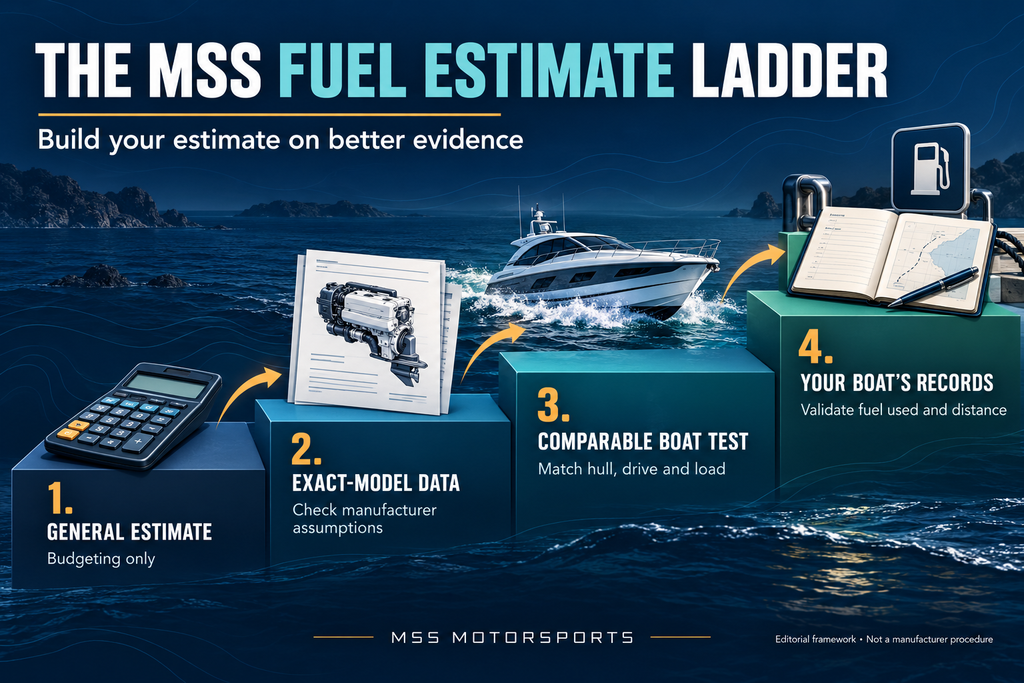
The MSS Fuel Estimate Ladder is an editorial framework for judging the evidence behind a consumption estimate. It is not an official Volvo Penta procedure.
Level 1: Generic Estimate for Early Budgeting
A broad estimate may help compare preliminary operating scenarios.
State its assumptions and uncertainty. Do not treat it as the sole basis for passage planning or a verified model-specific claim.
Level 2: Exact-Model Manufacturer Data
Matching documentation provides a stronger engine reference.
However, exact identification does not remove the need to understand the chart’s load assumptions or the vessel’s installation.
Level 3: Comparable Boat-Test Data
Check hull, displacement, engines, drives, propellers, and test conditions.
An original test of a similar boat can provide useful context. Differences should remain visible rather than being hidden behind a single comparison number.
Level 4: Validated Records from Your Boat
Repeated records from your own vessel provide the most directly relevant operating evidence.
Cross-check displayed consumption against fuel records where practical. Record speed, loading, conditions, and other fuel consumers.
Maintain separate profiles where operating conditions differ substantially. One calm-water observation should not become the assumed consumption for every journey.
The practical principle is simple: use engine data to build the estimate, and vessel evidence to assess how well it fits.
Estimate Fuel Burn by Model, Operating Load, and Hull Type
An engine chart helps explain fuel consumption. To estimate what your boat will use, connect that information to the propulsion package, vessel speed, and operating conditions.
The objective is to produce an estimate you can explain, check, and improve with measurements.
Estimating Fuel Consumption by Volvo Penta Model
There is no single reliable cruising-consumption figure for an entire Volvo Penta engine family. Match the exact model and data conditions before applying a number to your vessel.
D1 and D2 Sailing-Yacht Installations
For auxiliary sailing-yacht propulsion, identify the complete engine model, gearbox or saildrive, propeller, and vessel displacement.
A small engine’s rated horsepower does not establish consumption at your preferred motoring speed. The power required to move the boat matters.
Record fuel used, motoring hours, distance, and operating conditions. Distinguish steady motoring from maneuvering or periods spent charging batteries at different operating settings.
For displacement hull fuel economy, those records are more useful than a consumption figure copied from another yacht with a similar engine.
D3, D4, and D6 Installations
Searches for Volvo Penta D4 fuel consumption and Volvo Penta D6 fuel consumption can return different ratings, generations, and propulsion arrangements.
Check the full designation and document version. Volvo Penta’s documented D4/D6 update included changes to engine management, fuel injection, and other components, reinforcing the importance of generation-specific information.
Also identify the drive. A shaft-drive boat and an Aquamatic installation do not become equivalent because their engines have matching horsepower ratings.
If a published figure lacks its model, load basis, or vessel context, treat it as incomplete evidence.
D8, D11, and D13 Installations
For larger installations, relate fuel consumption to the required vessel task.
Rated output describes capability under specified conditions. It does not mean the engine delivers that output continuously during cruising.
When researching Volvo Penta D13 fuel consumption, distinguish full-load data, assumed propeller-load data, and measured vessel results. Each answers a different question.
For twin or multiple-engine installations, establish whether the reported consumption applies to one engine or the whole vessel.
IPS Packages
For Volvo Penta IPS fuel consumption, record both the engine identity and the complete propulsion package.
An IPS designation does not establish a universal horsepower or fuel-consumption figure.
Evaluate efficiency claims against the vessel, comparison installation, speed, displacement, and conditions used in the test. A favorable result on one boat is not a guaranteed percentage saving on another.
Volvo Penta Petrol Engines
Use exact-model documentation or closely matched vessel measurements for Volvo Penta petrol fuel consumption.
Do not apply a diesel estimating coefficient to a petrol engine. Likewise, avoid treating a horsepower multiplier as verified consumption across different petrol models.
Compare the same task: similar vessel conditions, desired speed, and loading.
| Engine or package | Information needed | Main comparison limitation |
|---|---|---|
| D1/D2 auxiliary propulsion | Exact model, propeller, vessel speed | Rated power does not establish operating load |
| D3/D4/D6 | Generation, rating, drive, vessel conditions | Family-wide figures conceal differences |
| D8/D11/D13 | Rating, load basis, propulsion arrangement | Full-load data is not automatically cruise data |
| IPS | Actual engine and complete package | System designation alone is insufficient |
| Petrol engines | Exact model and fuel-specific data | Diesel assumptions are unsuitable |
How RPM and Load Affect Fuel Burn
The Same RPM Can Represent Different Loads
Engine power depends on rotational speed and torque.
At a given RPM, different torque demand can produce different fuel consumption. Propeller selection, vessel resistance, and operating conditions influence that demand.
This is why fuel consumption by RPM must include the load assumption. An RPM reading alone cannot replace applicable data or measurements.
Why Half the RPM Does Not Mean Half the Fuel Burn
Fuel consumption does not generally follow a straight line with RPM.
If a chart gives consumption at rated speed, halving that figure does not establish consumption at half the RPM.
A propeller load curve also represents absorbed-power assumptions, not a universal formula for fuel use. Engine efficiency changes across operating points, so power scaling and fuel scaling should not be confused.
Rated Horsepower Versus Actual Output
Rated horsepower is the engine’s specified capability. Actual output is the power delivered during the operating condition being assessed.
Using rated power in a cruise calculation can overstate the assumed power demand.
The reverse problem also occurs: guessing a low load percentage can produce an unrealistically optimistic estimate.
If actual output is unknown, state the assumption and validate the result rather than presenting it as measured Volvo Penta fuel burn.
Select Cruise Settings Within Applicable Operating Guidance
There is no universal RPM percentage that gives every boat its economical cruising speed.
Follow the applicable engine and vessel guidance. Compare consumption and progress across suitable operating settings.
The preferred setting may reflect fuel economy, weather, journey time, comfort, and operating requirements. The lowest hourly reading is only one consideration.
How Hull Type Changes Fuel Economy
Displacement Hulls
As a displacement boat approaches the upper end of its efficient operating range, additional speed can require a substantial increase in power.
Simple hull-speed rules provide context, but hull form and conditions affect actual performance. They do not establish fuel consumption.
Record speed and fuel use together. This shows whether a small increase in progress requires a much larger increase in fuel.
Semi-Displacement Hulls
Semi-displacement vessels can show changing efficiency through transition speeds.
Their behavior should not be forced into a generic displacement or planing curve. Assess the actual vessel across suitable operating points.
Record loading and trim so comparisons remain meaningful.
Planing Hulls
For planing boat fuel consumption, reaching and maintaining plane changes the operating picture.
A lower speed may reduce hourly burn while increasing fuel required per mile. However, that does not mean faster operation always improves economy.
Compare total fuel flow and speed at appropriate settings. Follow vessel guidance when evaluating boat trim, and record the setting rather than assuming it stayed constant.
Weight, Fouling, Propellers, and Sea Conditions
Account for passengers, equipment, fuel, water, and other loading.
Hull fouling, propeller condition, and propeller matching can affect performance. Wind, waves, and current also change how much progress the vessel makes.
A light boat in calm conditions cannot be directly compared with the same boat heavily loaded and traveling against current.
Record these differences before interpreting a change as an engine-efficiency problem.
Fuel-Consumption Calculations You Can Use
The following examples are hypothetical. They demonstrate arithmetic and are not measured Volvo Penta performance figures.
Calculate Average Hourly Consumption
Average L/h = fuel consumed in litres ÷ operating hours.
If 120 litres are consumed over six hours:
120 ÷ 6 = 20 L/h.
That average may combine maneuvering, idling, and cruising. It does not establish consumption at one RPM.
If another engine or generator draws from the same tank, account for its use before attributing the total to propulsion.
Calculate Litres per Nautical Mile
L/nm = total propulsion consumption in L/h ÷ speed in knots.
At 40 L/h and 20 knots:
40 ÷ 20 = 2 L/nm.
For route progress, use speed over ground and record current conditions. Current affects the distance made good over the ground, even when engine operation appears unchanged.
At zero speed, this division cannot provide a meaningful traveling-efficiency figure.
Calculate Trip Fuel
Estimated propulsion fuel = distance in nautical miles × expected L/nm.
For 60 nautical miles at 2 L/nm:
60 × 2 = 120 litres.
This is the propulsion estimate for those assumptions. It excludes reserve, auxiliary consumers, delays, and operating segments with different consumption.
Calculate materially different segments separately rather than forcing the entire route into one cruise figure.
Calculate Twin-Engine Consumption
For twin-engine fuel consumption, add both engines:
Total propulsion L/h = port-engine L/h + starboard-engine L/h.
If the engines consume 24 and 26 L/h, the total is 50 L/h.
Do not double a published figure already stated as total vessel consumption. Do not assume both engines always use identical amounts.
Use Specific Fuel Consumption Carefully
When suitable inputs are available:
L/h = (specific fuel consumption in g/kWh × actual output in kW) ÷ (1,000 × fuel density in kg/L).
Assume, purely for illustration:
- Specific fuel consumption: 220 g/kWh.
- Actual output: 100 kW.
- Fuel density: 0.84 kg/L.
The result is:
(220 × 100) ÷ (1,000 × 0.84) ≈ 26.2 L/h.
This is not a manufacturer specification. The calculation depends on the efficiency value being applicable at the actual operating point.
Do not silently substitute full-load efficiency and rated output for unknown cruise conditions.
Worked Example: Lower Hourly Burn, Higher Trip Fuel
Consider two invented operating points:
| Operating point | Total consumption | Speed | Fuel per nautical mile | Time for 60 nm | Trip fuel |
|---|---|---|---|---|---|
| A | 18 L/h | 6 knots | 3 L/nm | 10 hours | 180 L |
| B | 40 L/h | 20 knots | 2 L/nm | 3 hours | 120 L |
Point A uses less fuel each hour but more fuel over the journey.
These figures demonstrate the calculation; they do not describe a particular boat’s performance or recommend a cruising speed.
The practical insight is that marine engine fuel consumption must be considered alongside the work accomplished. Hourly burn, journey efficiency, and total trip fuel are related—but they are not interchangeable.
Validate Fuel Consumption, Estimate Range, and Compare Costs
A calculation becomes more useful when you can check it against your boat.
This final section explains how to validate Volvo Penta fuel consumption, plan with appropriate allowances, and distinguish a change in operating conditions from a possible machinery problem.
Measure Your Boat’s Fuel Consumption
Use Available Fuel-Flow or Engine-Display Data
First establish what your equipment reports.
A display may show instantaneous consumption, accumulated fuel use, an individual engine, or combined consumption. Confirm the meaning and units in the applicable equipment documentation.
Also determine whether the reading is calculated by the engine-management system or measured by separate fuel-flow equipment. These are different measurement methods.
A dashboard figure is useful evidence, but its configuration and accuracy should be checked before treating it as verified fuel consumption.
For twin engines, record each engine separately where available. Make sure a combined reading is not counted twice.
Cross-Check Against Fuel Records
Keep records of fuel added, operating hours, distance, and other consumers drawing from the tank.
Use a consistent refueling reference without overfilling. Differences in vessel attitude and filling level can affect comparisons.
If a generator or heater shares the supply, the fuel added cannot automatically be attributed entirely to propulsion.
A recorded average over several operating periods can help check accumulated display readings. However, it may combine maneuvering, slow operation, and cruising rather than describe one RPM setting.
Build a Fuel-and-Speed Log
A simple log makes estimates easier to improve.
| Record | Why it matters |
|---|---|
| Date and engine configuration | Identifies the installation being assessed |
| Operating time and distance | Supports hourly and distance-based calculations |
| RPM and speed reference | Connects machinery operation with vessel progress |
| Per-engine and total fuel use | Prevents counting errors |
| Passengers, equipment, and tank loading | Helps explain changes in demand |
| Trim and propulsion details | Records relevant operating settings |
| Wind, sea, and current | Provides comparison context |
| Measurement method | Distinguishes display readings from calculated averages |
MSS Motorsports recommends including this operating evidence with an engine or repower enquiry. It describes your actual requirements more clearly than a request based only on horsepower.
Compare Repeatable Conditions
Compare observations taken under reasonably similar loading and environmental conditions.
Use ordinary, permitted operation with warmed machinery and stable readings where practical. Record differences rather than assuming they are insignificant.
Do not conduct performance trials when alarms, machinery condition, weather, traffic, or vessel guidance make them inappropriate.
Estimate Range Without Treating Tank Capacity as Usable Fuel
Nominal Capacity, Usable Fuel, and Reserve
Nominal tank capacity is not automatically the fuel available for a planned journey.
Establish usable fuel capacity from applicable vessel information. Then account for the fuel already onboard and the reserve selected for the passage.
Reserve requirements depend on the route, alternatives, expected conditions, measurement uncertainty, and applicable guidance. A single percentage cannot guarantee a suitable allowance for every voyage.
Keep the reserve separate from the fuel allocated to expected consumption.
Range Calculation
Estimated boat fuel range in nautical miles = planning fuel available ÷ expected litres per nautical mile.
For illustration, assume 400 litres remain available for planned consumption after reserve deductions, and the expected rate is 2 L/nm:
400 ÷ 2 = 200 nautical miles.
These are hypothetical inputs. The result is a planning estimate, not guaranteed range.
If conditions reduce progress or increase consumption, achievable distance can fall.
Build a Route with Different Operating Segments
A journey may include harbor maneuvering, steady cruising, slow passages, and waiting.
Calculate materially different segments separately:
Trip fuel = the sum of each segment’s expected fuel use, plus relevant auxiliary consumption.
For a time-based segment, multiply hours by expected L/h. For a distance-based segment, multiply nautical miles by expected L/nm.
Include uncertainty and anticipated delays when developing the overall fuel plan.
Why Has Your Volvo Penta Fuel Consumption Increased?
Check Whether the Comparison Is Fair
Before suspecting a fault, compare speed, loading, route, current, sea conditions, and measurement method.
Higher litres per hour at a higher speed does not establish declining efficiency. Likewise, poorer litres per nautical mile against a strong current may reflect reduced progress over the ground.
Compare equivalent operating conditions wherever possible.
Inspect Vessel and Propulsion Factors
Consider hull fouling, propeller condition, trim, and recent installation changes.
Additional equipment or tank loading may also change the vessel’s performance.
These factors can affect marine engine fuel consumption without proving an internal engine defect. Record relevant changes before requesting a diagnosis.
Investigate Engine Symptoms When Present
Fuel-use changes become more informative when accompanied by smoke, warnings, unusual temperatures, rough running, or reduced performance.
Record the exact messages and symptom timeline. Follow the applicable alarm instructions and seek professional investigation where required.
Volvo Penta’s support guidance emphasizes sharing the sequence of events and observed symptoms to assist troubleshooting.
Use Evidence Before Replacing Components
Increased consumption alone does not diagnose damaged injectors, a failed turbocharger, or a control-system fault.
Provide your operating log, engine identity, and service history. Ask what findings support the proposed repair.
A comparison with a generic internet figure is insufficient evidence for an expensive component replacement.
Compare Running Costs and Repower Options
Calculate Fuel Cost per Trip and Season
Fuel cost = estimated consumption × the stated fuel price.
A hypothetical trip using 120 litres at an assumed price of 1.50 currency units per litre costs 180 currency units in fuel.
For seasonal marine engine running costs, separate operating modes rather than multiplying every hour by a full-load figure.
Include auxiliary fuel use where relevant. Date any price assumptions because fuel prices change.
Compare the Same Vessel Task
Compare installations delivering similar speed and capability under equivalent loading and conditions.
An engine consuming less each hour at a much lower vessel speed may not reduce journey costs. Conversely, higher installed horsepower does not establish higher consumption during every operating condition.
Use both hourly burn and fuel per distance.
Include Installation and Ownership Costs
A Volvo Penta repower comparison should include the engine, transmission or drive, controls, cooling, exhaust, installation, commissioning, maintenance, and downtime.
A simple fuel-savings calculation does not capture the whole decision.
If estimating payback, state the assumptions:
Simple payback period = additional investment ÷ estimated annual savings.
That arithmetic depends on credible consumption differences, operating hours, fuel prices, and installation costs. It does not guarantee that savings will occur.
What to Send MSS Motorsports
Provide your complete engine designation, serial-number photograph, vessel details, and propulsion configuration.
Include gearbox ratio where relevant, fuel-and-speed records, desired performance, and equipment you intend to retain.
State your purchase timeframe and provide billing and delivery addresses for a formal quotation. Request written confirmation of package contents, compatibility requirements, warranty terms, shipping costs, and lead time.
Frequently Asked Questions About Volvo Penta Fuel Consumption
How Much Fuel Does a Volvo Penta Engine Consume?
There is no single brand-wide figure. Consumption depends on the exact model, delivered power, propulsion installation, vessel, and operating conditions.
Can RPM Alone Predict Fuel Consumption?
No. RPM must be considered alongside load. A published RPM table also needs its stated load assumptions.
Where Can I Find a Volvo Penta Fuel-Consumption Chart?
Start with manufacturer documentation matched to the complete engine designation. Volvo Penta provides engine identification and documentation resources; an authorized dealer can assist with applicable technical information.
What Is the Difference Between Full-Load and Propeller-Load Data?
Full-load fuel consumption describes operation at the specified full-load output. Propeller-load data uses an assumed relationship between speed and absorbed power.
How Do I Calculate D4 or D6 Fuel Burn?
Use exact-model documentation as a reference, then validate it with fuel records and operating conditions. Neither Volvo Penta D4 fuel consumption nor Volvo Penta D6 fuel consumption has one universal cruising figure.
Is Lower RPM Always More Economical?
No. Compare fuel per distance, suitable operating conditions, and journey requirements alongside hourly consumption.
Do Twin Engines Use Exactly Twice as Much Fuel?
Add their individual consumption. Doubling is appropriate only when both use the same amount and the starting figure represents one engine.
Are IPS Installations Always More Fuel-Efficient?
A universal comparison is inappropriate. Assess complete installations using clearly described vessel and test evidence.
How Do I Convert L/h into L/nm?
Divide total propulsion L/h by speed in knots. State the speed reference and operating conditions.
Why Has Consumption Increased Without an Alarm?
Loading, speed, fouling, propulsion condition, weather, current, or measurement differences may contribute. Compare records before assuming a machinery fault.
How Accurate Are Dashboard Fuel Readings?
Accuracy depends on the equipment, reporting method, configuration, and verification. Check documentation and cross-check accumulated readings against fuel records.
How Should I Estimate Range and Fuel Reserve?
Establish usable fuel, deduct an appropriate reserve, and calculate expected consumption across the route. Treat the result as an estimate with allowances for uncertainty.
Conclusion: Estimate from the Engine, Validate on the Boat
Useful Volvo Penta fuel consumption estimates combine accurate identification, understood data conditions, and repeatable vessel records.
Use hourly burn for time-based budgeting and fuel per nautical mile for journey efficiency. For range, account for usable fuel, reserve, route segments, and uncertainty.
The MSS Fuel Estimate Ladder gives you a practical way to improve the evidence: begin with a qualified estimate, obtain exact-model data, consider relevant vessel tests, and validate against your boat.
For an engine or replacement-package enquiry, contact MSS Motorsports with your engine identity, propulsion details, operating records, and purchase timeframe. Those details support a more relevant comparison and a clearly specified quotation.
