
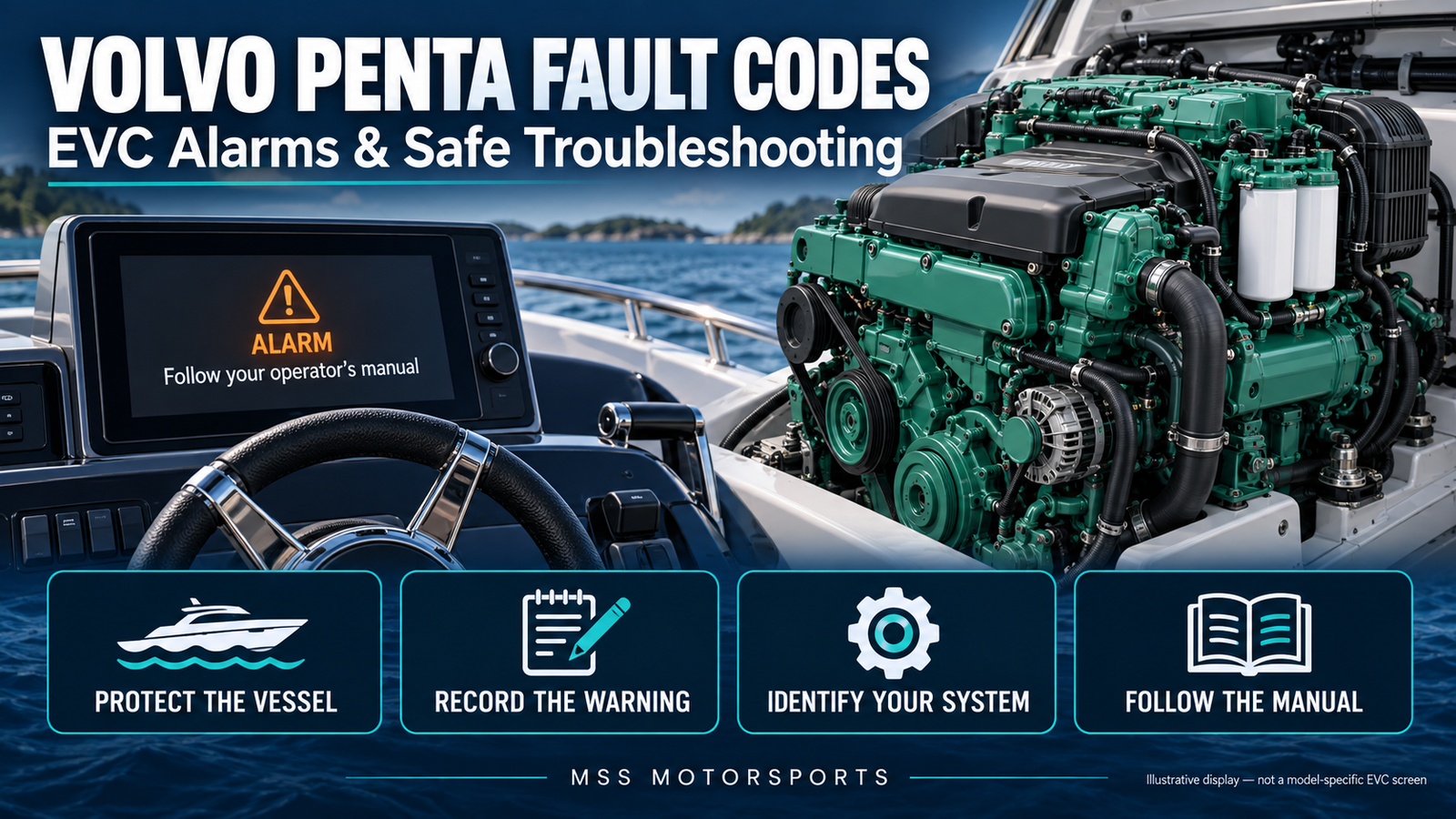
Understand the Alarm Before Attempting a Fix
While researching this guide, I found a detail in Volvo Penta’s official Easy Connect FAQ that is easy to overlook: diagnostic trouble codes are not available through the app for engines with MDI or certain older EVC generations.
That finding changed how I approached this article. An owner needs more than a code lookup. They need to know what equipment is installed, what information their display or app can provide, and which instructions apply to the warning. A missing code in an app does not establish that a reported alarm can be ignored.
Consider a hypothetical situation: you leave the marina, hear an alarm, and see an unfamiliar message at the helm. The engine still runs. You wonder whether to stop, restart, or order the component mentioned on screen.
The first decision concerns safe operation. Parts selection comes later.
Volvo Penta fault codes describe detected conditions or system faults. Their meaning and required response must be interpreted using documentation for the exact engine, propulsion equipment, and control system.
This guide explains how to preserve useful evidence and choose the appropriate next step. It uses Volvo Penta’s manufacturer guidance as its technical foundation. Examples are illustrative unless specifically identified as documented service cases.
Quick Answer—What Should You Do When a Volvo Penta Alarm Appears?
Protect the vessel, follow the displayed instructions and matching operator’s manual, and record the complete warning when safe. Obtain assistance when the alarm or symptoms indicate a serious condition or unreliable propulsion control.
Do not assume that continued engine operation means continued boat operation is safe.
Protect the vessel and follow the displayed instructions
Your immediate response must account for people aboard, nearby hazards, and the boat’s position. An engine warning during maneuvering requires attention to vessel control as well as the machinery.
Volvo Penta’s general support guidance describes red alarms as warning or danger indications and recommends stopping operation as soon as possible. Consult the applicable manual for the specific response. In an offshore emergency, contact local marine rescue authorities.
An amber indication is not blanket permission to continue. Read the complete message and any action displayed.
If shifting, throttle response, or steering becomes unreliable, prioritize bringing the vessel to safety and arranging assistance. Do not experiment with controls to see whether the problem clears.
Capture the warning before acknowledging or restarting
When safe, photograph the entire display. Include the wording, complete identifier, alarm indication, and any additional instruction.
Record which engine is affected in a twin-engine installation. Note whether the alarm appeared during starting, at idle, during gear engagement, or under cruising load.
Silencing an alarm does not confirm a repair. Acknowledgement, restart, and fault-clearing behavior depend on the fitted system. Follow its instructions rather than a general online reset sequence.
If urgent action is required, take that action first. Collecting evidence should never delay protecting the vessel.
Use a quick triage table
The following table helps organize observations. It does not assign universal alarm severity or replace the manufacturer’s instructions.
| Warning category | Immediate priority | Useful observation, when safe | What guides the next step |
|---|---|---|---|
| Oil-pressure warning | Follow the prescribed urgent response | Exact message, operating condition, visible leaks after shutdown | Matching manual and pressure assessment where required |
| Temperature warning | Follow alarm instructions; avoid increasing load to reproduce it | Temperature trend and changed exhaust-water discharge | Applicable cooling and fault-handling guidance |
| Voltage or power warning | Assess prescribed action and affected functions | Starting behavior, display changes, other equipment affected | Model-specific guidance and electrical testing |
| Throttle, shift, or steering warning | Protect reliable vessel control | Affected function, engine, or helm station | Installation-specific instructions and assistance |
| Unfamiliar EVC warning | Read and preserve the full message | Identifier, symptoms, timing, and recent work | Correct fault register or professional diagnosis |
What Are Volvo Penta Fault Codes and EVC Alarms?
Distinguish an alarm, a text message, and a diagnostic code
An alarm attracts attention through a sound, light, or display indication.
A text message describes a detected condition or an action to take.
A diagnostic trouble code is an identifier interpreted using the relevant technical documentation.
Your installation may present several forms of information together. It may also show a useful warning without displaying a numeric code at the helm.
When asking about Volvo Penta fault code meanings, preserve the complete message. A photograph is usually more reliable than a number remembered after returning to the dock.
Avoid shortening the description to “electrical fault” or “sensor problem.” Those phrases can omit the information needed to identify the correct diagnostic path.
What Electronic Vessel Control monitors depends on the installation
Electronic Vessel Control, or EVC, integrates engine information and connected propulsion functions on equipped installations.
The equipment fitted determines which functions and information are available. Engine, transmission, drive, and helm-control details may all matter when interpreting a warning.
Not every Volvo Penta engine uses EVC. Nor should a diesel engine, gasoline sterndrive package, and IPS installation be assumed to use identical fault explanations.
A message can identify an abnormal reading or signal without proving which component caused it. Appropriate tests may need to distinguish the measured condition from a sensor, connection, wiring, or power-supply problem.
Why EVC generation and display type matter
Different EVC generations and displays offer different interfaces and diagnostic capabilities.
For example, Volvo Penta’s Easy Connect FAQ states that diagnostic trouble codes are unavailable through the app for engines with MDI and EVC A, B, C1, and C2. That describes an app limitation; it should not be expanded into a claim that no other diagnostic information is available.
Identify the fitted display before following menu instructions. A video demonstrating one generation’s navigation does not establish the correct button sequence for another.
Find the Correct Fault Register for Your Installation
Identify the engine and propulsion equipment
Photograph the engine identification plate. Record its model, engine serial number, and current operating hours.
Where applicable, record the gearbox, saildrive, sterndrive, or IPS model and serial number. Photograph the helm display and control panel.
If you do not know the EVC generation, say so. Accurate photographs and known identification details are more useful than a guessed system designation.
For repowered or modified boats, verify what is actually installed. Original vessel documents may no longer describe the current equipment.
Locate the matching operator’s manual
Use Volvo Penta’s engine information resource to locate the relevant Volvo Penta operator’s manual and related documentation.
Find the sections covering safety, fault handling, and the EVC fault register. Confirm the document’s applicability and retain its reference with your service records.
Volvo Penta identifies the serial number as essential for efficient servicing and correct parts ordering. Establishing equipment identity also helps avoid using the wrong troubleshooting instructions.
Avoid mismatched online code lists
A Volvo Penta fault code list is useful only when you can establish which equipment and diagnostic format it covers.
Check whether it applies to marine or industrial equipment, diesel or gasoline engines, and the correct control-system generation.
Also distinguish diagnostic identifiers from document numbers, picture references, and labels printed beside warning illustrations. A number appearing near an alarm graphic is not automatically a fault code.
Do not use an unverified lookup result to authorize a repair or purchase. If the source does not identify its applicable equipment, obtain the correct documentation first.
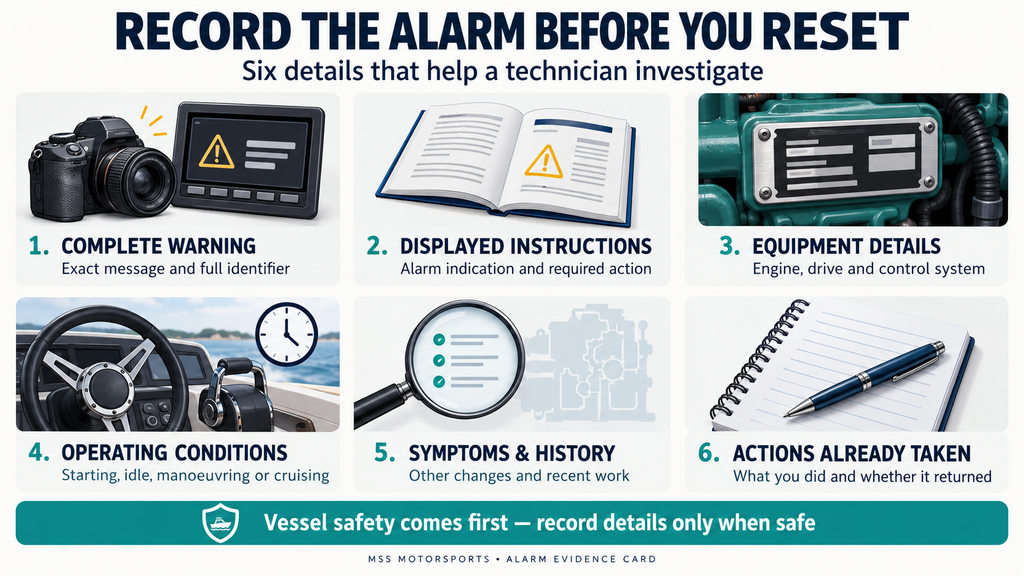
The MSS Alarm Evidence Card—Record Before You Reset
The MSS Alarm Evidence Card is an organizing framework proposed in this article. It is not an official Volvo Penta test procedure or a substitute for professional diagnosis.
Its purpose is to make an enquiry specific enough to guide the next investigation.
Record six pieces of evidence
| Evidence | What to capture |
|---|---|
| Complete warning | Exact wording, complete identifier, and photographs |
| Alarm instructions | Displayed indication and prescribed action |
| Equipment identity | Engine, drive, controls, and display details |
| Operating condition | Starting, idle, maneuvering, or cruising |
| Supporting observations | Symptoms, readings, recent work, and service history |
| Actions already taken | What you did and whether the warning returned |
Gather only information you can obtain safely. Do not conduct a demanding trial to fill an empty field.
Use an illustrative completed evidence card
Here is a hypothetical example:
“A coolant-temperature warning appeared on the starboard engine after sustained cruising. I photographed the display and followed the shutdown instructions once safe. Exhaust-water discharge appeared weaker than usual. I have not restarted. Engine and drive identification photographs are attached.”
This describes the event without declaring an impeller, sensor, or heat exchanger defective.
That distinction improves marine engine diagnostics. It allows the technician to select inspections and tests based on evidence rather than an assumed component failure.
Understand the contrarian insight
A disappearing alarm is not proof of a repaired fault, and a named component is not automatically a shopping list.
A restart can change what appears on the display. It does not establish why the warning occurred or whether it will return under different conditions.
Likewise, a sensor-related warning may require assessment of the actual operating condition, sensor circuit, connections, and supply before replacement is justified.
The useful handoff is straightforward: protect the vessel, preserve the message, identify the installation, and provide supporting observations. That gives Volvo Penta troubleshooting a clear starting point and reduces the temptation to buy parts before the cause is confirmed.
Read Fault Information and Understand Common Alarm Categories
How to Read Volvo Penta Fault Information
The most useful fault information combines the complete warning with the equipment identity and operating conditions. A number alone may not establish the correct meaning or response.
Find the fault information using the correct display instructions
To understand how to read Volvo Penta fault codes, start with the instructions for your installed display and EVC generation.
Depending on the equipment, information may appear as a pop-up, a warning symbol, a text description, or an entry in a fault menu. Do not assume every helm offers the same navigation or detail.
Volvo Penta North America provides an instructional video specifically for retrieving codes from an EVC-C display. Its stated scope is important: instructions for that display should not be treated as a universal procedure.
Read the warning’s action instructions before exploring menus. If urgent action is required, respond first and collect additional information when safe.
Distinguish active faults from recorded history
An active fault generally means the system is currently detecting the relevant condition. Recorded fault information describes a condition detected previously. How those states are presented, retained, or cleared depends on the installation.
When discussing active and stored fault codes, record what the display actually says rather than assigning a status yourself.
A historical warning may help explain an intermittent problem. An active warning may require immediate action. Neither status, by itself, proves which component needs replacement.
If a message disappeared after shutdown, report that fact along with the original photograph. Do not describe the problem as repaired without further evidence.
Preserve the complete code structure
If the display or diagnostic report includes several identifier fields, capture all of them, including their labels.
You may encounter formats containing terms such as MID, PID, SID, PSID, FMI, or SPN in diagnostic documentation. Do not assume every Volvo Penta installation uses every format, or that identical digits have equivalent meanings across systems.
A complete identifier should be interpreted against the matching documentation—not against whichever online result contains the same number.
Also distinguish a diagnostic identifier from a manual’s illustration reference. The number printed beside a warning picture may identify the picture rather than the fault.
Understand Easy Connect’s diagnostic limitations
Easy Connect diagnostics depend on the installed equipment and its compatibility.
Volvo Penta’s official FAQ states that diagnostic trouble codes are unavailable through the app for engines with MDI and EVC A, B, C1, and C2. Check the official compatibility information before assuming your installation can provide a particular function.
An app connection does not establish that every diagnostic feature is supported. Similarly, an empty code view does not establish that a warning shown elsewhere can be ignored.
Common Volvo Penta Alarm Categories—Meaning and Safe First Observations
The following guide explains categories of Volvo Penta EVC alarms. It is not a universal numeric code list.
For every warning, confirm the exact wording, prescribed response, and applicability in your operator’s manual. Volvo Penta’s support guidance directs owners to model-specific fault tracing and professional help when the cause needs investigation.
| Alarm category | What needs interpretation | Useful observation, when safe | Assessment may involve |
|---|---|---|---|
| Oil pressure or level | Whether the message concerns lubrication pressure or oil quantity | Exact wording, operating condition, visible leakage | Actual pressure, lubrication condition, measurement circuit |
| Coolant temperature | The reported temperature condition | Timing, temperature trend, associated symptoms | Coolant circulation, seawater supply, heat transfer, engine load |
| Exhaust temperature | The reported exhaust condition | Changed water discharge, steam, accompanying warnings | Applicable cooling and exhaust systems |
| Voltage or power supply | The affected supply or circuit | Starting behavior and other affected functions | Batteries, charging, connections, circuit testing |
| Water in fuel | The condition detected by the fitted system | Recent refueling and applicable separator observations | Fuel condition, filtration, detection circuit |
| EVC communication | Which communication or system function is affected | Affected displays, controls, and timing | Power supply, connections, network, modules |
| Throttle or shift | Which control function is unreliable | Affected station, engine, and response | Controls, configuration, wiring, propulsion equipment |
| Drive or transmission | The exact equipment and reported condition | Shifting, steering, vibration, or leakage changes | Matching gearbox, sterndrive, or IPS procedures |
Low oil pressure or oil-level warning
A low oil pressure warning and an oil-level warning concern different things. Read the full message before describing the problem.
Oil pressure relates to lubrication performance. Oil level relates to the quantity measured or indicated. Checking the level does not establish that pressure is adequate.
Follow the prescribed alarm response. After a safe shutdown, perform only the checks permitted by your manual, such as checking the level under specified conditions and observing external leakage.
Do not assume the sender is defective because the engine sounds normal. A technician may need to verify actual pressure before assessing the measurement circuit.
Coolant temperature or overheating warning
A coolant temperature alarm requires attention to the reported condition and its timing.
Did it appear shortly after starting, during maneuvering, or after sustained cruising? Was there a change in discharge from a water-injected exhaust? Did another warning appear first?
Those observations help direct the investigation. They do not prove an impeller, thermostat, or heat exchanger has failed.
Follow the applicable instructions. Allow sufficient cooling before permitted checks, and never open a hot cooling-system pressure cap. Avoid increasing load to reproduce a serious overheat.
Exhaust temperature warning
An exhaust temperature warning should not be dismissed because the coolant gauge appears normal.
The warning concerns a different monitored condition, and its meaning depends on the installation. Where a water-injected exhaust is fitted, changed water discharge or steam can provide useful supporting observations.
Do not touch a suspect hot hose or continue operating merely to see whether the coolant temperature eventually rises.
Use the matching manual to establish the required response. Inspection may need to consider the relevant seawater and exhaust systems, including possible damage resulting from inadequate cooling.
Battery voltage, charging, or power-supply warning
A battery voltage alarm identifies a condition requiring interpretation. It does not automatically mean the alternator or battery needs replacement.
Record whether the message appeared during starting, after startup, or while other equipment was operating. Note whether displays dimmed, instruments restarted, or controls behaved differently.
Inspect accessible areas only under safe conditions. Do not disconnect electrical components from a running installation as an improvised test.
Appropriate testing can distinguish battery condition, charging performance, connection problems, and circuit faults. Several simultaneous warnings are useful evidence, but they do not establish low voltage as the cause without verification.
Water in fuel or fuel-related warning
A water in fuel warning should be interpreted using the instructions for the fitted detection and filtration equipment.
Record recent refueling, filter replacement, storage, or fuel-system work. Follow the manual for any permitted water-separator inspection or draining procedure.
There is no universal draining or bleeding procedure suitable for every Volvo Penta installation.
If fuel is leaking, stop starting attempts and arrange assistance. High-pressure fuel-system work requires appropriate training and equipment.
EVC communication or system warning
An EVC communication fault concerns information exchange or an associated system condition. It does not, by itself, prove that an expensive control module has failed.
Record which functions are affected. Is one display unavailable? Are several instruments affected? Did the warning appear during starting or following electrical work?
Power supply, connections, wiring, network components, or modules may require investigation. Those are possible assessment areas, not a replacement list.
Avoid unplugging sensors or network connections to experiment with the warning. Preserve the evidence and arrange the appropriate tests.
Throttle, shift, control-lever, or helm-station warning
An EVC throttle fault or gear engagement warning deserves particular attention when it affects reliable maneuvering.
Record the affected engine and helm station, and describe the response: delayed engagement, unavailable control, unexpected neutral, or another observed change.
Do not perform an improvised calibration or bypass an interlock. Follow any alternative-control or recovery instruction only when it is explicitly provided for your installation.
If propulsion control becomes unreliable, prioritize vessel safety and obtain assistance before further operation.
Gearbox, sterndrive, or IPS-related warning
A transmission warning, Aquamatic fault warning, or IPS steering alarm must be matched to the installed equipment.
Similar wording does not establish identical causes or repairs. Record drive identity alongside engine identity, and include any change in shifting, steering, noise, vibration, or leakage.
A technician may need to assess the propulsion package rather than the engine alone.
Avoid treating an engine restart as proof that steering or drive operation has become dependable. Follow the prescribed response and obtain confirmation where control reliability remains uncertain.
Why an Alarm Can Trigger Reduced Power
Protective response depends on the detected fault
Volvo Penta reduced-power mode describes an operating response associated with certain detected conditions.
Not every alarm produces the same response. The applicable documentation explains whether a particular fault affects output, engine speed, or another function.
Reduced power is an effect of the detected condition, not a diagnosis of the failed component.
Reduced power does not establish safe continued operation
An engine that still runs at limited output may remain unsuitable for continued operation because of the underlying fault or reduced maneuverability.
Follow the message-specific instructions. Consider vessel position, weather, nearby hazards, and the reliability of the remaining controls.
Do not attempt to defeat a protective response or repeatedly restart to restore full power.
Record several warnings in their sequence
If multiple warnings appear, record their order and approximate timing where possible.
Include which message appeared first, which followed, and whether the engine or controls changed behavior between them.
That sequence can help professional Volvo Penta troubleshooting, but the earliest observed warning is not automatically the root cause. Diagnosis still needs the matching documentation and appropriate tests.
The goal is to provide a coherent account: what the system reported, what the boat did, and what happened next.
Safe Troubleshooting, Professional Diagnosis, and Next Steps
Safe Owner Checks—and Work to Leave to a Technician
Owner observations that improve diagnosis
You can make Volvo Penta troubleshooting more productive without dismantling the engine.
Start with the Alarm Evidence Card from Part 1. Preserve the exact warning, equipment identification, operating conditions, and actions already taken. Add recent service history, refueling, electrical work, or changes to the propulsion installation.
After a safe shutdown, perform only the accessible checks permitted by your manual. These may include checking fluid levels under specified conditions and observing visible leaks or damaged components. Do not open a hot cooling system or approach moving equipment.
For twin-engine boats, record whether the warning affects one engine or both. Existing observations from the unaffected side may provide context, but do not swap components or deliberately reproduce an unsafe condition to make a comparison.
An owner’s observations help describe the fault. They do not replace the measurements needed to confirm its cause.
Tests requiring training and equipment
Some questions need instruments and model-specific procedures.
A technician may need to verify actual oil pressure, assess fuel delivery, test an electrical supply under load, investigate network communication, or inspect drive and steering equipment.
The proposed repair should follow the evidence. For example, replacing a pressure sender is justified only when the investigation supports that conclusion—not simply because the warning mentions pressure.
Diagnostic-tool compatibility also matters. Do not assume a generic automotive scanner can access or correctly interpret every Volvo Penta diagnostic trouble code.
Volvo Penta explains that its dealers have trained technicians, specialist tools, and diagnostic resources for identifying the root cause of faults.
When to stop troubleshooting and arrange assistance
Stop owner-level investigation when a serious alarm requires action, a fuel leak is suspected, severe vibration or knocking develops, or propulsion control becomes unreliable.
Do not disconnect sensors, bridge terminals, bypass interlocks, or keep restarting to restore full output. These actions can introduce additional faults or interfere with protective functions.
Follow the matching manual and arrange appropriate assistance. In an emergency offshore, contact local marine rescue authorities.
Can You Reset or Clear a Volvo Penta Alarm?
Acknowledge, restart, and clear mean different things
Owners often use “reset” to describe several actions. Keep them separate when discussing the problem.
| Action | What it refers to | What it does not establish |
|---|---|---|
| Acknowledge | Responding to the displayed alarm using the prescribed control | That the underlying condition is corrected |
| Restart | Shutting down and restarting as instructed for the installation | That the fault cannot recur |
| Clear fault information | Removing recorded information through an applicable procedure | That a repair has been verified |
The exact behavior depends on the installed system. There is no universal reset Volvo Penta alarm sequence suitable for every engine and display.
When a prescribed restart may be appropriate
A restart should be considered only where the applicable instructions support it and the vessel’s circumstances allow it safely.
Capture the warning first when practical. Follow any specified shutdown and waiting procedure. Do not apply restart advice from a different EVC generation or engine package.
A warning disappearing afterward is an observation to report. It is not confirmation that a serious operating condition has been resolved.
What to do when the warning returns
If a Volvo Penta alarm keeps returning, record when it recurs and whether the accompanying symptoms remain the same.
Does it return during starting, after warming up, when engaging gear, or under load? Did the wording change? Did additional warnings follow?
Those details help a technician choose the appropriate diagnostic path. Repeatedly clearing the message can make the sequence harder to document while leaving the cause unresolved.
Turn Fault Information Into a Useful MSS Service Request
Send the Alarm Evidence Card and equipment details
A useful service enquiry should allow the provider to understand what happened without guessing.
Send the complete warning photograph, engine and drive identification, current hours, display details, operating symptoms, and relevant service history. Include what you have already done.
State the vessel’s location and how soon you need assistance. Confirm whether you need fault assessment, repair support, or parts for a diagnosis already established.
MSS Motorsports lists troubleshooting, diagnostics, and repairs among its marine engine services. Confirm the support available for your equipment and location through its Service & Maintenance page.
Confirm the scope before ordering parts
A fault enquiry and a parts enquiry are different requests.
If the cause remains uncertain, obtain the appropriate assessment before treating the message as a replacement list. If testing has confirmed the required component, provide the findings and applicable part reference.
MSS Motorsports describes compatibility checks using manufacturer, model, serial number, and OEM part number before preparing a quotation. Its process also addresses superseded references.
For a parts quotation, provide billing and delivery addresses and your intended purchase timeline. Confirm the quoted item, condition where relevant, availability, warranty terms, and delivery costs.
Verify the repair
Ask the service provider to document what was found, what was corrected, and how the result was checked.
Suitable verification depends on the original fault and installation. It may involve measurements, diagnostic review, leak checks, control checks, or an appropriately planned operational test.
A verified repair connects the original warning to a confirmed cause, corrective work, and evidence that the relevant function is operating correctly.
Do not conduct a demanding trial yourself simply because the warning has disappeared.
Preventive Maintenance Helps Troubleshooting—but Does Not Explain Every Code
Keep model-specific service records
Good records help establish what has changed.
Retain dates, engine hours, parts references, fluid specifications, and reports for engine and drive servicing. Note whether the warning began before or after recent work.
Use the applicable Volvo Penta maintenance schedule to plan routine service. Maintenance history gives the technician context and helps identify work that remains due.
Avoid blaming every warning on overdue maintenance
An overdue service item may be relevant, but it does not prove the cause of an alarm.
Likewise, a recently serviced engine can still develop a fault. “It was serviced last month” is useful background, not a reason to dismiss the warning.
Treat maintenance status as one part of the evidence. Confirm the fault using the appropriate documentation and tests.
Volvo Penta Fault Codes FAQs
What do Volvo Penta fault codes mean?
Volvo Penta fault codes identify detected conditions or system faults that require interpretation against the matching documentation. They do not automatically establish which component needs replacement.
Preserve the complete identifier, warning text, equipment details, and operating conditions.
Where can I find the correct Volvo Penta fault code list?
Start with the engine and propulsion identification, then locate the applicable manual through Volvo Penta’s engine information resource.
Use its fault-handling and fault-register sections. For detailed diagnostic identifiers, professional support may be needed. Avoid lists that do not state their applicable equipment.
Can I keep operating with an EVC alarm?
That depends on the exact warning, prescribed response, and vessel circumstances.
Follow the display and matching manual. Do not interpret continued engine operation or reduced output as permission to continue. Volvo Penta’s general guidance recommends stopping operation as soon as possible for red alarms.
Does an amber alarm mean the boat is safe to use?
No. Color alone does not establish safe operation.
Read the complete message and action instructions. Consider whether throttle, shifting, steering, or another essential function has changed. Seek assistance when control reliability is uncertain.
Does a sensor-related code prove the sensor has failed?
No. The investigation may need to distinguish the actual measured condition from a sensor, circuit, connection, or supply problem.
Replacing a sensor without confirming the cause can leave a genuine mechanical or electrical fault unresolved.
How do I read active fault information on my display?
Use the instructions for your installed display and EVC generation.
Some interfaces provide fault information through menus; others present different levels of detail. Record what the display shows and avoid applying a button sequence from unrelated equipment.
Can Easy Connect show every diagnostic code?
No. Diagnostic availability depends on compatibility.
Volvo Penta’s FAQ states that diagnostic trouble codes are unavailable through Easy Connect for engines with MDI and EVC A, B, C1, and C2. Check the manufacturer’s current compatibility guidance for your installation.
Can I reset a Volvo Penta warning myself?
Follow only the acknowledgement or restart procedure specified for your system and warning.
Clearing information does not repair the cause. Serious symptoms or returning alarms require appropriate assessment rather than repeated resets.
Why did the warning disappear after restarting?
The detected condition may no longer be present, or the information displayed may have changed according to the system’s behavior.
That does not establish why the warning occurred or whether it will return. Preserve the original details and report the sequence.
What information should I send to a marine technician?
Send the complete warning and identifier, engine and drive details, current hours, display photographs, symptoms, operating conditions, recent work, and actions already taken.
Include the vessel’s location and required timeline. These details make the enquiry more useful than a code number alone.
Conclusion: Use the Warning to Guide the Next Step
Understanding Volvo Penta fault codes begins with the right response: protect the vessel, preserve the complete warning, identify the equipment, and consult matching guidance.
The Alarm Evidence Card helps organize that information. Diagnosis establishes the cause, and suitable verification confirms the repair.
For diagnostic support or a compatible parts enquiry, contact MSS Motorsports with your warning photographs, engine and drive identification, operating symptoms, service history, and required timeline. Include billing and delivery addresses when requesting an official parts quotation.
