
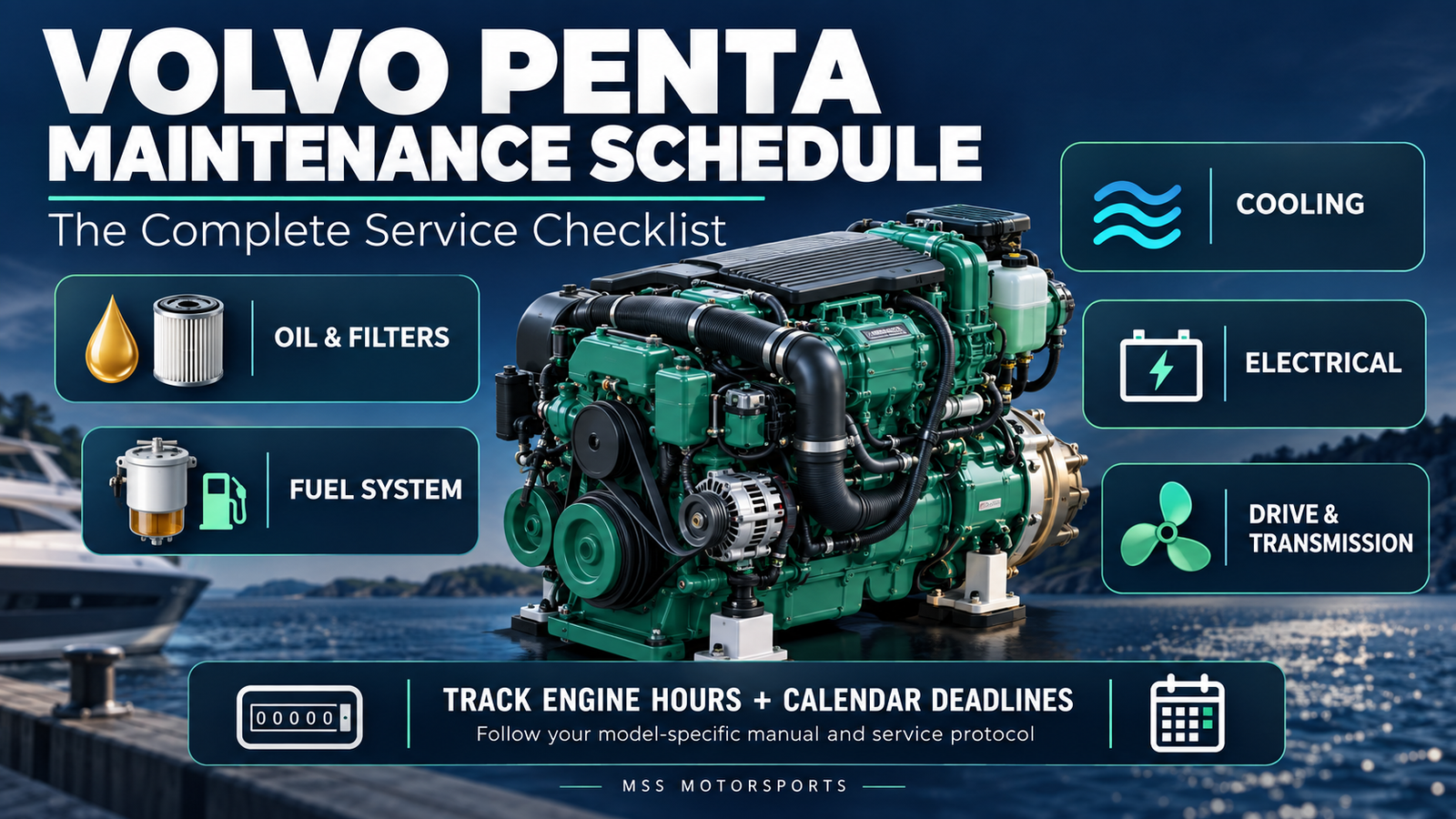
Find the Correct Schedule and Build Your Maintenance Checklist
While reviewing Volvo Penta’s official maintenance guidance for this article, I kept returning to one detail: service intervals are based on operating hours or elapsed time. It is easy to focus on the hour meter because it gives you a visible number. The calendar is less obvious, but it can be just as important.
Consider this hypothetical situation: you bought a boat last season, used it occasionally, and now want to prepare it for another year. The engine starts normally. Its hours are low. There is an invoice marked “engine service,” but no breakdown of the work.
Is everything current? You cannot tell from those facts alone.
The useful next step is to identify the engine, locate its maintenance requirements, and compare each task with the service record. That gives you evidence instead of an expensive guess.
A Volvo Penta maintenance schedule is the equipment-specific plan that identifies what must be inspected, cleaned, adjusted, or replaced—and when. It should be used alongside the documentation for the installed gearbox, saildrive, sterndrive, or IPS system.
Volvo Penta directs owners to the applicable maintenance schedule and states that intervals depend on operating hours or elapsed time. This guide helps you organize that information; the manufacturer’s documentation remains the source for exact requirements.
Quick answer: How often should a Volvo Penta marine engine be serviced?
Service your engine according to the schedule for its exact model and configuration. Track operating hours and calendar deadlines, follow the interval instructions in the relevant document, and include the associated transmission or drive.
There is no useful universal interval for every Volvo Penta marine engine. A sailing auxiliary, a gasoline sterndrive package, and a commercial diesel installation should not be placed on the same generic checklist.
How to Find Your Exact Volvo Penta Maintenance Schedule
Identify the engine model, generation, and serial number
Start with the identification plate. Take a clear photograph and record the model designation, serial number, and current engine hours.
A family name such as D1 or D6 narrows the search, but it may not establish the exact generation, installed equipment, or compatible replacement components.
Volvo Penta identifies the serial number as essential for efficient servicing and correct parts ordering. Its engine information resource provides access to manuals and service protocols.
Use those details to locate your Volvo Penta operator’s manual and applicable Volvo Penta service protocol. If a plate is unreadable or the engine has been replaced, resolve the identification before choosing parts or deadlines.
Identify the gearbox, saildrive, sterndrive, or IPS package
Next, identify the equipment that transfers engine power to the water.
Record the transmission or drive model and serial number where applicable. Keep photographs of its identification plate with the engine records.
An engine service does not automatically complete Volvo Penta gearbox maintenance, saildrive service, or the Volvo Penta engine problems of an Aquamatic or IPS package. Those components can have separate lubricant, inspection, sealing, and corrosion-protection requirements.
For a used boat, check whether the recorded equipment matches what is actually installed. Previous repairs or repowering may have changed the configuration.
Download the operator’s manual and applicable service protocol
Locate the maintenance schedule, safety instructions, fluid specifications, and procedures relevant to your equipment.
Save the document reference or revision so you know which instructions informed the work. Keep the engine and drive documentation together.
Do not substitute an industrial engine schedule for a marine installation or assume a newer manual applies to an older engine with a similar name.
If the applicable documentation remains unclear, ask a suitable service provider to help establish it before the job begins.
How to Read Volvo Penta Service Intervals Correctly
Track operating hours and calendar deadlines separately
Your hour meter records use. Your maintenance dates record elapsed time. A reliable marine engine maintenance checklist needs both.
Where your schedule gives paired limits and specifies whichever occurs first, apply that instruction.
For illustration only, imagine a task specified at 200 hours or 12 months, whichever comes first. At 12 months, that task would be due even if the engine had accumulated only 40 hours. Those figures are hypothetical, not a Volvo Penta recommendation.
Low engine hours do not establish that every maintenance task is current. Check each task against its own requirements.
Separate inspection, cleaning, adjustment, and replacement
Read the action beside the component carefully.
An inspection evaluates condition using the prescribed procedure. Cleaning removes contamination or deposits. Adjustment restores a specified setting. Replacement renews the component.
These actions are not interchangeable.
Replacing every inspected item can add unnecessary cost. Inspecting an item when scheduled replacement is required can leave the service incomplete.
Preserve the manufacturer’s wording in your checklist. “Replace fuel filter” is more useful than “fuel system checked,” because it identifies the work that needs evidence.
Check first-service requirements and special instructions
Look for initial inspection requirements, footnotes, operating-condition qualifications, and warranty-period instructions.
Do not assume every engine has the same first-service deadline. Confirm what applies to the supplied package.
Volvo Penta explains that its maintenance schedule identifies service packages and whether particular tasks may be performed by owners during the warranty period. It recommends using an authorized Volvo Penta dealer for servicing.
When planning work, confirm both the task and who should perform it.
The MSS Service Ledger: Turn the Schedule Into a Working Checklist
The MSS Service Ledger is a planning framework proposed in this article. It is not an official Volvo Penta protocol or a claim that MSS uses a manufacturer-approved proprietary method.
Its purpose is straightforward: make every required task traceable from instruction to completion.
Give every task five fields
Build your ledger using this structure:
| Maintenance task | Source and required action | Due date or engine hours | Responsible person | Completion evidence |
|---|---|---|---|---|
| Engine oil and filter | Applicable engine protocol and fluid specification | Enter documented limits | Assigned person, as permitted | Date, hours, oil specification, filter reference |
| Seawater impeller | Applicable inspection or replacement instruction | Enter documented limits | Assigned service provider | Work performed and condition findings |
| Transmission lubricant | Matching transmission documentation | Enter documented limits | Assigned service provider | Lubricant specification and service record |
| Newly discovered leak | Assessment needed to identify source | Arrange according to urgency | Qualified technician | Diagnosis and verified corrective work |
The rows illustrate the format. They do not prescribe intervals or confirm which tasks apply to your installation.
Separate scheduled work from newly discovered faults
Routine maintenance and fault assessment serve different purposes.
A scheduled fuel filter replacement may be due even when the engine runs normally. Conversely, a new fuel leak needs attention even when the next scheduled service is months away.
Record an alarm, leak, unusual vibration, or changed temperature as a separate assessment task. Include when it occurs and any accompanying observation.
Repairing that fault does not automatically complete other scheduled work. Keep the records separate enough to show what remains due.
Close each task with evidence
Record the date, engine hours, parts references, fluid specification, findings, and next deadline. Retain the invoice or technician’s report where available.
Here is an important practical insight: a Volvo Penta service kit contains parts; it does not prove that the complete service has been performed.
A kit may exclude drive work, adjustments, diagnostics, fluids, or operational verification. Compare its contents with the actual service scope before ordering.
MSS Motorsports describes equipment identification and compatibility verification as part of its parts sourcing process. Provide the model and serial number rather than relying only on a familiar engine name.
Before-Departure and After-Use Checks
Before starting: permitted fluid and visual checks
Follow the manual’s procedure for checking engine oil and coolant. Required conditions can include engine temperature, shutdown time, and how the vessel is positioned.
Inspect accessible areas for fresh leaks, deteriorated hoses, unusual bilge accumulation, or visibly damaged connections. Check the seawater intake arrangement and strainer where applicable and as instructed.
Secure the engine before approaching service points. Never open a hot cooling-system pressure cap or reach near moving belts or shafts.
These observations help identify changes. They do not replace scheduled servicing.
During normal operation: monitor changes from the baseline
Watch the instruments and listen during normal, safe operation.
Useful observations include starting behavior, warning messages, temperature, charging indication, oil pressure where displayed, vibration, smoke, and discharge from a water-injected exhaust.
Compare behavior with your installation’s normal operation under reasonably similar conditions. An unfamiliar reading needs model-specific interpretation rather than a universal internet threshold.
Do not run the engine hard to recreate a serious warning. Follow the applicable alarm instructions and prioritize vessel safety.
After shutdown: record anything unusual
Write down the symptom while the details are fresh.
“Temperature increased after sustained cruising, with weaker exhaust-water discharge” gives a service provider more information than “engine runs hot.” Neither description confirms the failed component.
Record recent maintenance, refueling, grounding, or other changes that preceded the symptom. Photograph warning displays or visible leaks if it is safe to do so.
A useful maintenance record combines scheduled work with observations from ordinary operation. That gives your technician a clearer starting point and helps you plan the next service with confidence.
Service the Engine and the Complete Propulsion Package
The Complete Scheduled Engine Service Checklist
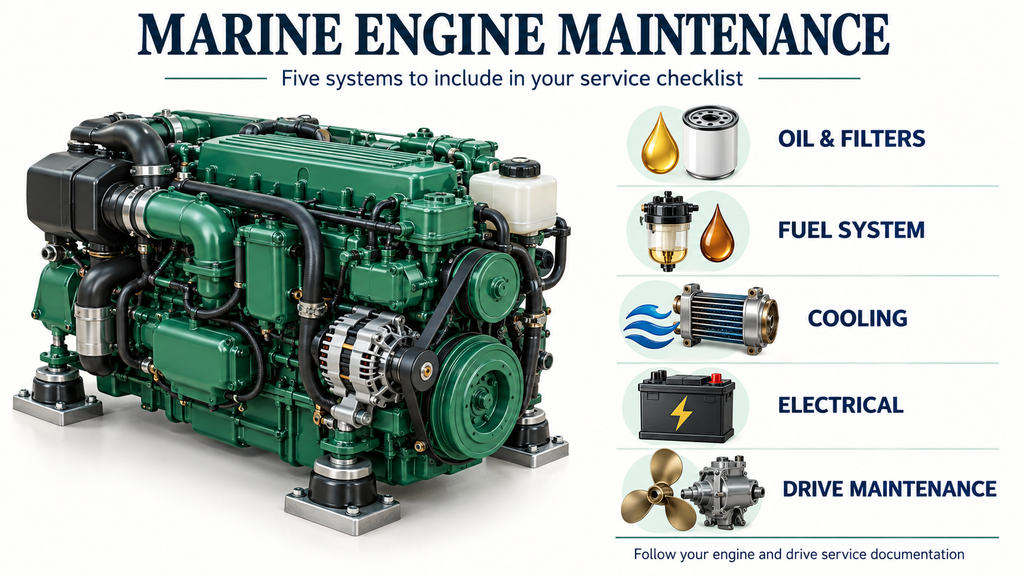
Once you have identified your equipment and recorded its deadlines, organize the work by system. This makes it easier to see what is included, what needs specialist attention, and what remains unfinished.
Your Volvo Penta maintenance schedule determines the required action and interval. The checklist below helps you organize those requirements; it does not create universal replacement deadlines.
| System | Items to account for, where fitted | What to record |
|---|---|---|
| Lubrication | Engine oil, oil filter, level and leak checks | Oil specification, filter reference, date and hours |
| Fuel | Engine filters, pre-filter, water separator, connections | Parts fitted, contamination findings, work performed |
| Cooling | Coolant, seawater strainer, impeller, hoses, coolers and applicable anodes | Products used, condition findings, inspection or replacement |
| Air and exhaust | Intake components, filters and exhaust connections | Condition, restrictions or damage found |
| Electrical and controls | Batteries, connections, charging and control equipment | Inspection or test results |
| Mounting | Engine mounts, fasteners and installation condition | Findings and corrective work |
Engine oil, oil filter, and lubrication
The correct Volvo Penta oil change interval comes from the documentation for your engine. Before servicing, confirm the required oil specification, filter reference, capacity, and filling procedure.
Oil selection involves more than viscosity. Two products with the same viscosity grade may meet different performance specifications. Match the requirements in the manual rather than relying on a “marine oil” label.
After the work, verify the level and inspect for leakage under the prescribed conditions. Record the oil product, quantity used, filter reference, date, and engine hours.
An oil change is routine maintenance. A low oil-pressure warning, unexplained oil loss, or suspected contamination requires assessment of the underlying problem. Do not assume fresh oil resolves the cause.
Fuel filters, water separation, and fuel-system condition
Identify the complete filtration arrangement. Your installation may have an engine-mounted filter and a separate pre-filter or water separator supplied as part of the boat’s fuel system.
Plan fuel filter replacement and water or contamination checks according to the applicable instructions. Confirm the correct elements, seals, and any installation-specific parts before opening the system.
If a problem began after refueling or filter replacement, record that sequence. It gives the technician a useful starting point without proving the cause.
Priming and bleeding procedures vary between engines. Do not apply an older mechanical diesel procedure to a common-rail system.
Leave high-pressure injection work to qualified personnel. If fuel is leaking, stop starting attempts and arrange appropriate assistance.
Seawater cooling and freshwater coolant circuit
A cooling checklist should account for both the seawater path and the freshwater coolant circuit.
Depending on the installation, relevant components can include the intake, strainer, seawater pump, impeller, hoses, coolers, heat exchanger, and exhaust-water injection point.
Confirm the Volvo Penta impeller replacement interval and inspection requirements for your equipment. If an impeller has lost vanes, replacing it may leave debris elsewhere in the circuit. The inspection needs to account for missing material.
For coolant, verify the specified product and concentration. Do not assume different formulations can be mixed safely. Check levels only under the conditions described in the manual, and never open a hot pressure cap.
Heat exchanger service should follow the applicable requirements and findings. Overheating can have several causes; it is not automatic proof that the heat exchanger or impeller needs replacement.
Belts, air intake, and exhaust components
Include the prescribed belt inspections, adjustments, and replacement tasks. Check the relevant belt arrangement rather than assuming every engine uses the same tensioning method.
For air intake servicing, establish whether your engine has a replaceable filter or another arrangement requiring attention.
Exhaust inspections should consider accessible hoses, connections, deterioration, and evidence of leakage. Work around hot exhaust components requires appropriate precautions.
Record abnormalities such as new belt noise, damaged hoses, or changed exhaust behavior. A visual observation helps direct further inspection, but it does not establish the condition of every internal component.
Electrical equipment, mounts, and controls
Include battery security, accessible connection condition, corrosion observations, and charging concerns in the service plan.
A lit helm display does not prove that a battery or starting circuit performs correctly under load. Repeated slow cranking deserves testing rather than repeated battery replacement without investigation.
Follow the documentation for mounts and fasteners. Do not casually tighten coupling or mounting components when the correct procedure is unknown.
Where fitted, Electronic Vessel Control (EVC) adds control and monitoring equipment to the installation. Record warnings before clearing them, and use suitable expertise for diagnostic interpretation or software work.
Service the Drive and Transmission Alongside the Engine
An engine service is only one part of propulsion maintenance. The associated transmission or drive needs its own applicable checklist.
Shaft-drive gearbox and driveline
For Volvo Penta gearbox maintenance, confirm the transmission model, lubricant specification, service interval, and level-check procedure.
Do not assume the gearbox takes the same oil as the engine.
Include applicable checks for leaks, couplings, mounts, and driveline condition. New vibration following a grounding, propeller strike, or installation work may require alignment and propeller assessment.
A gearbox fluid change will not correct a damaged propeller or misaligned shaft. Describe when the vibration occurs so the investigation starts in the right place.
Saildrive maintenance
A saildrive service plan should identify the exact drive and its requirements for lubricant, seals, corrosion protection, and the hull sealing arrangement.
Where a diaphragm is fitted, obtain its inspection and replacement requirements from the relevant documentation. Avoid choosing a deadline from a general online discussion.
Match sacrificial anodes to the drive and the manufacturer’s requirements. Do not select them solely by appearance.
Plan ahead for work that requires haul-out or specialist access. That makes the service scope clearer before the boat is lifted.
Aquamatic sterndrive maintenance
Aquamatic sterndrive maintenance may include lubricant, bellows, seals, anodes, trim, steering, and other drive-specific items.
Confirm which tasks apply to the installed model and which require the boat out of the water.
Do not assume acceptable external appearance confirms the condition of the lubricant or sealing system. Follow the prescribed inspection and testing procedures.
Keep the drive’s service history alongside the engine record so a completed engine service does not obscure overdue drive work.
IPS maintenance
Use the matching IPS service schedule for the installed package.
Account for the applicable lubrication, sealing, corrosion-protection, steering, and diagnostic requirements. Similar-looking equipment or comparable engine output does not justify transferring another drive’s intervals.
Record both engine and drive identification when arranging service. This helps the provider establish the equipment, documentation, and access needed for the job.
Volvo Penta describes its marine support network as covering the propulsion installation from helm to propeller, including service and specialist support.
What Changes Between Volvo Penta Engine Families?
D1 and D2 sailing auxiliaries
A Volvo Penta D1 maintenance schedule or D2 service interval search should lead back to the exact engine documentation.
Shaft-drive and saildrive packages may share engine tasks while requiring different propulsion maintenance. Confirm the engine generation, transmission or drive, and serial numbers before selecting parts.
Installation access matters too. A routine task becomes harder when filters or pumps are difficult to reach, so account for access when planning the service.
D4, D6, D11, and D13 diesels
A D4 maintenance checklist, D6 service schedule, or D11/D13 plan should reflect the actual engine, duty, controls, and propulsion arrangement.
Equipment can differ between generations and configurations. A service interval found for another engine in the same family may not apply to yours.
For commercial use, confirm the requirements associated with the installation and operating duty. Do not substitute a leisure-use assumption for the applicable instructions.
Gasoline engines and older installations
Gasoline engines have ignition and fuel-system considerations that differ from marine diesel preventive maintenance.
Use gasoline-specific procedures and safety instructions. Diesel troubleshooting advice should not be applied mechanically to a gasoline engine.
For older boats, compare documentation with the installed equipment. Replacement engines, changed controls, and modified filtration arrangements can make an old parts list incomplete.
Storage, Lay-Up, and Recommissioning
Prepare for seasonal or extended inactivity
Follow the applicable preservation instructions for the engine and associated equipment.
The plan may need to address fuel, cooling, lubrication, batteries, corrosion protection, and the drive. Do not reduce lay-up to a single additive or a brief engine run.
Record known faults before storage and arrange repairs where appropriate. Otherwise, recommissioning can begin with unresolved problems.
Adapt storage planning to the actual environment
Winterization addresses relevant cold-weather risks, but extended inactivity also matters in warm climates.
Storage duration, temperature, humidity, and whether the boat remains afloat affect planning. Use the manufacturer’s instructions for your circumstances.
Starting an engine occasionally is not a substitute for the prescribed preservation procedure.
Check the installation before returning to service
Follow the recommissioning instructions and review the service ledger for overdue tasks.
Confirm the installation is ready for operation, check for leaks under the prescribed conditions, and verify controls and engine behavior during a suitable, safe run.
Record anything unusual before a demanding trip. The goal is to return to service with known maintenance status and a clear operating baseline.
Plan the Work, Choose Compatible Parts, and Keep Reliable Records
Which Checks Can Owners Perform—and When Is Professional Service Needed?
Owner tasks depend on the manual and competence
The right question is: does the applicable manual permit this task, and can you complete it safely with the correct tools and instructions?
Recording hours, photographing warnings, and making permitted visual or fluid-level checks can provide useful information without dismantling equipment. Servicing a pressurized system or adjusting a driveline requires a different level of knowledge.
Before starting, read the entire procedure, including preparation, isolation, safety precautions, and verification afterward. Check any requirements that apply during the warranty period.
If you cannot access a component safely or verify that the work was completed correctly, arrange professional support. An unfinished procedure can leave the installation less reliable than before.
Tasks requiring specialist skills or equipment
High-pressure fuel-system work, diagnostic interpretation, driveline alignment, and complex drive servicing require suitable training and equipment.
A technician should connect the proposed repair to the inspection or test results. For example, an oil-pressure warning may require actual pressure verification before a sender is replaced. A vibration complaint may require an assessment of the mounts, coupling, shaft, or propeller.
Volvo Penta recommends servicing through an authorized dealer and explains that its maintenance schedule identifies which tasks owners may perform during the warranty period. Confirm the appropriate provider for manufacturer-specific or warranty-related work.
Owner observations help establish urgency and preserve evidence. Professional testing establishes what work is needed when the cause remains uncertain.
Prepare the Right Parts and a Clear Service Request
Verify service-kit contents and fluid specifications
Before buying a Volvo Penta service kit, compare its contents with every task due on your ledger.
Confirm the engine model, serial number, applicable parts references, and any separate drive requirements. Check whether seals, fluids, installation-specific filters, or other consumables must be ordered separately.
A complete order should identify:
| Item | What to verify |
|---|---|
| Filters | Correct application and current part reference |
| Impeller and associated seals | Compatibility with the installed pump |
| Engine oil | Required specification and quantity |
| Coolant | Approved type and applicable concentration |
| Transmission or drive lubricant | Exact equipment requirement |
| Anodes | Correct application and manufacturer requirements |
| Additional components | Whether the scheduled work or inspection findings require them |
For genuine Volvo Penta parts, confirm the product identity and supply details. If an alternative component is proposed, establish compatibility and any relevant warranty implications before purchase.
Appearance alone is not enough. A filter that screws into place may still be unsuitable for the application.
Give MSS Motorsports the details needed for a quotation
A useful enquiry tells the service or parts provider what is installed, what is due, and when you need it.
Send the engine and drive identification plates, current hours, recent service records, required tasks, and any symptoms. Include installation photographs if access or configuration may affect the work.
Explain whether you need scheduled maintenance, parts only, or an assessment of a fault. State your preferred service date or how soon you intend to purchase.
For an official parts quotation, provide the billing and delivery addresses. Confirm the service location, scope, exclusions, availability, freight costs, and lead time before making arrangements.
MSS Motorsports lists scheduled maintenance, diagnostic support, and parts sourcing on its website. Its parts process describes compatibility checks using the manufacturer, model, serial number, and applicable parts references.
Use the Service & Maintenance page for service enquiries and Parts & Accessories for component requests. Confirm the support available for your equipment and location.
Volvo Penta Maintenance Schedule FAQs
How often should a Volvo Penta marine engine be serviced?
Follow the maintenance schedule for the exact engine and associated propulsion equipment. Track operating hours and elapsed time, applying the interval instructions in the relevant document.
An annual visit may complete several tasks, but it does not automatically satisfy every requirement. Check what was performed against the full schedule.
Does a low-hour engine still need calendar-based maintenance?
Yes, where the applicable schedule specifies calendar deadlines. Low usage does not cancel those requirements.
Record the date and engine hours for each completed task. That lets you track the next deadline without assuming the hour meter tells the whole story.
Where can I find my exact Volvo Penta maintenance schedule?
Use your engine model and serial number to locate the applicable documentation through Volvo Penta’s engine information resource.
Identify the transmission or drive separately where necessary. Volvo Penta provides access to operator manuals, service protocols, and related product information through this resource.
What is the correct Volvo Penta oil change interval?
The correct Volvo Penta oil change interval is specified in the documentation for your engine and applicable operating conditions.
Confirm the oil specification, filter, and interval together. Do not transfer an interval from another model or extend it simply because the oil looks clean.
How often should a Volvo Penta seawater impeller be replaced?
Follow the Volvo Penta impeller replacement interval or inspection requirement specified for the exact equipment.
Damage, reduced cooling performance, or other symptoms may require assessment before scheduled work is due. If vanes are missing, the inspection should account for possible debris farther along the seawater circuit.
Do the engine and drive have separate service requirements?
Yes, associated equipment can have maintenance requirements beyond the engine schedule.
A gearbox, saildrive, Aquamatic drive, or IPS package may need its own lubricant, corrosion-protection, sealing, and inspection tasks. Keep the relevant documentation together and record completion for each component.
Does a Volvo Penta service kit include everything needed?
Do not assume so. Compare the kit contents with the actual service scope.
Fluids, drive parts, installation-specific filters, adjustments, diagnostics, and verification may be outside the package. The tasks due determine the parts required; the kit contents should not determine the entire service plan.
Can I service my Volvo Penta engine myself?
That depends on the procedure, manual instructions, warranty requirements, competence, and tools available.
Perform only work you can complete safely and verify correctly. Volvo Penta recommends authorized-dealer servicing; check the applicable instructions before deciding who performs each task.
What should I do if a used boat has incomplete service records?
Identify the installed equipment, gather available invoices, and compare the documented work with the applicable schedule.
Ask a suitable service provider to assess unknown maintenance status and establish a written plan. Do not assume every item is current—or automatically replace every component—without considering the evidence and manufacturer requirements.
Record the resulting work clearly so future decisions have a reliable starting point.
Conclusion: Keep Every Service Task Identified, Scheduled, and Recorded
A useful Volvo Penta maintenance schedule connects the correct equipment documentation with clear deadlines, compatible parts, and evidence of completed work.
Identify the engine and propulsion package. Track hours and calendar limits. Preserve the difference between inspection and replacement. Record what was done, and treat new alarms or abnormal symptoms as additional assessment needs.
The MSS Service Ledger helps organize those decisions, while the manufacturer’s documentation supplies the technical requirements.
For maintenance support or compatible parts, contact MSS Motorsports with your engine and drive identification, current hours, service history, and required timeline. Include billing and delivery addresses for a parts quotation so compatibility, scope, and delivery terms can be confirmed.
