
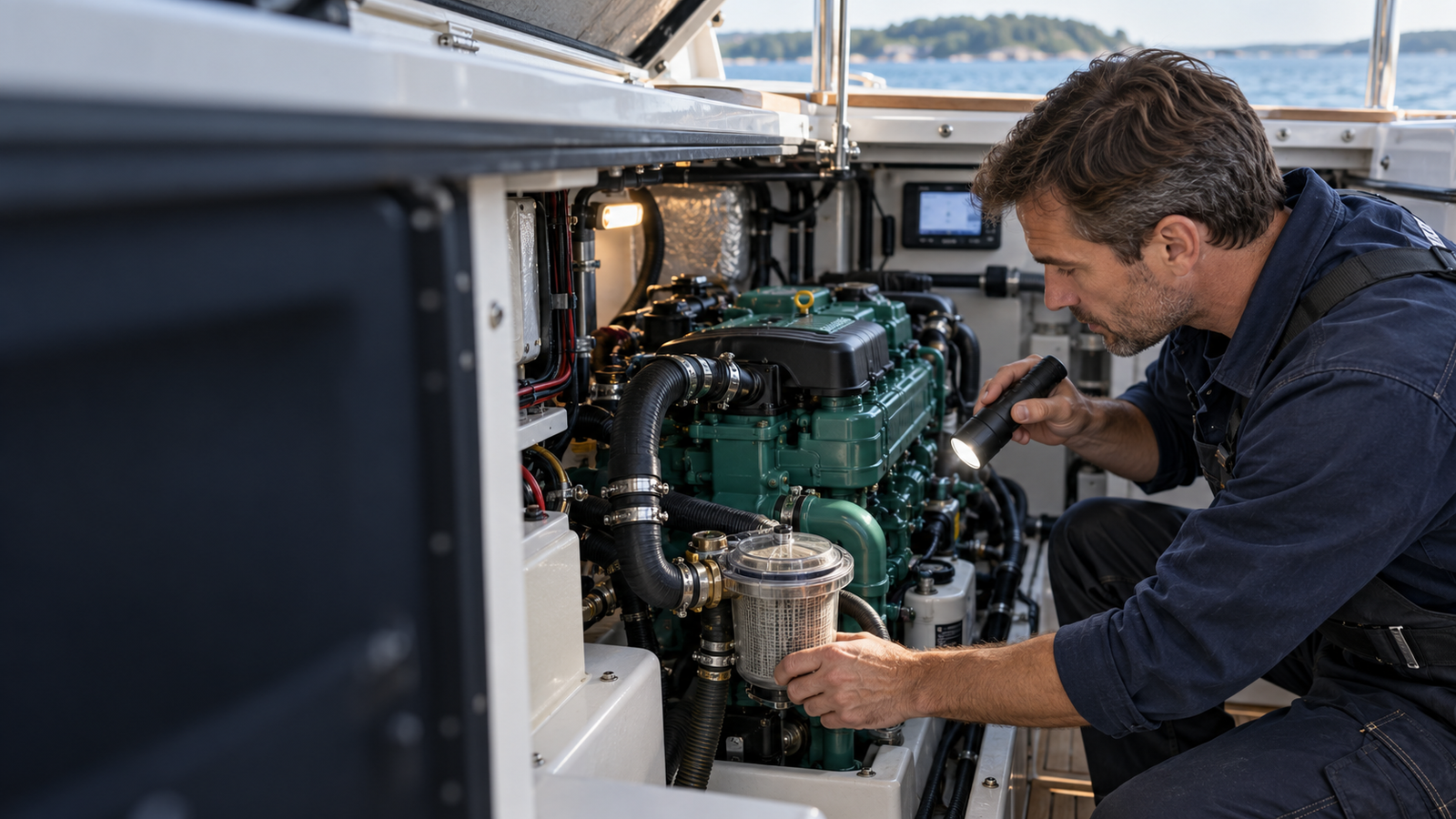
Imagine leaving the marina with a Volvo Penta engine that sounds perfectly normal. Ten minutes later, the temperature climbs whenever you increase speed. Back at idle, it settles down. It is tempting to search for an impeller and order one immediately.
If I were helping you describe that problem to a technician, I would start with two details: the temperature rises under load and it falls at idle. Then I would ask what happened to the water discharge, whether an alarm appeared, and what changed since the last normal trip. Those observations do not diagnose the engine, but they give the investigation a useful starting point.
That dockside scene is illustrative, not a customer case. The principle behind it is practical: a warning sign tells you where to investigate; it does not tell you which part to buy.
Quick answer: Common Volvo Penta engine problems can show up as overheating, an oil-pressure warning, difficult starting, power loss, abnormal smoke, vibration, fluid leaks, or an EVC alarm. First decide whether it is safe to keep the engine running. Then record the exact symptom, when it occurs, and any accompanying change. Use the operator’s manual for your engine to interpret its warnings and permitted owner checks.
This guide covers both diesel and gasoline engines. It also distinguishes the engine from the equipment attached to it: a shaft gearbox, saildrive, Aquamatic sterndrive, or IPS system can affect what you experience at the helm.
Quick answer: What should you check first?
| Warning sign | First useful observation | Priority |
|---|---|---|
| Low oil-pressure alarm | Record the warning; after a safe shutdown, check for an obvious leak and follow the manual’s oil-level procedure | Stop and investigate |
| Temperature rising | Note whether it happens at idle or under load, and whether exhaust-water discharge changed | Follow the alarm instructions; stop if it persists |
| No crank | Note whether the display dims, the starter clicks, and the control is in neutral | Avoid repeated starting attempts |
| Cranks but will not start | Note recent fueling or service, fuel level, and any warning message | Separate fuel, electrical, and control checks |
| Loss of speed or RPM | Record engine RPM and vessel speed together, plus smoke, temperature, and alarms | Reduce load and investigate |
| New vibration, leak, or loss of control | Note when it began and what else changed | Stop for severe symptoms or unreliable control |
The table is a triage aid. A technician still needs evidence to confirm the cause.
Before troubleshooting: identify the engine and protect the vessel
When to stop the engine and seek assistance
Stop as soon as it is safe to do so if you have a low oil-pressure alarm, severe overheating, a significant fuel leak, heavy metallic knocking, major coolant loss, severe vibration, or unreliable propulsion control. Your position on the water matters: take the steps needed to protect the vessel and people aboard, and contact local marine rescue services in an emergency.
Do not open a hot cooling system or put your hands near a running belt, shaft, or drive. Do not loosen high-pressure diesel injection lines or repeatedly restart an engine to see whether a serious warning disappears. Volvo Penta’s support guidance points owners to the operator’s manual for alarm responses and fault tracing specific to their engine.
Record the details that change the diagnosis
Take a clear photograph of the engine identification plate and, if applicable, the drive or gearbox plate. Record the engine hours, exact alarm text, displayed temperature, RPM, vessel speed, recent work, and whether the fault appears cold, hot, at idle, in gear, or under load.
This is more useful than saying, “My Volvo Penta is losing power.” Compare these descriptions:
“The boat feels slow.”
“The engine reaches its usual RPM, but the boat is slower than last month under a similar load.”
The second description gives a technician a reason to assess the hull, propeller, and drive alongside the engine. Record an existing safe observation; do not run the boat at high speed to recreate an unsafe fault.
Volvo Penta identifies the serial number as the key to finding the correct manuals and product information. It also helps avoid ordering a component for the wrong engine generation.
Keep model families separate
A D1 sailboat auxiliary, a D6 diesel used in a cruiser, and a gasoline V8 sterndrive have different systems and service procedures. A shaft-drive engine can have a healthy engine but a gearbox or propeller problem. An Aquamatic or IPS installation adds other drive and control components to the investigation.
Do not assume that every helm displays the same Volvo Penta EVC fault information. Volvo Penta’s compatibility guidance distinguishes EVC generations and engines without EVC; diagnostic-code availability differs. Identify the engine, controls, and drive before interpreting a message.
The MSS Paired Evidence Method: check two signals before choosing a part
This framework organizes information for a service request. It is not a Volvo Penta test procedure, and it does not replace measurements by a qualified technician.
Pair the symptom with its operating condition
When does it happen? “Hot only above cruising RPM” is different from “hot immediately after startup.” “Hard to start after sitting overnight” is different from “hard to restart when warm.” Record the pattern without trying to force the fault to appear again.
Pair engine data with boat behavior
An engine problem and a boat problem can feel alike at the helm. Compare engine RPM with vessel speed under reasonably similar conditions. If the boat slows, note hull condition, recent propeller work, loading, and any change in vibration. Those facts help determine where a technician should look first.
Pair an alarm with a physical observation
Save the exact alarm text. Then note what you can see or measure safely: a falling fluid level, visible leak, changed water discharge from a water-injected exhaust, smoke, or unusual sound. An alarm identifies a condition requiring attention; it does not, by itself, confirm a failed sensor or component.
Pair the finding with the correct model and serial number
A useful handoff follows this order: observed symptom → exact engine and drive identification → appropriate inspection or test → confirmed repair recommendation. MSS Motorsports describes troubleshooting and cooler service among its services. Providing these details helps the team assess the request before quoting parts or work.
12 Volvo Penta warning signs, likely causes, and first checks
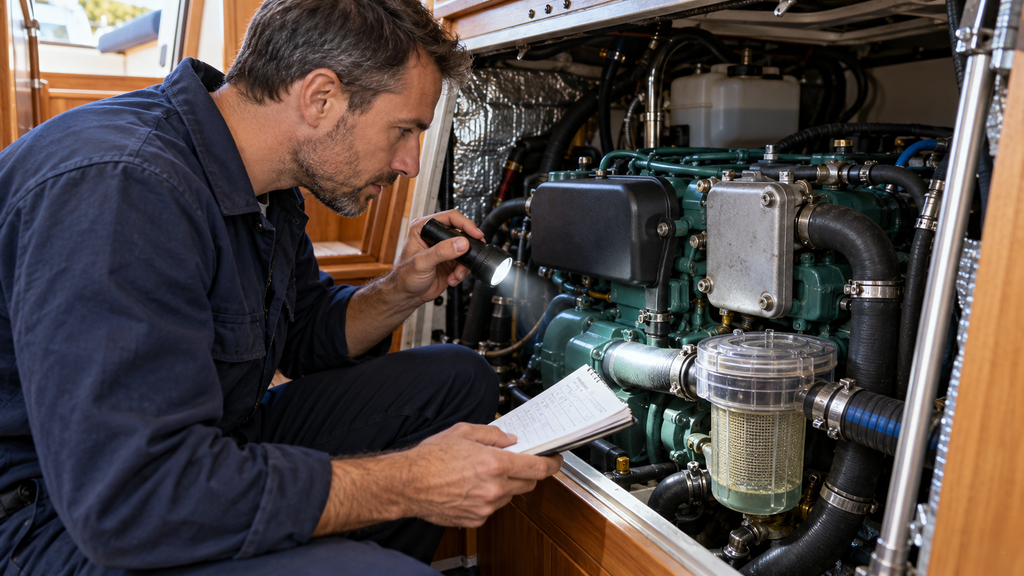
1. Low oil-pressure warning or an unexpected pressure drop
A low oil-pressure alarm calls for action because the engine depends on adequate lubrication. A faulty sender is possible, but so is a real pressure loss. The display alone cannot safely distinguish them.
What to check first: Stop the engine as soon as it is safe. Record the alarm, RPM, and temperature. Once shut down, follow your manual’s oil-level procedure and look for an obvious external leak. If oil is escaping or the level is unexpectedly low, do not restart the engine to “check again.”
A technician can measure actual pressure and investigate the lubrication system or its sender based on the result. Buying a new sensor before that test could leave a genuine oil-pressure problem unresolved.
2. Coolant temperature rising or an overheat alarm

Volvo Penta overheating may involve the seawater supply, coolant circulation, heat transfer, or the load placed on the engine. The timing helps narrow the possibilities. Does the temperature rise quickly at idle, only during acceleration, or after sustained cruising?
What to check first: Reduce load and follow the manual’s alarm instructions. Note the temperature trend and any change in discharge from a water-injected exhaust. After a safe shutdown and sufficient cooling, follow the manual when checking accessible coolant level or the seawater strainer.
A blocked intake, damaged impeller, cooling-system leak, restricted heat exchanger, or excessive load may need investigation. These are possible causes, not a diagnosis. Never open the pressure cap on a hot engine. If the temperature continues to climb, stop operating rather than trying to complete the trip under load.
3. Reduced wet-exhaust water flow, steam, or an unusually hot exhaust
On an installation with a water-injected exhaust, a noticeable drop in water discharge can point toward a raw-water flow problem. Steam or an unusually hot exhaust area makes the observation more urgent, even if the coolant gauge has not yet risen.
What to check first: Note when the change began, whether there is a temperature warning, and whether the seawater intake or strainer has recently been serviced. Shut down safely before anyone inspects the system. The seawater route may include the intake, strainer, pump, coolers, heat exchanger, and exhaust injection point; its exact arrangement depends on the model.
Do not touch a hot hose or assume that fitting a new impeller completes the repair. If an impeller has lost vanes, the missing pieces may have moved downstream. A proper inspection needs to establish both the cause of reduced flow and where any debris went.
ork, storage, or an earlier overheat. Report whether it never fires or briefly starts and stops; that distinction helps. Look for an obvious fuel leak from a safe position.
Stop attempting to start if you suspect leaking fuel. Leave high-pressure diesel injection work and gasoline fuel-pressure or ignition testing to a qualified technician. The exact Volvo Penta manual for your engine should guide any owner-level starting checks.
6. Rough idle, hesitation, or stalling
Rough running is a description of how the boat feels and sounds, not a diagnosis. An uneven engine, an irregular fuel supply, a control issue, or vibration transmitted through a mount or drive can produce complaints that sound similar over the phone.
Ask when it happens. Is idle rough only when cold? Does the engine hesitate as you accelerate? Does it stall after warming up, or only when you engage gear? Did it begin after fueling, maintenance, or an electrical repair?
What to check first: Record the pattern and any smoke, alarm, temperature change, or unusual smell. If the engine runs smoothly in neutral but shakes or stalls as the drive is engaged, include the gearbox, drive, propeller, and vessel load in the assessment. If it is uneven in neutral as well, fuel, air, combustion, and model-specific controls become more relevant lines of investigation.
Do not keep maneuvering in confined water with an engine that repeatedly stalls. Secure the boat and arrange an assessment.
7. Loss of power or failure to reach expected RPM under load
“My Volvo Penta has lost power” can describe at least two situations. The engine may be unable to make its usual power, or the boat may require more power than before to reach its usual speed.
On the engine side, a technician might investigate fuel restriction, air or exhaust restriction, turbocharger performance where fitted, and a protective reduction in output associated with a fault. On the boat side, hull fouling, propeller damage or mismatch, excessive loading, and driveline resistance deserve attention. These are possibilities to test, not a list of parts to replace.
What to check first: If the engine can be operated safely, record RPM, vessel speed, temperature, smoke, and alarms at a normal, moderate operating point. Compare with an earlier trip only if loading and conditions are reasonably similar. Note a recent propeller strike, bottom work, fuel-filter change, or new warning.
The paired evidence matters. A boat that loses speed while engine RPM remains close to its usual value calls for a different investigation from an engine that struggles to reach RPM and produces smoke. Avoid a wide-open-throttle test when the engine is hot, alarming, vibrating heavily, or otherwise unsafe.
Direct answer: Loss of power under load does not prove injector failure. Confirm whether the engine, drive, propeller, or hull is responsible before ordering expensive components.
8. Unusual exhaust smoke
Record the smoke’s color, how long it lasts, and when it appears: startup, idle, acceleration, or sustained load. Also record changes in oil or coolant level, temperature, and engine behavior. Smoke color helps frame questions, but color alone cannot identify the failed component.
Black smoke
On a diesel, persistent black exhaust smoke can accompany an air-to-fuel imbalance or excessive load. The investigation may include the air path, turbocharger operation on fitted models, exhaust restriction, fuel delivery, hull fouling, and propeller load. Note whether smoke appears only during acceleration or continues at steady speed.
Do not buy injectors solely because you see black smoke. The same observation can arise when the engine is working against an abnormal load.
White smoke
A brief white-looking plume on a cold, damp morning may behave differently from dense smoke that persists after warm-up. If it continues alongside rough running, difficult starting, falling coolant level, or rising temperature, have the engine assessed promptly.
Tell the technician whether the plume disappears as the engine warms and whether it has a distinct smell. Avoid assuming every white plume is coolant or every cold-start plume is harmless.
Blue smoke
Persistent blue smoke may indicate oil entering the combustion process. Check whether the oil level has been falling using the procedure in your manual, and note whether smoke appears mainly at startup, idle, or under load. Inspection is needed to establish the source.
These color descriptions are most useful when discussing diesels. Gasoline engines have different combustion and emissions equipment, so their exhaust symptoms need the correct model-specific interpretation.
9. Fuel consumption rises at a comparable speed and load
A surprising fuel bill is a reason to look at your records. It is not proof that the engine has developed a mechanical fault. Current, wind, passenger load, hull condition, propeller condition, and how the boat was operated can all affect a trip.
What to check first: Compare fuel used, distance, RPM, and speed across trips with similar conditions. Note any recent hull cleaning, propeller replacement, service work, smoke, temperature change, or inability to reach normal RPM. If your instrumentation provides fuel data, keep its limitations and the way it was measured in mind.
Direct answer: Rising fuel use alongside black smoke and falling performance strengthens the case for an engine-and-load investigation. Rising fuel use with a slower boat but otherwise familiar engine behavior also warrants a hull and propulsion check. A small operating log gives MSS Motorsports or your technician a sounder starting point than a single unusually expensive journey.
10. New vibration, knocking, grinding, or whining
A new sound or vibration is a warning sign, even if the engine still reaches its usual RPM. The useful first question is when does it happen?
A vibration at idle in neutral may point toward an engine running problem or a loose mounting component. A vibration that begins only when you engage gear may involve the marine gearbox, shaft, coupling, propeller, saildrive, sterndrive, or IPS drive. A noise that changes during a turn may provide another clue about the drive or steering system. These patterns help narrow the search; none identifies a failed part on its own.
What to check first: Reduce power and find a safe place to stop. Note whether the symptom occurs in neutral, ahead, astern, or during turns. If you can do so from a safe position, record a short video with the engine speed and operating condition. Never reach near a rotating shaft or moving belt to locate a noise.
A sharp knock, grinding sound, or severe vibration calls for prompt shutdown once the vessel is safe. Continued operation could turn a repairable driveline fault into wider damage. Ask a marine technician to inspect the installation before another loaded run.
11. Oil, coolant, fuel, or seawater where it should not be
A small stain can tell you about a leak before a gauge or alarm does. But fluid in the bilge does not always come from the component directly above it; hoses, engine angles, and movement can carry it elsewhere.
What to check first: Once the engine is off and safe to approach, photograph the fluid and the surrounding area before wiping anything away. Record its apparent color, location, and rate of accumulation. Check accessible fluid levels only as your operator’s manual directs. Do not open a hot cooling-system cap or touch a pressurized fuel line.
Treat a fuel leak, rapidly increasing fluid level in the bilge, or active seawater entry as urgent. Shut down when safe, follow the vessel’s fire and bilge procedures, and get qualified help. A technician can trace the actual source and determine whether a hose, seal, cooler, pump, or another component needs attention.
12. EVC warning, reduced-power mode, or shifting trouble
On equipped engines, Electronic Vessel Control (EVC) links engine information with controls and other propulsion functions. An alert may be accompanied by limited power, unusual throttle response, or trouble engaging gear. The display message is valuable evidence, but it does not automatically prove that the component named in a warning has failed.
What to check first: Record the exact message, alarm color, engine hours, and what happened immediately before the warning. Note whether the fault affects one engine or both in a twin-engine installation. Include the engine and drive identification when requesting help. Volvo Penta EVC generations and display capabilities vary, so follow the operator’s manual for your particular system.
If you lose reliable control of propulsion or shifting, focus on bringing the vessel to safety. Arrange a diagnostic inspection before using it again. A shaft-drive boat, an Aquamatic sterndrive, and an IPS installation may require different checks, even when the helm displays a similar symptom.
What an owner can observe—and what needs a marine technician
Useful owner-level observations
You can make a service visit more productive without dismantling the engine. Write down the symptom in plain language, then add the conditions that make it appear: cold start or warm engine, idle or load, neutral or in gear, calm water or a rough passage.
Record engine hours, RPM, temperature readings, alarm text, and the approximate time the issue began. Photograph the engine identification plate, visible leaks, and any relevant display. If the manual allows an accessible visual or fluid-level check after shutdown, record what you found. A service history and the date of the last filter, impeller, coolant, or drive service can also help.
Use the Paired Evidence Method from Part 1: match an engine reading with a second observation. “The temperature rose under load and exhaust water flow looked weaker than usual” gives a technician more to work with than “the engine overheats.”
Checks to leave to a qualified technician
Some questions need instruments, training, or access to moving and pressurized systems. These include verifying actual oil pressure, measuring cooling-system performance or fuel pressure, interpreting fault data in context, and testing compression or turbocharger boost. A vibration complaint may also require inspection of propeller condition, couplings, mounts, and alignment.
The point of an owner’s first checks is to identify urgency and preserve evidence. A sound diagnosis should explain why the proposed repair fits both the symptom and the test result.
Repair, rebuild, or repower?
Repair when the fault is isolated and confirmed
A repair makes sense when testing identifies a specific fault and the rest of the installation is in reasonable condition. For example, a confirmed cooling-system restriction should lead to a cooling-system remedy, with a follow-up check under the conditions that originally caused the overheating. Replacing several plausible parts without confirming the cause can cost more while leaving the problem in place.
Ask the service provider what was tested, which parts are included, and how the result will be verified. If a failed component caused secondary damage, include that in the repair scope.
Assess a rebuild when internal condition is the real question
A rebuild deserves consideration when testing points to significant internal wear or damage and the engine package is otherwise worth retaining. Request a written scope: which components will be measured, machined, renewed, or reused? Ask about parts availability, warranty terms, labor, and expected downtime.
An estimate built before disassembly may change when hidden damage becomes visible. Make room for that uncertainty when comparing it with replacement.
Compare repower costs across the whole installation
A Volvo Penta repower becomes a serious option when several major repairs are approaching, suitable parts are difficult to obtain, or the existing engine and drive no longer suit the boat’s use. Compare the installed project cost, not only the price of the replacement engine.
That comparison may need to account for the engine’s duty rating, dimensions and weight, mounts, gearbox and reduction ratio, propeller, exhaust, cooling connections, wiring, controls, and display compatibility. Sterndrive and IPS projects bring their own drive and integration requirements. Confirm what the package includes before assuming existing components can be retained.
MSS Motorsports UG lists marine inboard engines and offers service and maintenance support. Share your vessel and existing propulsion details when comparing repair with replacement so the quotation addresses the complete installation.
Preventive checks that make future faults easier to identify
Good maintenance does more than reduce the chance of a breakdown. It gives you a baseline, making a change in temperature, exhaust flow, starting behavior, or fuel use easier to spot.
Start with the Volvo Penta manual and service protocol for your exact engine. Service points and intervals differ by model and installation. Depending on the package, scheduled work may cover engine oil and filters, fuel filtration, coolant, the seawater strainer and impeller, belts, anodes, and drive or transmission servicing.
Keep a simple log with dates, engine hours, work performed, parts used, and readings taken during normal operation. After a service, check for leaks and confirm that the engine behaves normally on a suitable run. If a fault appears later, that record helps distinguish a new issue from a long-developing one.
Frequently asked questions
What are the first signs of a Volvo Penta engine problem?
Common early signs include harder starting, unusual alarms, rising temperature, reduced exhaust water flow, new vibration, changed smoke, and a loss of power under load. Record when each symptom occurs and compare it with your boat’s normal readings. Stop when an alarm or symptom indicates immediate danger.
Why does my Volvo Penta overheat only under load?
Under load, the engine produces more heat. A cooling restriction or reduced heat transfer may become visible only then. A fouled seawater intake, strainer, impeller, heat exchanger, or another cooling-system fault is possible. Check what you can safely observe, then arrange a proper diagnosis before another hard run.
Why does the engine run but the boat move slowly?
The engine and vessel may be telling different stories. Compare actual engine RPM with the boat’s usual speed under similar load and conditions. Hull or propeller fouling, propeller damage, driveline trouble, and an engine that cannot reach its expected RPM can each produce poor performance. The RPM pattern helps direct the next inspection.
Does an EVC alarm prove the named part has failed?
No. An EVC warning reports a detected condition or system fault; the cause still needs diagnosis. Record the complete warning and the conditions in which it appeared. The engine model, serial number, and EVC generation help a technician interpret the information and choose the right tests.
Can a dirty hull or damaged propeller feel like engine trouble?
Yes. Added hull resistance or an inefficient propeller can reduce boat speed and change how heavily the engine is loaded. Inspect these possibilities when speed falls, especially if the engine otherwise runs normally. If it also cannot reach its expected RPM, investigate the engine and propulsion system together.
Are the first checks the same for diesel and gasoline engines?
The safety priorities are similar: respond to serious alarms, avoid leaks and moving parts, and record the symptom. The likely causes and service tests differ. A diesel fuel-delivery problem and a gasoline ignition problem may both produce a no-start or misfire complaint. Use the manual for the exact engine before following a troubleshooting path.
How do I find the correct manual and replacement parts?
Find the engine’s model and serial number on its identification plate, then use Volvo Penta’s engine information page to locate the applicable manual and service information. Record the drive or transmission details as well. For replacement parts, verify compatibility against the exact configuration before ordering.
When should I consider replacing the engine instead of repairing it?
Consider replacement when a confirmed repair is extensive, several major systems need work, downtime is costly, or parts availability makes the existing installation hard to support. Compare a written repair estimate with a complete repower quotation, including the drive, controls, installation work, and any components that cannot be reused.
Conclusion: turn symptoms into a useful service request
Common Volvo Penta engine problems become easier to address when you separate the warning sign from its possible cause. Protect the vessel first. Then record what happened, when it happened, and what a second observation tells you. That small amount of evidence can prevent an expensive guess.
If you need help assessing a fault, sourcing a part, or comparing a repair with a replacement package, contact MSS Motorsports UG. Send the engine model and serial number, drive or gearbox details, engine hours, exact alarm text, photos where useful, service history, and the conditions that bring on the symptom. Those details help turn “something is wrong” into a productive next step.
