
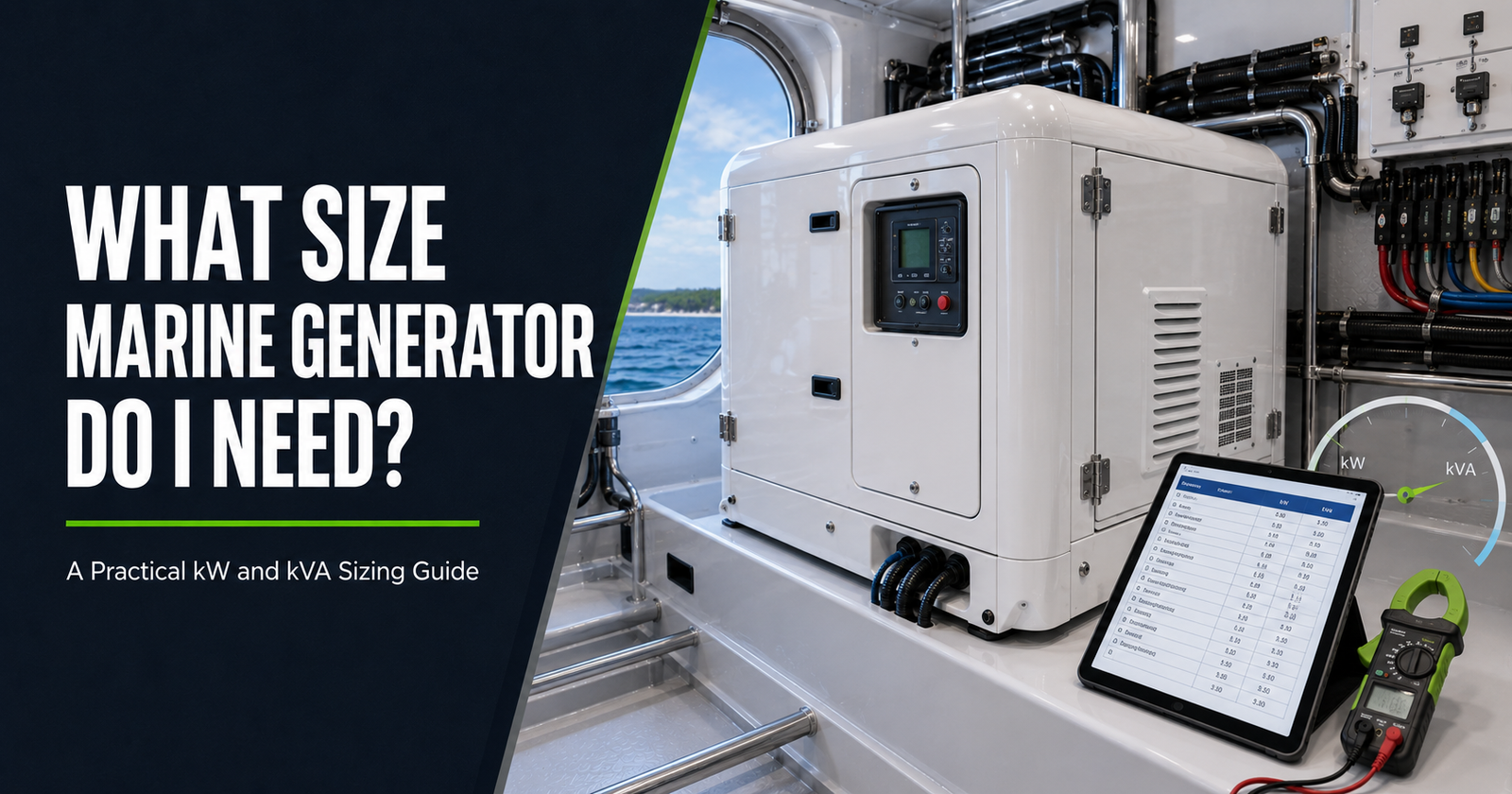
A typical marine generator enquiry begins like this:
“I have a 45-foot yacht. What size generator do I need?”
It sounds like a straightforward question, but vessel length does not tell us enough. Two 45-foot yachts can have completely different electrical demands. One might need power for battery charging, refrigeration and a few domestic appliances. The other may have multiple air-conditioning compressors, a watermaker, electric cooking, a water heater and several pumps operating throughout the day.
The correct question is not simply, “What size marine generator do I need?”
It is:
“What electrical loads must the generator support, which of them will operate simultaneously, and what happens when the largest motor starts?”
That distinction matters. A generator can support the normal running load and still struggle when an air-conditioning compressor starts. It can also be unnecessarily oversized, leaving the diesel engine operating under a light load for long periods.
This practical marine generator sizing guide explains how to calculate running demand, starting demand, kW, kVA and power factor before comparing generator models.
It is designed for yacht owners, boatbuilders, fishing-vessel operators, commercial buyers and anyone planning a new installation or replacing an existing marine generator.
Why Vessel Length Cannot Determine Generator Size
Vessel length is useful background information, but it is not a load calculation.
A 40-foot sailing yacht may need a compact generator primarily for battery charging, refrigeration and occasional air conditioning. A 40-foot charter boat could require continuous air conditioning, hot water, galley power and entertainment systems. A fishing boat of the same length might need pumps, freezers, deck lighting and other working loads.
The vessel’s electrical demand depends on:
- The number and type of connected loads
- Their running power
- Their starting requirements
- Which loads operate simultaneously
- Daily generator operating hours
- Voltage, frequency and phase
- Load-management arrangements
- Ambient operating conditions
- The generator’s transient performance
Boat length can help identify the general application, but it should never be used as the primary method of sizing a marine generator for a boat.
Marine Generator Sizing Is About More Than Total Watts – What Size Marine Generator Do I Need
A proper calculation considers two operating conditions.
Steady-state demand
This is the electrical power required after all intended appliances and systems are running normally.
Examples include:
- Lighting
- Battery chargers
- Water heaters
- Cooking appliances
- Refrigerators
- Electronics
- Air-conditioning compressors after startup
- Pumps after startup
Transient demand
This is the short but substantial demand created when a motor, pump or compressor starts.
A generator may have enough continuous output for the steady-state load but insufficient transient capacity to start the largest motor without excessive voltage or frequency drop.
Cummins explains in its official generator sizing guidance that load characteristics and motor-starting requirements are important parts of generator selection. Rehlko’s technical guide also explains why motor starting kVA cannot be evaluated by simply matching a motor’s headline kVA to the generator’s continuous rating.
The lesson is simple: total running watts are only the beginning.
Step 1: Create a Complete Electrical Load List
Start by listing every AC load the generator may be expected to supply.
Do not rely on memory. Walk through the vessel compartment by compartment and record the actual electrical information from labels, manuals or technical sheets.
Your list may include:
- Air-conditioning compressors
- Refrigerators and freezers
- Battery chargers
- Inverter-chargers
- Water heaters
- Watermakers
- Electric cooking appliances
- Microwaves
- Coffee machines
- Washing machines
- Ice makers
- Bilge pumps
- Freshwater pumps
- Hydraulic pumps
- Deck machinery
- Navigation systems
- Communication systems
- Lighting
- Entertainment systems
- Workshop tools
- Commercial refrigeration
- Passenger-service loads
For each load, record:
- Description
- Quantity
- Voltage
- Phase
- Running watts
- Running amperage
- Starting watts or current
- Power factor, if stated
- Expected operating time
- Whether it may run with other major loads
This becomes your marine generator load worksheet.
Use manufacturer data whenever possible
Do not estimate from a similar appliance if the actual nameplate information is available.
Two air-conditioning units of similar cooling capacity may have different running current, locked-rotor current or inverter technology. The difference can materially affect generator selection.
When specifications are missing, a qualified marine electrician may need to measure current under controlled operating conditions.
Step 2: Separate Resistive and Motor-Driven Loads
Not all electrical loads behave the same way.
Resistive loads
Resistive loads generally convert electrical power into heat. Examples include:
- Water heaters
- Electric cooktops
- Kettles
- Toasters
- Certain lighting systems
Their starting demand is usually close to their normal running demand.
A 1.5 kW water heater normally adds approximately 1.5 kW while its heating element is energised.
Motor-driven loads
Motors and compressors can require substantially more power during startup.
Examples include:
- Air conditioners
- Refrigeration compressors
- Pumps
- Hydraulic motors
- Watermakers
- Freezers
- Certain deck systems
The short-duration starting demand may be described as:
- Starting current
- Starting watts
- Locked-rotor amps
- LRA
- Inrush current
- Starting kVA
This starting demand can create a temporary voltage and frequency dip.
Electronic and nonlinear loads
Modern vessels may also have inverter-chargers, variable-speed drives, switch-mode power supplies and other electronic loads.
Their impact cannot always be understood from simple wattage alone. Harmonic current, power factor and charging behaviour may influence generator and alternator selection.
If a large portion of the vessel’s demand comes from chargers, drives or sensitive electronic systems, the application should be reviewed using the manufacturer’s technical data.
Step 3: Calculate the Running Load
The running load is the sum of the loads expected to operate simultaneously.
The key word is “simultaneously.”
If every listed appliance will never operate at the same time, adding every watt can produce an unnecessarily large result. But removing loads simply because they operate intermittently can underestimate real demand.
Ask practical questions:
- Can both air-conditioning compressors run together?
- Can the water heater operate while cooking?
- Does the battery charger automatically draw maximum input after starting the generator?
- Can the watermaker operate while the air conditioning is running?
- Are refrigeration compressors likely to cycle at the same time?
- Are any major loads manually controlled?
- Does the vessel have automatic load shedding?
- Can large loads be started in sequence?
A useful worksheet should distinguish between:
- Continuous loads
- Intermittent loads
- Essential loads
- Nonessential loads
- Loads that can be delayed
- Loads that must start automatically
Do not confuse connected load with expected demand
Connected load is the total rating of everything connected to the system. Expected demand is the realistic combination likely to operate at one time.
Both values are useful, but they answer different questions.
Connected load shows the maximum theoretical demand. Expected simultaneous demand helps identify the generator’s likely steady-state requirement.
Step 4: Identify the Largest Starting Load
Once the running load has been established, identify the motor or compressor with the largest starting requirement.
This is often an air-conditioning compressor, but it may also be:
- A refrigeration compressor
- A seawater pump
- A hydraulic motor
- A watermaker pump
- A freezer compressor
- A commercial working motor
Do not simply multiply every motor’s running watts by three. That shortcut may be used for a rough early estimate, but it is not a dependable final calculation.
Actual starting demand varies according to:
- Motor design
- Compressor design
- Starting method
- Mechanical load
- Supply voltage
- Power factor
- Direct-on-line starting
- Soft-start modules
- Variable-frequency drives
- Inverter-driven compressors
- Existing system condition
Use the manufacturer’s starting-current or locked-rotor information whenever available.
Step 5: Account for Loads Already Running During Startup
Suppose the generator is already carrying 5 kW when a compressor starts.
The generator must temporarily support:
- The existing 5 kW running load
- The compressor’s starting demand
- Any reactive demand associated with the motor
- An acceptable voltage and frequency response
You should not add the compressor’s complete starting figure to its running figure if the starting figure already represents the total startup demand. What matters is the additional demand above its normal running requirement.
For example:
- Compressor running demand: 1.5 kW
- Compressor starting demand: 4.5 kW
- Additional startup demand: approximately 3.0 kW
If the other loads already require 5.0 kW, the illustrative transient requirement becomes approximately 8.0 kW, subject to power factor and generator-response considerations.
This is where marine genset sizing becomes more technical than adding numbers from a list.
A Practical Yacht Generator Sizing Example
Consider a cruising yacht with the following illustrative electrical loads.
| Load | Running demand | Starting demand |
|---|---|---|
| Air conditioner 1 | 1.6 kW | 4.8 kW |
| Air conditioner 2 | 1.2 kW | 3.6 kW |
| Battery charger | 1.0 kW | 1.0 kW |
| Water heater | 1.5 kW | 1.5 kW |
| Refrigerator | 0.3 kW | 0.9 kW |
| Watermaker | 0.8 kW | 2.4 kW |
| Microwave | 1.2 kW | 1.2 kW |
| Lighting and electronics | 0.3 kW | 0.3 kW |
The total connected running load is approximately 7.9 kW.
But suppose the vessel’s operating plan prevents the microwave and water heater from operating together. The expected running demand might then be closer to 6.4 kW.
Now consider the largest air conditioner:
- Running demand: 1.6 kW
- Starting demand: 4.8 kW
- Additional startup demand: 3.2 kW
If the generator is already carrying 6.4 kW, the temporary demand could approach 9.6 kW.
Does that mean a 10 kW generator is automatically correct?
Not necessarily.
A 10 kW model becomes a candidate for technical comparison, but final selection still depends on:
- Generator transient response
- Alternator characteristics
- Motor-starting power factor
- Permitted voltage dip
- Load sequencing
- Operating margin
- Frequency
- Voltage
- Phase
- Ambient conditions
- Manufacturer rating basis
This is why a calculated number should be used to identify suitable models—not to bypass model-specific verification.
The example values above are illustrative. Actual appliance and motor data must be used for a real vessel.
Understanding kW, kVA and Power Factor
A useful kW and kVA sizing guide must explain what these ratings mean.
Kilowatts
Kilowatts represent real power: the portion of electrical power that performs useful work.
The generator’s engine must provide enough mechanical power to support this real electrical demand.
Kilovolt-amperes
Kilovolt-amperes represent apparent power. Apparent power includes real power and the reactive component associated with inductive or capacitive loads.
Power factor
Power factor describes the relationship between kW and kVA.
The basic formula is:
kW = kVA × power factor
You can rearrange it as:
kVA = kW ÷ power factor
For example, a 10 kVA rating at a 0.8 power factor corresponds to:
10 kVA × 0.8 = 8 kW
This is why a 10 kVA generator should not automatically be described as a 10 kW generator.
Northern Lights’ official technical reference manual includes the same relationship between kW, kVA and power factor and describes sizing as one of the most important generator-selection steps.
Why ratings may differ by phase
Some single-phase generators are rated at or close to a 1.0 power factor, while many three-phase generator ratings are stated at a 0.8 power factor. However, never assume the value. Use the specification sheet for the exact model.
The output may also vary according to voltage, phase and frequency. Rehlko’s official marine generator product guide specifically notes that kW ratings can vary with voltage on applicable models.
Useful Electrical Formulas
These formulas can help when load information is stated in volts and amperes rather than watts.
Single-phase real power
kW = volts × amperes × power factor ÷ 1,000
Example:
A single-phase load draws 20 amps at 230 volts with a 0.9 power factor.
230 × 20 × 0.9 ÷ 1,000 = 4.14 kW
Single-phase apparent power
kVA = volts × amperes ÷ 1,000
Using the same voltage and current:
230 × 20 ÷ 1,000 = 4.6 kVA
Three-phase real power
For a balanced three-phase load using line-to-line voltage:
kW = 1.732 × volts × amperes × power factor ÷ 1,000
Three-phase apparent power
kVA = 1.732 × volts × amperes ÷ 1,000
Three-phase calculations assume balanced loading. If the phases are significantly unbalanced, a qualified marine electrician should assess the installation.
Do not use a guessed power factor. If it is not stated, obtain manufacturer information or request a professional calculation.
Why Air Conditioning Often Determines Generator Size
Air conditioning is one of the most important factors when choosing a generator for yacht air conditioning.
The compressor may require a substantial current increase during startup. If several units start together, the resulting voltage dip can cause:
- Generator overload
- Low-frequency shutdown
- Dim or flickering lights
- Contactor dropout
- Compressor failure to start
- Protective breaker operation
- Unstable power to sensitive electronics
Can a soft starter reduce the required generator size?
A suitable soft-start system may reduce compressor-starting current. Variable-speed and inverter-driven air-conditioning systems can also behave differently from traditional fixed-speed compressors.
However, do not reduce the proposed generator size merely because a soft starter may be installed later.
Confirm:
- Soft-starter compatibility
- Expected starting-current reduction
- Compressor manufacturer approval
- Generator response
- Other loads operating during startup
The final calculation should be based on documented performance.
Should You Add a Safety Margin?
Yes, but not an arbitrary one.
A generator should have enough capacity to support expected demand, motor starting and reasonable future changes. At the same time, an excessive margin may produce an oversized marine generator that spends too much time operating under a light load.
There is no single percentage that is correct for every vessel.
A suitable allowance depends on:
- Load type
- Daily operating profile
- Largest starting demand
- Generator transient capability
- Expected future additions
- Commercial or recreational duty
- Ambient operating conditions
- Manufacturer recommendations
The better approach is to calculate the real load accurately and then evaluate suitable generator models using their published capabilities.
What Happens When a Marine Generator Is Too Small?
An undersized marine generator may show symptoms such as:
- Excessive voltage drop
- Frequency drop
- Overload shutdown
- Difficulty starting compressors
- Circuit-breaker trips
- Heavy exhaust smoke under load
- Unstable operation
- Overheating
- Reduced service life
- Poor power quality
Sensitive electronic systems may also respond poorly to unstable voltage or frequency.
A generator that starts and runs successfully with no load has not passed a sizing test. Its performance must be evaluated under the intended operating load.
What Happens When a Marine Generator Is Too Large?
A greatly oversized generator may cost more to purchase, ship and install. It may also require more space and add unnecessary weight.
More importantly, a diesel engine that spends extended periods operating at a very light load may not reach the operating conditions for which it was designed.
Possible long-term consequences can include:
- Carbon accumulation
- Incomplete combustion
- Exhaust deposits
- Cylinder glazing
- Increased maintenance
- Reduced fuel efficiency relative to the useful power produced
The objective is not to purchase the largest generator that fits. It is to select a model that can handle the vessel’s real demand while operating within an appropriate range.
Load Management Can Change the Calculation
A vessel does not always need to run every high-demand load at once.
A properly planned load-management strategy may:
- Prevent two air-conditioning compressors from starting together
- Temporarily disconnect a water heater
- Delay the watermaker
- Reduce battery-charger input
- Prioritise navigation and essential systems
- Shed nonessential galley loads during high demand
This can reduce peak generator demand without reducing essential onboard capability.
Manual load management
The operator switches certain appliances off before starting a large load.
This can work on smaller vessels, but it depends on consistent operator attention.
Automatic load management
A controller prioritises important circuits and disconnects lower-priority loads when demand approaches a set limit.
This is more dependable for complex vessels, passenger applications and installations where several high-demand systems operate automatically.
Load management should be designed intentionally. It should not be used to hide a generator that is fundamentally too small for the intended service.
Frequency, Voltage and Phase Still Matter
A sizing calculation is incomplete until the electrical configuration has been confirmed.
50 Hz or 60 Hz?
A 50 Hz marine generator and a 60 Hz marine generator may have different rated outputs and operating speeds.
Common configurations include:
- 1500 rpm at 50 Hz
- 1800 rpm at 60 Hz
- 3000 rpm at 50 Hz
- 3600 rpm at 60 Hz
These are common relationships, but model specifications should always be checked.
The generator frequency must match the vessel’s electrical system and connected loads.
What voltage is required?
Confirm the voltage from:
- Vessel switchboard
- Shore-power system
- Existing generator plate
- Major appliance labels
- Electrical drawings
Single phase or three phase?
A single-phase marine generator is common on smaller boats and yachts. A three-phase marine generator may be required for larger motors, commercial refrigeration, pumps and other substantial loads.
Three-phase systems require attention to phase balance. The total generator rating may not be fully usable if most loads are concentrated on one phase.
Do Not Use Shore-Power Capacity as the Only Sizing Method
The vessel’s shore-power breaker can provide useful background information, but it does not automatically reveal the correct generator size.
Shore power and generator power may behave differently during motor startup. The marina supply may have greater short-duration capacity than a small onboard generator.
The vessel may also use different load-management practices while connected to shore.
Use shore-power data as one part of the assessment—not as a substitute for a boat generator load calculation.
Can You Replace an Old Generator With the Same kW Rating?
Sometimes, but the old rating alone is not enough.
Before choosing a replacement, check whether the vessel has added:
- More air-conditioning capacity
- Larger battery chargers
- Electric cooking
- A watermaker
- Additional refrigeration
- Entertainment systems
- New pumps
- Other high-demand systems
Also compare the old and proposed generator’s:
- Continuous kW
- kVA
- Power factor
- Motor-starting capability
- Frequency
- Voltage
- Phase
- Operating speed
- Alternator design
- Rating conditions
Two generators with the same published kW may respond differently to the same starting load.
Account for Ambient Operating Conditions
Generator ratings are established under defined test conditions. Actual available output may be affected by:
- High engine-room temperature
- Restricted ventilation
- High altitude
- Cooling-water temperature
- Exhaust restriction
- Fuel condition
- Installation configuration
A yacht operating in a hot climate may place different thermal demands on a generator than the same vessel operating in cooler conditions.
Review the manufacturer’s derating information when the generator will operate in unusually hot, elevated or restricted conditions.
Do not add an arbitrary capacity percentage to compensate for a poor installation. Ventilation, cooling and exhaust issues should be corrected directly.
A Copyable Marine Generator Load Worksheet
Use the following structure when preparing your enquiry:
| Load description | Quantity | Voltage | Phase | Running watts or amps | Starting watts, amps or LRA | Power factor | Runs simultaneously? |
|---|---|---|---|---|---|---|---|
| Air conditioner | |||||||
| Refrigerator | |||||||
| Battery charger | |||||||
| Water heater | |||||||
| Watermaker | |||||||
| Galley appliances | |||||||
| Pumps | |||||||
| Lighting | |||||||
| Other loads |
Add notes explaining:
- Which loads are essential
- Which can be switched off
- Which start automatically
- Which represent future additions
- Whether load management is installed
This information gives a generator dealer or marine electrician a much stronger basis for recommending a model.
Common Marine Generator Sizing Mistakes
Using vessel length as the calculation
Length does not identify the number, type or starting characteristics of onboard loads.
Adding only running watts
Running watts do not capture compressor or motor-starting demand.
Adding every appliance at full load
This can produce an unrealistic total if many loads never operate together.
Ignoring power factor
A kVA rating cannot be treated as the same number of kW without checking power factor.
Applying a universal starting multiplier
Starting current differs between motors and starting systems. Use actual technical data.
Ignoring phase balance
A three-phase generator can be limited by a heavily loaded individual phase.
Assuming more capacity is always better
Excessive oversizing adds cost, weight and the risk of prolonged light-load operation.
Choosing before confirming frequency and voltage
The correct output with the wrong electrical configuration is still the wrong generator.
Ignoring future electrical additions
If a watermaker or additional air-conditioning unit is planned, include it in the assessment.
Selecting from generator rating alone
Transient response, alternator capability and motor-starting performance must also be reviewed.
When Professional Sizing Is Particularly Important
A detailed technical review is strongly recommended when the vessel has:
- Multiple air-conditioning compressors
- Large refrigeration systems
- Three-phase motors
- Hydraulic power packs
- Stabiliser systems
- Electric cooking
- Large inverter-chargers
- Variable-frequency drives
- Sensitive navigation or communication systems
- Automatic load management
- Multiple generators operating in parallel
- Commercial or passenger-vessel duties
The larger and more complex the electrical system becomes, the less reliable simple arithmetic becomes.
Manufacturer sizing tools and technical software can evaluate load steps, voltage dip, frequency response and alternator characteristics more accurately than a basic spreadsheet.
Frequently Asked Questions
How many kW does my boat generator need?
It depends on the expected simultaneous running load and the largest starting demand. Prepare a complete load list and calculate both conditions before comparing models.
Is a 5 kW generator enough for a yacht?
It may be sufficient for a smaller yacht with modest electrical demand, but vessel length alone cannot confirm this. Air conditioning, water heating and battery charging can quickly increase the requirement.
What size generator is needed to run marine air conditioning?
Use the air conditioner’s running current, starting current or locked-rotor data. Include the loads already operating when the compressor starts. Multiple compressors may require sequencing or approved soft-start systems.
How do I convert kVA to kW?
Multiply kVA by the stated power factor:
kW = kVA × power factor
For example, 10 kVA at a 0.8 power factor equals 8 kW.
How do I convert amps to kW?
For single phase:
kW = volts × amps × power factor ÷ 1,000
For balanced three phase:
kW = 1.732 × volts × amps × power factor ÷ 1,000
Should I add 20% spare capacity?
A fixed percentage is not suitable for every vessel. The allowance should reflect motor starting, future loads, generator response, duty and manufacturer recommendations.
Is an 1800 rpm generator better than a 3600 rpm generator?
Not universally. Lower-speed models may suit longer operating schedules, while higher-speed generators may offer a smaller and lighter installation. The calculated load, duty, size and operating profile should be considered together.
Can a generator be tested after installation?
Yes. Commissioning should include progressive load testing, voltage and frequency checks, seawater-flow inspection, alarm verification and monitoring for leaks or abnormal operating conditions.
Can I use the rating of my old generator?
Use it as a reference, but confirm whether the vessel’s loads have changed and whether the proposed generator has comparable electrical and transient characteristics.
What information should I send for a generator quotation?
Provide the vessel type, load worksheet, voltage, frequency, phase, largest starting load, expected daily operating hours, installation dimensions, destination and required delivery schedule.
Final Sizing Advice
The right generator is not necessarily the one with the largest output or the lowest price.
It is the generator that can:
- Carry the realistic simultaneous load
- Start the largest motor or compressor
- Maintain acceptable voltage and frequency
- Match the vessel’s electrical configuration
- Operate within a suitable load range
- Support the vessel’s intended duty
- Allow for carefully considered future demand
Begin with an accurate load list. Separate running and starting demand. Confirm kW, kVA and power factor. Identify loads that operate together, and then compare suitable generator models using manufacturer data.
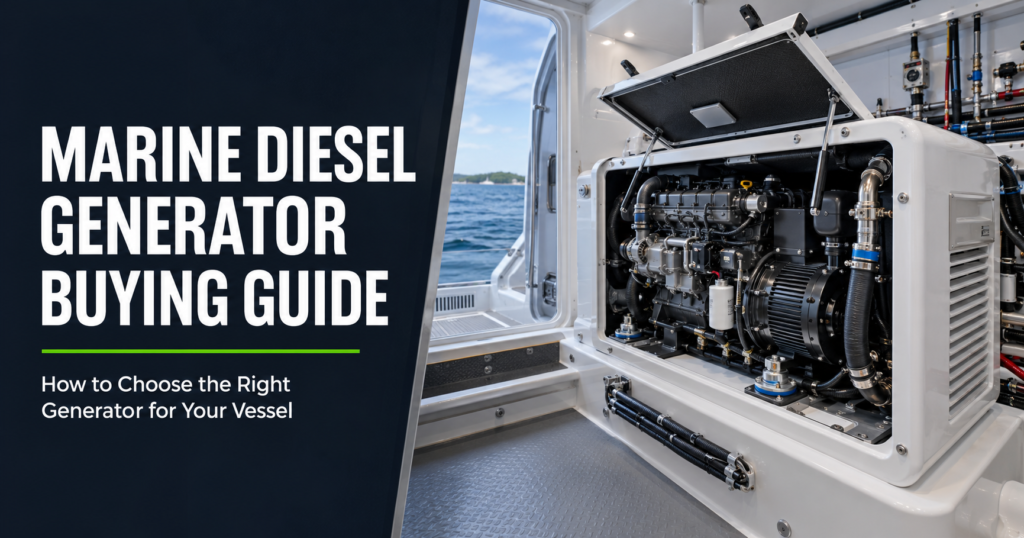
For a broader explanation of installation, cooling, noise, controls and brand comparison, readers can also consult the Marine Diesel Generator Buying Guide.
To request a generator recommendation from MSS Motorsports UG, provide your completed load information, vessel application, voltage, frequency, phase, installation dimensions and destination. The proposed model and configuration can then be reviewed before a written quotation is prepared.
