
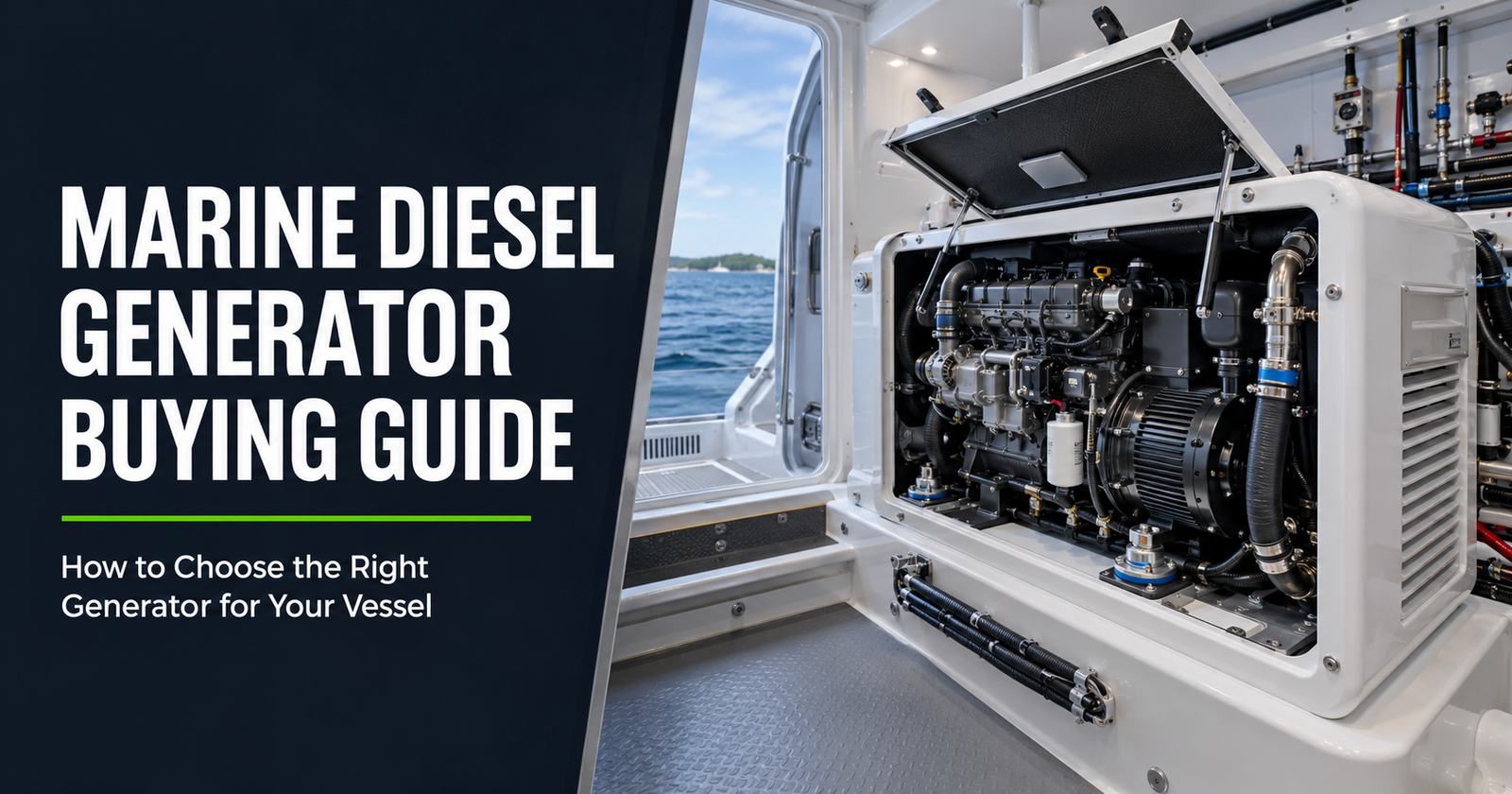
Choosing a marine generator should be simple. You determine how much electrical power the vessel needs, find a generator with the appropriate output and place the order.
Except that is rarely how it works.
A generator can have the right kW rating and still be wrong for the vessel. It might have the wrong frequency, insufficient motor-starting capacity, unsuitable dimensions or an exhaust arrangement that cannot be installed safely. It could also be so oversized that it spends much of its life operating under an unnecessarily light load.
That is why a proper marine diesel generator buying guide must look beyond the number printed on the specification sheet.
At MSS Motorsports UG, our objective is to help buyers compare the technical and commercial details before a generator is ordered. That includes rated output, starting loads, frequency, voltage, phase, operating speed, cooling, dimensions, service access, standard components, available options and delivery requirements.
This guide explains how to choose the right marine generator for a boat, yacht, fishing vessel or commercial vessel without relying on guesswork.
There Is No Universal “Best” Marine Generator
Buyers frequently ask, “What is the best marine generator?”
The honest answer is that there is no universal best model.
A compact generator that works well aboard a sailing yacht may be entirely unsuitable for a passenger vessel. A low-speed generator designed for extended operation may be unnecessary for a boat that only needs occasional power at anchor. A quiet generator with a full sound enclosure may be attractive, but the enclosure is of little benefit if it makes the generator too large for the available compartment.
The right generator is the one that matches:
- The vessel’s actual electrical demand
- The largest starting load
- The required voltage and frequency
- The intended daily operating hours
- The available installation space
- Cooling and exhaust arrangements
- Maintenance-access requirements
- The vessel’s operating region
- Available technical support and replacement parts
Price matters, but it should come after these points have been established. A lower-priced generator that requires major modifications—or cannot run the intended loads—is not the less expensive choice.

Begin With the Vessel, Not the Generator Catalogue
Before comparing brands or models, define what the generator must do.
What type of vessel is it?
A diesel generator for a yacht normally supplies hotel loads such as air conditioning, refrigeration, lighting, battery charging, entertainment systems, water heaters and galley appliances.
A commercial fishing vessel may need to power pumps, freezers, hydraulic systems, deck machinery and working lights. Passenger vessels may have larger hotel loads and longer operating schedules. Workboats may need reliable power for tools, navigation systems and mission-specific electrical loads.
Two vessels of the same length can therefore require very different generators.
How will the generator be used?
Ask whether the generator will provide:
- Occasional power during short trips
- Overnight power while the vessel is at anchor
- Continuous hotel power during extended cruising
- Power for commercial operations
- Standby power for important vessel systems
- Support for high-starting-load machinery
Operating profile matters because a generator intended to run for several hours every day should not be selected in the same way as one used occasionally.
How many hours will it run?
Estimate both daily and annual operating hours.
A recreational vessel might use its generator mainly during weekends or seasonal cruising. A charter, passenger or commercial vessel may accumulate hours quickly. This affects the appropriate engine speed, duty rating, maintenance schedule and long-term service expectations.
Do not choose a generator solely because it can produce the required output. Confirm that its intended duty is appropriate for how the vessel will actually operate.
Calculate the Vessel’s Electrical Demand
This is where accurate marine generator sizing begins.
Cummins’ official marine generator sizing tool starts with the same essential step: estimate the power the vessel needs. That sounds obvious, but it is often the step buyers rush through.
Prepare a complete electrical load list
Record every electrical load that may be supplied by the generator, including:
- Air-conditioning compressors
- Refrigerators and freezers
- Battery chargers and inverters
- Water heaters
- Watermakers
- Galley appliances
- Bilge and freshwater pumps
- Navigation and communication systems
- Lighting
- Entertainment systems
- Deck machinery
- Workshop tools
- Commercial refrigeration
- Hydraulic power packs
For each item, record the voltage, phase, running watts or amperage and starting current where applicable. Use the manufacturer’s label or technical documentation whenever possible.
Understand running watts and starting watts
An appliance may use one amount of power after it is running but require considerably more power for a brief period during startup.
This is particularly important for:
- Air-conditioning compressors
- Refrigeration compressors
- Pumps
- Electric motors
- Hydraulic systems
Imagine a generator that can comfortably support the vessel’s normal running load. Everything appears correct until two air-conditioning compressors attempt to start at nearly the same time. Frequency drops, voltage becomes unstable or the generator protection system trips.
The generator is not necessarily defective. The motor-starting load may simply exceed its transient capacity.
Cummins’ technical guidance on generator sizing distinguishes between running and starting characteristics because starting motors can place a sudden demand on the generator. This is why the total running load alone is not enough.
Determine which loads operate simultaneously
Adding the full rating of every appliance can produce an unnecessarily large generator. Using only the average load can produce one that is too small.
The correct calculation should identify:
- Loads that operate continuously
- Loads that operate intermittently
- Loads likely to operate at the same time
- The largest motor-starting requirement
- Whether high-demand loads can be sequenced
Load sequencing can prevent multiple compressors or motors from starting simultaneously. However, this should be part of a properly designed electrical system not an assumption made to justify a generator that is too small.
A simple sizing example
Consider a yacht with the following illustrative loads:
| Electrical load | Approximate running demand | Illustrative starting demand |
|---|---|---|
| Air conditioner 1 | 1.5 kW | 4.5 kW |
| Air conditioner 2 | 1.5 kW | 4.5 kW |
| Battery charger | 1.2 kW | 1.2 kW |
| Water heater | 1.5 kW | 1.5 kW |
| Refrigerator | 0.3 kW | 0.9 kW |
| Pumps and lighting | 0.8 kW | 1.4 kW |
If all loads operate simultaneously, the approximate running demand is 6.8 kW. But selecting a 7 kW generator would leave almost no available capacity for starting an air-conditioning compressor.
That does not automatically mean a specific larger rating is correct. The final selection depends on actual manufacturer data, compressor-starting characteristics, load sequencing, generator transient response and the required operating margin.
The figures above are only an example. Your vessel’s nameplate data should be used for an actual recommendation.
Understand the Difference Between kW and kVA
The terms kW and kVA generator ratings are related, but they are not interchangeable.
What is kW?
Kilowatts measure real power—the power that performs useful work. Heating elements, lights and other mainly resistive loads are commonly described in watts or kilowatts.
What is kVA?
Kilovolt-amperes measure apparent power. This includes both the useful power consumed by a load and the additional electrical effect created by reactive loads.
The relationship is:
kW = kVA × power factor
If a generator is rated in kVA, you cannot assume that the same number represents available kW. The applicable power factor must be considered.
For example, a generator rated at 10 kVA does not necessarily provide 10 kW. The manufacturer’s specification should state the corresponding kW rating and assumed power factor.
Why does power factor matter aboard a vessel?
Motors, transformers, pumps and compressors can introduce reactive demand. The generator and alternator must support the complete electrical load, not only the portion converted into useful work.
This is another reason why comparing two generators by a single headline number can be misleading. Review the rated kW, kVA, power factor, voltage, phase and frequency together.
Confirm Frequency, Voltage and Phase
A generator must be compatible with the vessel’s electrical system. These specifications should be confirmed before a model is quoted.
50 Hz versus 60 Hz marine generators
A 50 Hz marine generator and a 60 Hz marine generator are not automatically interchangeable.
Frequency affects motors, pumps, compressors, clocks and other frequency-sensitive loads. A motor designed for one frequency may run at the wrong speed, overheat or perform incorrectly when supplied by another.
Fifty-hertz systems are common in many European and international markets, while 60 Hz is common in the United States and certain other regions. However, the vessel’s existing electrical system—not its temporary location—should determine the required frequency.
If the vessel was built in Europe but is currently located in the United States, do not assume it requires 60 Hz. Check the switchboard, shore-power arrangement, existing generator and connected loads.
Confirm the required voltage
Common marine configurations may include:
- 120V
- 120/240V
- 230V
- 230/400V
- Other model- or vessel-specific arrangements
Never assume that a generator’s voltage can be changed easily after purchase. Some alternators are reconnectable, while others are supplied for a specific configuration. Control components, breakers and connected loads must also be compatible.
Single-phase versus three-phase output
A single-phase marine generator is common aboard many recreational boats and smaller yachts. A three-phase marine generator may be required for larger motors, commercial systems, and higher electrical demand.
If three-phase power is required, the load across the phases must be considered. A vessel with heavily unbalanced phase loading may not use the generator’s full rated capacity effectively.
The quotation should state frequency, voltage and phase clearly. “Ten-kilowatt marine generator” is not a complete specification.
Compare Low-Speed and High-Speed Generators
Generator speed is another important buying factor.
Common fixed-speed configurations include:
- 1500 rpm for certain 50 Hz generators
- 1800 rpm for certain 60 Hz generators
- 3000 rpm for certain 50 Hz generators
- 3600 rpm for certain 60 Hz generators
These relationships typically depend on alternator pole configuration, so always confirm the specifications for the individual model.
1500 and 1800 rpm generators
Lower-speed generators are often considered for applications requiring extended running hours, lower mechanical speed and commercial-duty operation. They may be larger and heavier than a higher-speed generator with a similar output.
3000 and 3600 rpm generators
Higher-speed generators can provide substantial output from a more compact package. This can be valuable aboard smaller boats where installation space and weight are tightly restricted.
Higher speed does not automatically mean poor quality, just as lower speed does not automatically make a generator suitable for every vessel.
The right comparison includes:
- Intended daily operating hours
- Rated duty
- Generator dimensions
- Weight
- Sound level
- Fuel consumption
- Service requirements
- Purchase price
- Expected ownership period
Do not choose by rpm alone.
Measure the Installation Space Properly
The most expensive generator may be the one that cannot be moved through the engine-room opening.
Before ordering, record:
- Maximum available length
- Maximum available width
- Maximum available height
- Access-hatch dimensions
- Passageway dimensions
- Available lifting points
- Foundation or mounting dimensions
- Permitted dry and operating weight
Measure the route into the vessel, not just the final generator compartment.
Allow room for connections
The published generator dimensions may not include every installed connection or optional component. Additional space may be required for:
- Exhaust outlet
- Fuel supply and return lines
- Seawater inlet
- Coolant expansion arrangement
- Battery cables
- AC output cables
- Remote-control harness
- Circuit breaker
- Sound-enclosure panels
Protect future service access
A generator can fit inside the compartment and still be almost impossible to maintain.
Check which side provides access to:
- Oil filter
- Fuel filter
- Oil dipstick
- Raw-water pump
- Seawater impeller
- Belts
- Air filter
- Coolant fill
- Electrical terminals
- Control components
The Northern Lights marine generator buyer’s guide specifically highlights the value of arranging service points on an accessible side. That is not a minor convenience. It affects labour time, routine maintenance and whether essential checks are completed consistently.
If routine service requires removing unrelated vessel components, the installation is likely to become expensive and frustrating.
Review Cooling, Exhaust, Fuel and Ventilation Requirements
A water-cooled marine generator is part of a complete onboard system. The generator cannot be selected in isolation from the proposed installation.
Cooling system
Many marine generators use a closed freshwater cooling circuit connected to a heat exchanger. Seawater passes through the heat exchanger and removes heat from the closed circuit.
The installation may include:
- Seacock
- Sea strainer
- Seawater hose
- Raw-water pump
- Heat exchanger
- Anti-siphon protection
- Wet-exhaust components
The exact arrangement depends on the generator and its position relative to the waterline.
If the generator is installed below or near the waterline, the risk of seawater siphoning into the engine must be assessed. Follow the installation manual for the exact model because anti-siphon requirements and permitted installation heights are not universal.
Exhaust system
A marine wet-exhaust system must manage both exhaust gas and injected cooling water safely.
Its design may involve:
- Water-injected exhaust elbow
- Waterlift muffler
- Exhaust hose
- Gooseneck or high loop
- Exhaust/water separator
- Hull outlet
- Suitable drainage and support
Poor routing can increase exhaust back pressure or allow seawater to reach the engine. Both can result in serious damage.
Ventilation
The generator compartment needs sufficient air for combustion and heat removal. A sound enclosure does not eliminate this requirement.
Fischer Panda’s marine generator operating guidance calls for a leak-free exhaust arrangement and adequate fresh-air supply. These are safety and performance requirements, not optional refinements.
Fuel system
Confirm:
- Fuel type and specification
- Supply-line diameter
- Return-line requirements
- Fuel lift limits
- Primary filtration
- Water separation
- Tank position
- Shut-off arrangement
- Hose suitability
Contaminated fuel, restricted lines or excessive lift can cause hard starting, power loss and unstable operation even when the generator itself is functioning correctly.
Consider Noise and Vibration
A quiet generator is especially important aboard a yacht or liveaboard vessel, but published sound figures require context.
Compare sound data fairly
When reviewing a quiet marine diesel generator, ask:
- At what distance was the sound measured?
- Was the generator operating under load?
- Was a sound enclosure installed?
- Were the doors or access panels closed?
- Was the exhaust included in the measurement?
A lower dB figure is only meaningful when the testing conditions are comparable.
Sound enclosure
A factory sound enclosure can reduce airborne noise and present a cleaner installation. However, it also adds size, weight and another layer that must be opened or removed for servicing.
Confirm the enclosed dimensions, not only the open-generator dimensions.
Flexible mounts and structural vibration
Flexible mounts help isolate vibration, but their effectiveness depends on correct selection and installation. Mounting foundations must be sufficiently strong and properly aligned.
Exhaust noise, hose contact, rigid pipework and surrounding structures can also transmit vibration through the vessel. Quiet operation depends on the complete installation.
Examine the Controls and Protection Systems
The control panel should provide more than a start button.
Depending on the model, useful functions may include:
- Remote start and stop
- Operating-hour display
- AC voltage and frequency display
- Engine-temperature indication
- Oil-pressure indication
- Low oil-pressure shutdown
- High coolant-temperature shutdown
- Overspeed protection
- Overcurrent protection
- Low seawater-flow warning
- Fault codes
- Remote monitoring
- Parallel-operation capability
The required controls depend on the vessel.
A smaller recreational boat may only need a straightforward remote panel. A commercial installation may require remote alarms, integration with a vessel-monitoring system, load sharing or multiple-generator control.
Confirm which panel and harness are included. A photograph showing a remote panel does not necessarily mean that the panel is supplied as standard.
Match the Generator to the Application
Sailing yachts
A compact marine generator for a sailing yacht often prioritises reduced weight, restricted dimensions, quiet operation and easy access within a small machinery space.
The generator may support battery charging, refrigeration, watermaking and occasional air conditioning. Because the available compartment can be limited, connection positions may matter as much as the overall dimensions.
Motor yachts
Motor yachts commonly carry larger hotel loads. Air conditioning, water heating, galley appliances, refrigeration and entertainment systems may operate together for extended periods.
Starting loads and passenger comfort therefore become major considerations.
Fishing boats and workboats
A commercial marine generator may supply pumps, deck machinery, freezers, lighting and work systems. Longer operating hours, serviceability, duty rating and replacement-part availability may carry more weight than achieving the smallest possible footprint.
Passenger and charter vessels
These vessels may require substantial hotel power, dependable daily operation and carefully planned redundancy. The selection may involve three-phase output, load management and multiple generator sets.
Replacement and repower projects
A replacement generator should not be selected merely because it has the same rated output as the old one.
Compare:
- Dimensions
- Weight
- Mounting footprint
- Exhaust position
- Seawater connections
- Fuel connections
- Voltage
- Frequency
- Phase
- Controls
- Cable size
- Circuit protection
- Service-side orientation
The newer generator may be more compact, but its connections may be positioned differently. Plan the complete conversion before shipment.
How to Compare Marine Generator Brands
The generator market includes established ranges from Cummins Onan, Rehlko/Kohler, Fischer Panda, Northern Lights, Westerbeke, Mase, Paguro, Phasor, Nanni, VETUS, and other manufacturers.
The objective should not be to declare one brand best for every vessel. A useful comparison asks:
- Is the required output available?
- Does the manufacturer offer the correct frequency and voltage?
- Is a single- or three-phase version available?
- What is the rated speed?
- Will the generator fit the compartment?
- Is a sound enclosure available?
- Where are the main service points?
- Which controls are standard?
- Are installation accessories included?
- What warranty conditions apply?
- Are replacement parts available in the vessel’s operating region?
- What is the current production or delivery lead time?
Brand reputation is relevant, but model suitability is more important.
A well-known generator that cannot support the starting load or cannot be serviced in its installed position is still the wrong generator.
New Versus Reconditioned Marine Generators
A new generator normally provides documented specifications, current production status and a stated manufacturer or seller warranty. It may also offer newer controls and improved compatibility with modern vessel-monitoring systems.
A reconditioned marine generator can be considered where budget, availability or replacement compatibility is important. However, the condition must be described accurately.
Before purchasing a reconditioned generator, request:
- Model and serial number
- Recorded operating hours
- Rebuild or service history
- Components replaced
- Test results
- Photographs
- Included controls and accessories
- Written warranty terms
- Clearly stated exclusions
“Reconditioned” should describe a documented process, not simply a generator that has been cleaned and painted.
What Should a Marine Generator Quotation Include?
Two quotations showing the same model and price may not include the same package.
A professional quotation should identify:
- Exact manufacturer and model
- New or reconditioned condition
- Rated kW and kVA
- Frequency
- Voltage
- Phase
- Engine speed
- Cooling configuration
- Sound enclosure, if included
- Control panel
- Wiring harness
- Flexible mounts
- Exhaust components
- Standard accessories
- Optional accessories
- Excluded components
- Warranty conditions
- Stock status or lead time
- Packing method
- Freight terms
- Payment schedule
- Quotation validity
This is where careful buyers save themselves trouble.
If one offer includes a sound enclosure, panel, harness and flexible mounts while another includes only the basic generator, comparing the bottom-line prices alone tells you very little.
At MSS Motorsports UG, the quotation process is intended to establish the proposed configuration and commercial terms in writing before an order is accepted.
Plan Installation and Commissioning Before Delivery
A marine generator installation involves fuel, cooling water, exhaust gas, high-current DC connections and AC power. It should be completed or reviewed by suitably qualified marine professionals.
The official Northern Lights installation manual describes marine generator installation as a complex task requiring specialised knowledge and recommends work by a qualified dealer or boatyard.
Commissioning should normally include:
- Inspection of all mounting points
- Verification of fuel connections
- Cooling-system checks
- Inspection of seawater flow
- Exhaust inspection
- Battery and starting-system checks
- Confirmation of voltage, frequency and phase
- Progressive load testing
- Alarm and shutdown checks
- Inspection for fuel, coolant, seawater and exhaust leaks
- Recording operating readings
- Completion of applicable warranty documentation
Do not treat first startup as commissioning. A generator can start and run while still having an installation problem that appears only under load.
Consider Maintenance Before You Buy
The best time to think about generator maintenance is before the generator is installed.
Confirm whether routine service items can be reached easily:
- Engine oil
- Oil filter
- Fuel filters
- Air filter
- Seawater impeller
- Drive belts
- Coolant
- Zinc anodes, where applicable
- Starting battery
- Electrical terminals
Also ask whether the required filters, belts, impellers and sensors are readily available.
A marine generator maintenance schedule is model-specific, so follow the applicable operator’s manual. Operating hours, time intervals and environmental conditions may all affect when service is due.
Cummins’ official Onan marine generator maintenance guidance also includes running the generator from its control stations, applying available load and checking control operation. Maintenance is not limited to changing oil.
Easy service access and local parts support can reduce downtime over the generator’s entire working life.
Common Marine Generator Buying Mistakes
Most costly mistakes are avoidable.
Choosing by price alone
A low purchase price can be cancelled out by missing components, difficult installation, unsuitable electrical output or poor parts availability.
Sizing from average demand
Average demand does not account for the worst simultaneous load or the startup of large motors and compressors.
Ignoring frequency and voltage
The correct kW rating cannot compensate for the wrong electrical configuration.
Confusing kW with kVA
Always compare the complete rating and stated power factor.
Buying an excessively large generator
More power is not always better. A greatly oversized diesel generator may spend too much time under light load and can cost more to purchase, install and maintain.
Forgetting the access route
Measure hatches, doors, stairs and passageways—not just the final compartment.
Ignoring service clearance
If the oil filter or seawater pump cannot be reached, routine maintenance becomes unnecessarily difficult.
Assuming photographed accessories are included
The product image may show optional panels, enclosures or installation components. Confirm the written scope of supply.
Selecting before planning the exhaust and cooling system
Installation feasibility should be assessed before payment and shipment.
Failing to confirm warranty conditions
Ask who provides the warranty, what it covers, when coverage begins and whether commissioning or registration is required.
Information to Provide When Requesting a Recommendation
To obtain a useful recommendation and accurate quotation, provide as much of the following information as possible:
- Vessel type
- Vessel length
- Recreational or commercial use
- Required frequency
- Required voltage
- Single- or three-phase output
- Complete load list
- Largest starting load
- Expected daily operating hours
- Available installation dimensions
- Maximum acceptable weight
- Existing generator details
- Cooling arrangement
- Exhaust arrangement
- Destination country or port
- Preferred delivery date
- Preferred generator brands, if any
If you are replacing an existing generator, photographs of the compartment, model plate, mounting arrangement and connection positions can also be useful.
You do not need to know every technical answer before contacting a dealer. But the more accurate the vessel information, the more precise the recommendation can be.
Frequently Asked Questions
What size marine generator do I need for my boat?
The correct size depends on the total simultaneous running load, the largest motor-starting demand, the generator’s transient response and the intended operating margin. Vessel length alone cannot determine generator size.
Prepare a load list using the actual electrical ratings of onboard appliances and machinery before selecting a model.
Is a 50 Hz or 60 Hz generator better?
Neither is universally better. The generator frequency must match the vessel’s electrical system and connected loads. Confirm the existing switchboard, shore-power arrangement and appliance ratings.
What is the difference between kW and kVA?
kW represents real power, while kVA represents apparent power. The relationship depends on power factor. Review both values when comparing generator specifications.
Is an 1800 rpm generator better than a 3600 rpm generator?
Not automatically. An 1800 rpm generator may suit extended operation, while a 3600 rpm model may provide a smaller and lighter package. Compare duty rating, dimensions, sound, operating hours and service requirements.
Can a marine generator run air conditioning?
Yes, provided it is sized for both the air conditioner’s running demand and compressor-starting demand. Multiple air-conditioning units may require load sequencing.
Should I choose a sound-enclosed generator?
A sound enclosure can improve onboard comfort, particularly on yachts and liveaboard vessels. Confirm its effect on dimensions, weight, ventilation and service access before ordering.
Can I replace my existing generator with a different brand?
Yes, but the replacement must be compared for output, frequency, voltage, phase, dimensions, weight, mounting points, exhaust routing, cooling connections and controls. A different brand is rarely a direct swap without verification.
How long should a marine diesel generator last?
Service life depends on generator design, duty, operating load, maintenance, installation quality and operating environment. A model name or engine speed alone cannot provide a reliable lifespan estimate.
Should I buy a new or reconditioned generator?
A new generator may be preferable when warranty, current specifications and long-term support are priorities. A properly documented reconditioned generator may suit certain replacements or budgets. Condition, testing, included components and warranty should be confirmed in writing.
What information is needed for a quotation?
At minimum, provide the required output or electrical load list, voltage, frequency, phase, vessel application, destination and preferred delivery schedule. Installation dimensions and existing generator details make the quotation more accurate.
Final Advice: Choose by Application, Not Output Alone
Here is the central lesson: do not buy a marine generator because one number looks correct.
Choose it because the complete specification matches the vessel.
That means confirming marine genset sizing, motor-starting demand, kW and kVA, frequency, voltage, phase, operating speed, duty rating, dimensions, weight, cooling, exhaust, ventilation and service access.
Then confirm what is included, what is optional, how the generator will be packed, when it can be delivered and which warranty conditions apply.
A carefully selected generator should do more than start and produce electricity. It should support the vessel’s real loads, fit the available compartment, remain accessible for servicing and provide dependable onboard power throughout its intended working life.
To receive a model recommendation, send MSS Motorsports UG your vessel details, electrical load list, installation dimensions and delivery destination. We can review the requirements and prepare a written quotation showing the proposed generator configuration, included components, available options and commercial terms.
