
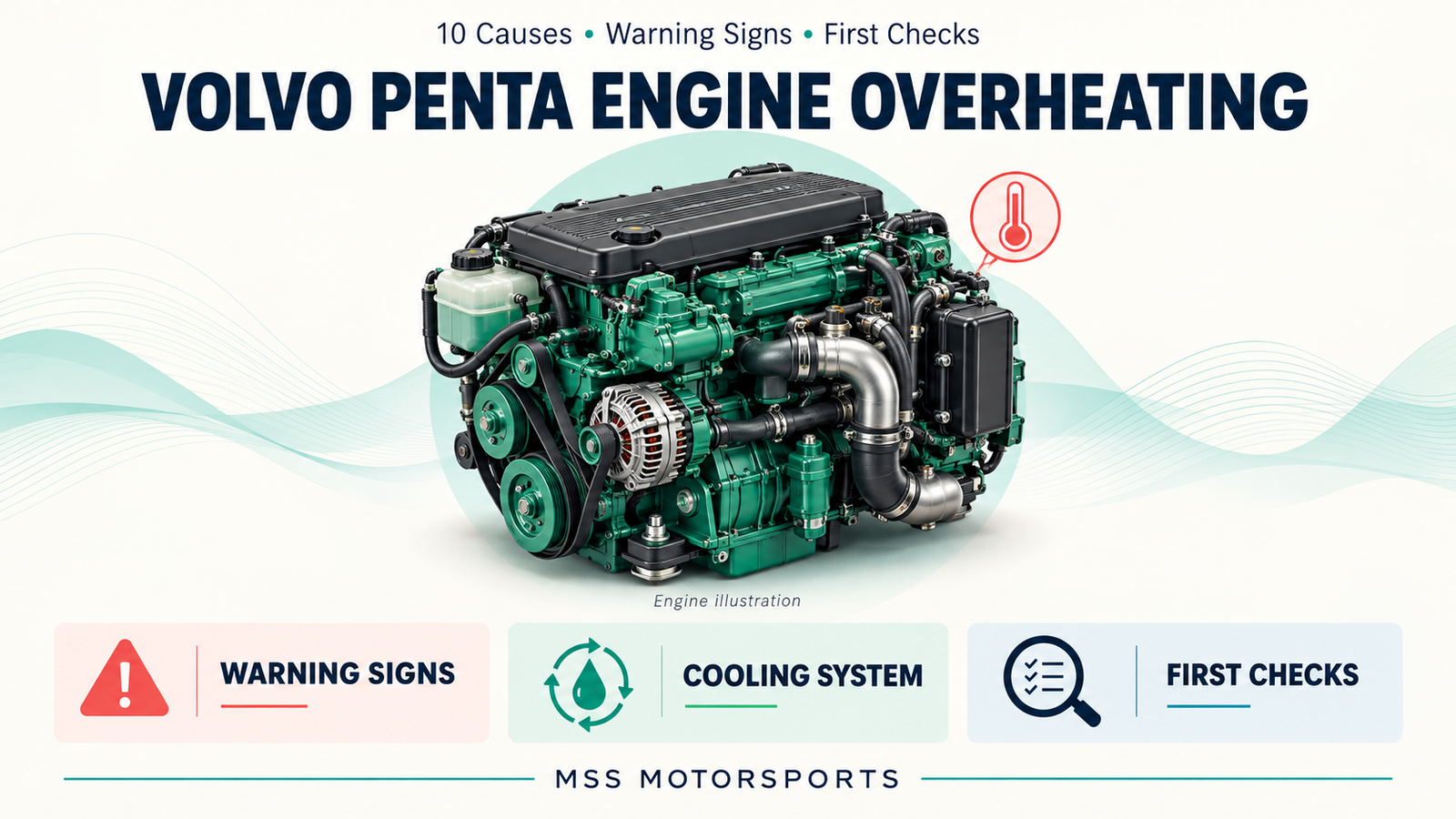
fault.
Volvo Penta’s support guidance describes red alarms as warning or danger conditions and recommends stopping operation as soon as possible. Follow the instructions for your exact equipment while addressing navigation and crew safety.
Do not assume that every overheating engine should remain idling. Likewise, do not rely on automatic shutdown or power reduction to prevent damage.
If safe operation is compromised, obtain appropriate assistance. For an offshore emergency, contact the relevant rescue authorities.
Record useful information without delaying necessary action
When safe, note the exact Volvo Penta overheating alarm wording, displayed temperature, RPM, and operating conditions.
Useful details include whether the warning appeared:
- Shortly after starting.
- During idle or low-speed operation.
- Under sustained load.
- Following recent cooling-system work.
- Suddenly or after a gradual temperature increase.
On a twin installation, record the affected side and whether both engines were operating under comparable conditions.
Collecting evidence must not delay a required shutdown or other safety action.
Let the engine cool before inspecting
Keep clear of hot surfaces, steam, belts, and rotating components.
Do not open a hot pressurised coolant system. Allow it to cool and follow the applicable inspection instructions. Manufacturer-authored Volvo Penta operator information warns of serious injury from opening a hot coolant system.
Before maintenance, prevent accidental starting according to the equipment’s procedure.
Opening a seawater strainer, hose, or pump can create a water-ingress risk, depending on the installation. Follow the required isolation procedure or obtain qualified help. Do not dismantle below-waterline components simply because they appear accessible.
Know when owner checks should stop
Stop if access is unsafe, leakage is significant, or the task exceeds your experience.
Steam, repeated critical warnings, abnormal mechanical noise, damaged exhaust components, or suspected internal damage justify professional assessment.
Avoid repeated restarts to reproduce a dangerous condition. A warning that disappears after cooling still needs an explanation.
The goal is to make useful observations without turning an unresolved fault into a more serious problem.
Warning Signs of Volvo Penta Engine Overheating
Temperature warnings, alarms, and protection responses
A Volvo Penta temperature warning may appear through a gauge, display, audible alarm, or EVC engine alarm, depending on the equipment.
Read the actual message rather than assuming that every alarm means engine coolant overheating.
Protection responses also vary. An engine may have particular derating or shutdown functions, but these should not be assumed across the range.
The applicable operator manual determines the recommended response—not a generic alarm description.
Steam, coolant loss, and changing exhaust observations
Steam, visible leakage, falling coolant level, or a change in exhaust discharge can help guide an investigation.
They do not establish the cause by themselves.
Smoke and steam can be difficult to distinguish visually. Likewise, exhaust-water discharge varies by installation and may not be readily observable.
Record what changed. Avoid concluding that visible water proves adequate cooling, or that a particular cloud identifies a failed component.
Why there is no universal normal temperature for every model
Use the specifications and operating guidance for your exact engine and cooling configuration.
Check the units and measurement source. A display may report coolant temperature, another system temperature, or a warning derived from particular conditions.
An infrared thermometer measures a surface under its measurement conditions. That reading is not automatically equivalent to the temperature measured by a coolant sensor.
Do not dismiss an alarm because one external surface appears cooler than the displayed value.
How Does the Volvo Penta Cooling System Work?
The seawater circuit removes heat on applicable installations
Many installations use outside water to remove heat through a circuit containing an intake, strainer where fitted, Volvo Penta seawater pump, relevant coolers, and discharge components.
Their order and arrangement vary.
Use the applicable diagram to identify the raw-water cooling system on your boat. Do not assume that an illustration for another engine shows your installation correctly.
The closed coolant circuit carries heat away from the engine
In a heat-exchanger-cooled installation, coolant circulates through the engine and transfers heat through the exchanger.
The term “freshwater cooled” describes the internal cooling arrangement. It does not necessarily mean that seawater is absent from the complete system.
This distinction matters because a fault on either side can affect cooling performance.
The heat exchanger transfers heat between separate circuits
The Volvo Penta heat exchanger transfers heat between coolant and outside water without those fluids normally mixing.
Volvo Penta’s cooling-system documentation describes coolant being cooled through a heat exchanger supplied with pumped seawater. This explanation applies to installations using that arrangement.
A restriction can affect flow. Deposits can also affect heat transfer. These are related investigation areas, but they are not identical faults.
Identify exceptions before following generic advice
Direct raw-water cooling, different petrol configurations, keel cooling, and other arrangements require suitable documentation.
Shaft-drive, saildrive, sterndrive, and IPS installations can also have different intake and discharge arrangements.
Identify the actual cooling configuration before following component-specific advice.
The MSS Overheating Evidence Check
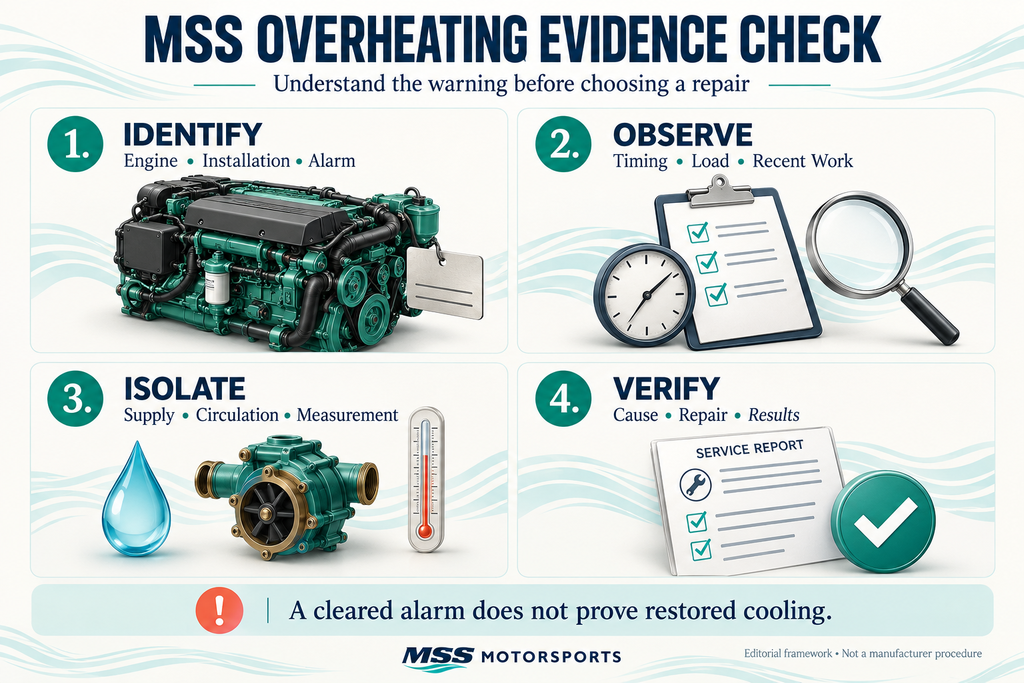
This is an original MSS Motorsports editorial framework. It is not an official Volvo Penta procedure.
Identify: confirm the equipment and exact warning
Record the full engine identity, propulsion arrangement, alarm source, and applicable manual.
This helps prevent a coolant fault from being confused with an exhaust or transmission warning.
Observe: record timing and operating conditions
Note whether the warning appeared at idle, under load, after starting, or after servicing.
Record observations only when safe. Do not continue operating to gather a more complete symptom history.
Isolate: investigate the relevant system
Separate seawater supply, coolant circulation, heat transfer, exhaust cooling, and measurement concerns.
Owner observations and technician tests serve different purposes. A visible inspection can identify a clue without confirming the complete diagnosis.
Verify: establish that the cause was corrected
Document what failed, why it failed, and how the repair was checked.
Replacing an impeller or clearing an alarm does not, by itself, prove that cooling has been restored.
Ten Causes and the Evidence Needed to Investigate Them
Once the vessel is secure and the required alarm response has been followed, diagnosis can begin.
The useful question is: Which part of the cooling system is failing to perform its job, and what evidence supports that conclusion?
The ten categories below cover common investigation areas for Volvo Penta engine overheating. They are not ranked by failure frequency, and not every category applies to every installation. The final category concerns an incorrect temperature indication rather than confirmed overheating.
Do not restart an engine or open a cooling component simply to work through this list. Follow the applicable manual and obtain qualified assistance where required.
Ten Common Causes and Diagnostic Possibilities
1. Restricted Seawater Intake or Blocked Strainer
What can restrict supply
Debris, marine growth, an obstruction, or an incorrectly positioned valve where fitted can limit water entering the system.
A blocked seawater strainer is one possible location. The intake or another section of the supply route may also require assessment.
What to check first
With the engine stopped, identify the actual intake arrangement. Make accessible observations permitted by the manual.
An apparently clear strainer does not prove that the complete supply route is unrestricted.
Opening components can create water ingress. Follow the required isolation procedure rather than assuming the strainer is safe to open.
When a technician is needed
Seek help for inaccessible intakes, uncertain valve condition, recurring blockage, or below-waterline work.
A seawater supply problem should be investigated before assuming the pump itself has failed.
2. Damaged Impeller or Seawater-Pump Wear
Why an impeller fault can reduce cooling
A damaged marine engine impeller or worn pump components can affect water delivery on installations using that design.
The impeller is important, but its appearance does not establish the condition of the entire Volvo Penta seawater pump.
Why replacing the impeller may not resolve the fault
Investigate why it failed.
A supply problem, pump wear, installation issue, or retained fragments may remain after replacement. If sections of the old impeller are missing, their location needs suitable investigation.
A new component cannot remove an obstruction elsewhere in the circuit.
Verification needed
Follow the applicable pump inspection procedure and establish satisfactory cooling performance through appropriate checks.
Overheating after impeller replacement requires further diagnosis—not another automatic parts change.
3. Seawater-Hose Restriction or Suction-Side Air Leakage
Possible faults
A hose may be kinked, deteriorated, internally restricted, or connected inadequately.
Air leakage on the suction side can affect supply without producing an obvious external water leak.
Initial observations
Inspect accessible hose condition and recently disturbed connections with the engine stopped.
Record changes associated with maintenance. Do not reach near moving components to investigate during operation.
Technician assessment
Suitable leak and flow checks can establish whether a seawater intake restriction or suction-side fault is present.
The absence of visible leakage does not prove the supply system is sound.
4. Fouled Heat Exchanger or Restricted Seawater-Side Coolers
Distinguish restriction from poor heat transfer
Debris can restrict water flow, while deposits can affect heat transfer. Other coolers within the applicable circuit may also need inspection.
A Volvo Penta heat exchanger should therefore be assessed for the relevant fault, rather than declared healthy because some water reaches the discharge.
Check service and failure history
Review previous impeller damage, cooler maintenance, and recent repairs.
Retained debris or unresolved restrictions deserve attention when a pump repair has not restored satisfactory operation.
Cleaning and testing
Use model-appropriate inspection and heat exchanger cleaning methods.
Avoid universal chemical-cleaning instructions. Construction, materials, and servicing requirements vary.
5. Low Coolant, Leakage, or Failure to Retain Specified Pressure
Check coolant only under safe, cold conditions
Follow the applicable cold-level procedure.
Look for accessible evidence of an engine coolant leak, but do not open a hot pressurised system.
Investigate repeated coolant loss
Topping up does not explain why coolant was lost.
Establish whether the system was filled correctly and whether loss continues. Do not treat repeated replenishment as a completed repair.
Pressure-system assessment
A competent technician can perform appropriate cap and cooling-system tests using the equipment’s specified limits.
A suspected pressure problem requires evidence before replacing components.
6. Trapped Air After Coolant Work or an Unsuitable Coolant Mixture
Connect the symptom to recent maintenance
A cooling-system airlock is worth investigating when warnings follow draining, hose replacement, or other coolant work.
The timing helps direct the investigation. It does not prove the cause.
Confirm the specified coolant and filling procedure
Use the required Volvo Penta coolant specification. Colour alone cannot establish compatibility.
Follow the applicable filling and bleeding instructions. A procedure for another engine may not suit your arrangement.
Verify restoration
Confirm suitable filling, circulation, and operating checks after the work.
Investigate persistent warnings rather than assuming the system will correct itself through continued running.
7. Thermostat or Bypass-Control Malfunction
Why thermostat behaviour matters
A marine engine thermostat controls circulation according to the system’s design.
A malfunction can affect cooling, but a temperature warning alone does not identify the thermostat as faulty.
Evidence before replacement
Use suitable inspection or testing to establish whether circulation control is functioning correctly.
Consider the cooling arrangement and other findings before choosing a replacement.
Why removal is not a universal workaround
Removing a thermostat can disrupt the designed flow arrangement.
Manufacturer-authored Volvo Penta operator information for certain petrol engines specifically warns against removing it as an overheating workaround. Apply the instructions for your exact equipment.
8. Coolant Circulation-Pump or Drive-System Fault
Distinguish the coolant pump from the seawater pump
The coolant circulation pump moves coolant through the internal circuit. The seawater pump supplies outside water on applicable installations.
They perform different jobs, so replacing one does not establish that the other is functioning correctly.
Check the applicable drive arrangement
Inspect belts only where relevant and under safe, stopped conditions.
Do not assume that every pump is belt-driven or that a visible belt establishes satisfactory pump operation.
Technician checks
Appropriate mechanical and circulation assessment can distinguish a pump or drive fault from another cooling problem.
9. Restricted Exhaust Cooling or Discharge Components
Where applicable
Water-injection elbows, exhaust passages, discharge components, and petrol manifolds or risers may require investigation where fitted.
An exhaust elbow restriction is one possibility within an installation-specific assessment.
Separate exhaust overheating from coolant overheating
Identify the warning source.
Marine exhaust cooling and engine coolant temperature are not interchangeable measurements. Similar alarm descriptions can lead an investigation toward the wrong system.
Escalation
Obtain qualified help for damaged exhaust components, suspected water ingress, or unclear restriction.
Do not dismantle an unfamiliar exhaust arrangement without the required information and precautions.
10. Temperature Sensor, Wiring, or Display Fault
Treat the warning as genuine until checked
A temperature sensor fault is possible, but should not be assumed because the engine appears to run normally.
The absence of obvious steam or leakage does not invalidate a warning.
Compare appropriate measurements
A technician can compare relevant readings using suitable methods.
Infrared surface measurements depend on the surface and measurement conditions. They are not direct substitutes for coolant-temperature readings.
Confirm the fault professionally
Use applicable diagnostic and electrical tests.
Do not bypass alarms or protection systems to continue operating.
| Investigation category | Useful clue | Appropriate next step |
|---|---|---|
| Intake or strainer | Obstruction or recent fouling | Safe inspection and supply assessment |
| Impeller or pump | Damage, wear, or missing fragments | Pump and relevant downstream inspection |
| Hose or suction side | Deterioration or recent work | Suitable leak and flow checks |
| Exchanger or cooler | Maintenance history or retained debris | Applicable inspection |
| Coolant or pressure system | Cold-level loss or leakage | Leak and pressure assessment |
| Filling or mixture | Warning after coolant work | Verify specification and procedure |
| Thermostat | Suspected circulation-control issue | Applicable testing |
| Circulation pump | Suspected mechanical or drive fault | Pump assessment |
| Exhaust cooling | Relevant warning or discharge change | Installation-specific inspection |
| Measurement system | Conflicting indications | Appropriate reading verification |
This table guides investigation. It does not diagnose the engine.
How Operating Conditions Help Narrow the Investigation
Overheating only under load
Volvo Penta overheating under load can justify investigating cooling capacity, restriction, and operating conditions.
Propeller loading and vessel condition may also be relevant.
The pattern does not identify one cause by itself. Avoid deliberately repeating a dangerous condition to confirm it.
Overheating at idle or low speed
For engine overheating at idle, investigate applicable supply, circulation, and measurement concerns.
Do not prescribe increasing the throttle as a universal solution. The required response comes from the relevant alarm instructions.
Overheating shortly after starting
Record whether the engine was actually cold and what work preceded the warning.
A rapid temperature indication does not automatically establish a sensor fault or genuine rapid heating.
Starting conditions and suitable verification matter.
Overheating after servicing or impeller replacement
Review the components disturbed and the procedures followed.
Check applicable assembly, supply, filling, pump condition, leakage, and retained-debris concerns.
Do not assume that the newest component must be faulty—or that replacing it rules out the whole system.
One engine overheating on a twin installation
Compare observations under similar conditions.
The unaffected engine provides context, but differences in equipment, servicing, loading, or repair history can matter.
It is not a definitive benchmark for diagnosing the other engine.
Professional Diagnosis, Repair Verification, and Prevention
An overheating warning gives you a reason to investigate. It does not tell you which component to buy or whether the engine needs rebuilding.
A completed overheating repair should establish the cause, address the affected system, and verify satisfactory operation under appropriate conditions. Clearing the warning alone is insufficient.
This final section explains how installation differences affect diagnosis, when to involve a technician, and how to prepare a useful enquiry for MSS Motorsports.
Model and Installation Differences That Matter
D1 and D2 sailing installations
Identify the exact engine and gearbox or saildrive arrangement.
Confirm the intake, cooling configuration, and applicable maintenance instructions. Similar-looking installations may have different component arrangements or service requirements.
Do not assume that a diagram for another sailing engine describes your boat.
D3, D4, and D6 engines
For Volvo Penta D4 overheating or Volvo Penta D6 overheating, record the full designation, generation, propulsion configuration, and exact alarm.
Establish whether the warning concerns engine coolant, charge air, exhaust, or another monitored system where fitted.
A family name alone does not establish the correct components, operating thresholds, or procedures.
D8, D11, and D13 engines
Confirm the application, rating, cooler arrangement, and relevant service documentation.
Do not transfer a procedure from a different application simply because the engine family matches.
The technician should select tests and interpret findings using applicable specifications.
Older MD, TAMD, and KAD engines
Establish the exact identity, cooling configuration, and repair history.
Previous modifications make vessel records useful. Confirm current parts support before planning repairs.
Age alone does not identify the overheating cause.
Petrol, Aquamatic, and IPS installations
For Volvo Penta petrol engine overheating, identify the actual cooling and exhaust arrangement.
Aquamatic and IPS installations also require confirmation of the relevant propulsion equipment and intake configuration.
One diesel cooling diagram cannot explain every Volvo Penta installation.
When Professional Overheating Diagnosis Is Needed
Repeated alarms or no established cause
Seek qualified assessment when warnings recur or the cause remains unresolved.
An alarm disappearing after cooling does not establish that the fault has corrected itself. Repeated topping up or parts replacement can leave the underlying problem unanswered.
Follow the applicable operating instructions before any further use.
Appropriate technician tests
Testing should follow the equipment identity, symptoms, and initial findings.
Depending on the installation, assessment may include:
- Relevant diagnostic readings and alarm information.
- Cooling-system pressure and circulation checks.
- Seawater-supply and pump assessment.
- Heat-exchanger or cooler inspection.
- Appropriate temperature-measurement verification.
Volvo Penta’s support guidance describes trained technicians’ access to specialist tools, diagnostics, and workshop information.
Ask what each test establishes and what remains uncertain. Avoid requesting a specific replacement before the investigation supports it.
Assessing possible damage after significant overheating
The incident alone cannot establish whether internal damage occurred.
A technician may recommend further inspection or testing according to the symptoms and findings. Provide the alarm history, known operating conditions, leakage observations, and work already completed.
Do not declare the engine ruined—or unaffected—without evidence.
How to Verify an Overheating Repair
Confirm the underlying cause
Document what failed and why.
If an impeller was damaged, establish whether relevant supply, pump-condition, and missing-fragment concerns were investigated.
If coolant was lost, identify the reason rather than treating replenishment as the repair.
Check the affected system and related components
Complete applicable checks for leaks, retained debris, circulation, and correct assembly.
A local repair can leave a restriction or fault elsewhere unresolved.
Use the relevant procedure rather than assuming that a replaced component proves the whole system is healthy.
Verify operation under appropriate conditions
Use suitable technician-led checks where necessary.
There is no universal verification RPM or temperature target for every engine. Follow the applicable requirements and stop according to warnings.
A short run without an alarm may not reproduce the conditions under which the original problem occurred. The verification plan should account for that safely.
A cleared alarm is not equivalent to a verified repair.
Record the repair and results
Retain the diagnosed cause, components replaced, applicable part numbers, test findings, operating conditions, and follow-up recommendations.
These records make future marine engine troubleshooting more effective.
How to Reduce the Risk of Repeat Overheating
Follow the exact maintenance schedule
Use the Volvo Penta maintenance schedule for the engine and propulsion equipment.
Track operating hours and elapsed time. Volvo Penta’s support guidance bases servicing on both measures.
Check what each service includes and retain evidence of completed work.
Maintain intake, pump, cooler, and coolant systems
Service applicable components according to their requirements.
Do not assume every installation has the same strainer, pump, cooler, or exhaust arrangement.
Address recommendations arising from inspection rather than waiting for another warning.
Use specified fluids and correct parts
Select parts using complete equipment identity and applicable information.
Confirm replacement requirements, including associated components where relevant.
For Volvo Penta coolant, use the specified product requirements rather than colour alone as a compatibility test.
Record changing operating behaviour
Keep useful records of warnings, displayed temperatures, operating conditions, and maintenance.
Investigate meaningful changes promptly. Trends should support diagnosis without encouraging continued unsafe operation.
Preparing a Useful Enquiry for MSS Motorsports
Information for a parts request
Provide identification photographs, component details, the existing part number where available, and the diagnosed requirement.
A clear photograph of the fitted component can help establish the enquiry’s scope.
“An impeller for a Volvo diesel” leaves important compatibility questions unanswered.
Information for servicing or technical assistance
Provide the exact alarm wording, onset conditions, recent work, and existing findings.
Confirm the assistance available. Complex diagnosis should be handled by an appropriately qualified technician.
The MSS Overheating Evidence Check—Identify, Observe, Isolate, Verify—can help organise the information without pretending to replace professional assessment.
Replacement-engine enquiries when justified
If assessment supports replacement, send vessel details, propulsion configuration, and the required gearbox ratio where relevant.
Include intended purchase timing and billing and delivery addresses for the quotation.
Confirm engine condition, included transmission or drive, controls, accessories, warranty terms, delivery costs, and lead time.
An unresolved temperature alarm alone does not justify repowering.
Frequently Asked Questions
Why is my Volvo Penta engine overheating?
Possible causes include restricted cooling-water supply, pump faults, cooler restriction, coolant loss, circulation problems, and applicable exhaust-cooling faults. Diagnosis is needed to establish the cause.
What should I do when the temperature alarm sounds?
Follow the exact alarm instructions, prioritise vessel safety, and stop operation when required. Record information only when safe.
Can I keep running an overheating engine at idle?
Do not assume idling is permitted. Follow the applicable instructions; continued operation may be inappropriate.
What temperature is normal for my Volvo Penta engine?
Use the specifications for the exact equipment and measurement. There is no universal value for every model.
Can a damaged impeller cause overheating?
Yes, on applicable installations it can affect cooling-water delivery. Pump condition, supply, and other faults may also need investigation.
Why does it still overheat after replacing the impeller?
The original cause, supply problem, pump wear, retained debris, or another cooling fault may remain unresolved.
Why does it overheat only under load?
Volvo Penta overheating under load can point toward cooling or operating conditions that become inadequate under greater demand. The pattern does not establish a single cause.
Does exhaust-water discharge prove cooling is adequate?
No. Visible discharge alone cannot establish satisfactory cooling throughout the system or under load.
Can a thermostat cause overheating?
A thermostat or circulation-control fault can be relevant. Confirm it through applicable assessment rather than guessing.
Can a faulty sensor trigger an overheating warning?
It is possible. Treat the warning as genuine until appropriate checks establish otherwise.
Should I open the coolant cap or add coolant while hot?
Do not open a hot pressurised system. Let it cool and follow the applicable procedure.
Does overheating mean I need an engine rebuild?
No. Establish the cause and assess any resulting damage before deciding on repair scope.
Conclusion: Confirm the Cause Before Replacing Parts
Volvo Penta engine overheating requires a safe response followed by an evidence-based investigation.
Identify the equipment, record useful observations, diagnose the relevant system, and verify the repair. A replaced component or cleared warning does not establish restored cooling by itself.
Discuss Your Requirements with MSS Motorsports
For a parts or replacement-engine enquiry, contact MSS Motorsports with identification photographs, alarm details, operating conditions, and relevant findings.
Provide the diagnosed component requirement or replacement configuration where established. Arrange qualified technical assessment when the cause remains uncertain.
